Why Agrivoltaics Is the Best Solution to Land-Use Conflicts
The Growing Challenge of Balancing Food Production and Solar Development
As governments, utilities, and private investors accelerate renewable energy deployment, a new challenge is emerging across global energy markets: land-use conflict. Large-scale solar farms require significant land resources, yet much of the available land is already being used for agriculture. In many regions, developers face growing resistance from farmers, local communities, and regulators who are concerned about losing productive farmland to solar installations.
This is where agrivoltaics is rapidly changing the conversation. Rather than forcing a choice between food production and clean energy generation, agrivoltaics allows both activities to coexist on the same piece of land. The concept is simple, but its implications are enormous. By combining agricultural operations with photovoltaic systems, landowners can generate electricity while continuing to grow crops, raise livestock, or maintain agricultural productivity.
For EPC contractors, solar developers, agricultural investors, and government planners, agrivoltaics represents more than an innovative solar application. It is increasingly becoming one of the most practical solutions to land scarcity, project permitting challenges, and long-term sustainability goals. As global demand for both food and renewable energy continues to increase, dual-use solar systems are emerging as a critical part of future infrastructure planning.
In this article, we examine why agrivoltaics is gaining momentum worldwide, how it solves land-use conflicts, what engineering considerations are involved, and why many industry experts believe it will play a major role in the next generation of solar development.
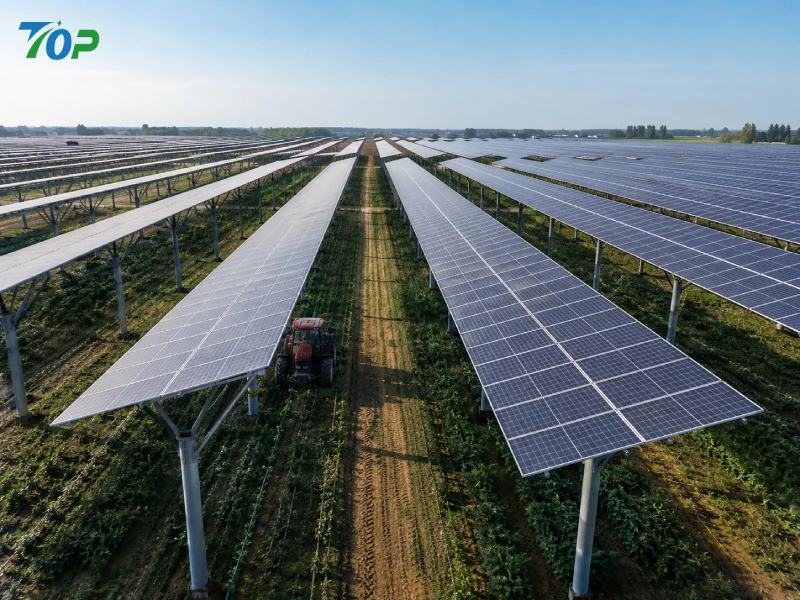
The Growing Conflict Between Food Production and Solar Expansion
The renewable energy sector is expanding at an unprecedented pace. Countries around the world have announced ambitious decarbonization targets, utilities are increasing renewable energy procurement, and corporations are investing heavily in clean power to meet ESG commitments.
Solar energy sits at the center of this transition because photovoltaic systems are scalable, cost-effective, and deployable in nearly every climate zone. However, the rapid expansion of solar infrastructure has introduced a challenge that many policymakers did not fully anticipate: competition for land.
Utility-scale photovoltaic projects often require between 4 and 6 acres of land per megawatt depending on module efficiency, terrain conditions, and project design. A 100 MW solar farm can easily occupy more than 500 acres. While this land requirement may appear manageable at first glance, the situation becomes more complex in regions where agricultural land is already under pressure from urbanization, industrial development, and population growth.
The result is an increasingly common debate:
Should valuable farmland be used for food production or solar power generation?
Historically, developers had to choose one or the other. Agricultural fields were converted into dedicated solar facilities, effectively removing the land from food production for decades. While this approach helped expand renewable energy capacity, it also triggered concerns regarding food security, agricultural income, and rural economic stability.
Why Traditional Solar Farms Face Increasing Land-Use Resistance
Loss of Agricultural Production
One of the primary concerns surrounding conventional solar development is the permanent or long-term removal of farmland from agricultural use.
Farmers often rely on productive land not only as an income source but also as a generational asset. When large solar farms replace agricultural operations, communities may perceive the project as sacrificing food production in exchange for electricity generation.
This concern becomes particularly significant in regions with limited arable land. Countries such as Japan, South Korea, and parts of Europe have relatively constrained agricultural resources, making farmland preservation a national priority.
As a result, regulatory agencies increasingly scrutinize solar projects proposed on agricultural land. In some jurisdictions, obtaining permits for farmland conversion has become substantially more difficult than it was a decade ago.
Community Opposition and Social Acceptance Challenges
Community acceptance has become a critical factor in project success. Even when solar developments comply with technical and environmental requirements, local resistance can significantly delay construction schedules.
Residents often raise concerns about:
- Loss of agricultural identity
- Visual impacts on rural landscapes
- Reduced farming activity
- Long-term land-use restrictions
- Perceived threats to food security
For EPC contractors and developers, these concerns translate into longer approval timelines, additional stakeholder consultations, and higher development costs. In extreme cases, projects may be postponed or cancelled despite meeting all technical requirements.
Increasing Regulatory Restrictions
Governments are also responding to these concerns through tighter land-use policies.
Many countries have introduced farmland protection measures designed to prevent excessive conversion of agricultural land into non-agricultural uses. Solar projects proposed on productive farmland frequently encounter additional environmental reviews, agricultural impact assessments, and zoning restrictions.
While these regulations are intended to preserve agricultural productivity, they create additional complexity for solar developers seeking suitable project sites.
Why This Matters for EPC Contractors
From an EPC perspective, land-use conflicts are not merely political issues—they directly affect project economics.
Delayed permits can increase development costs. Extended approval processes may affect financing arrangements. Community opposition can create uncertainty that impacts investor confidence. Even when a project ultimately proceeds, additional studies and consultations consume valuable time and resources.
This is one reason why agrivoltaics is attracting growing attention across the solar industry. By preserving agricultural activity rather than replacing it, developers can often reduce opposition while improving project acceptance among stakeholders.
What Is Agrivoltaics?
Agrivoltaics, sometimes referred to as Agri-PV or dual-use solar, is the practice of using the same land area for both agricultural production and photovoltaic electricity generation.
Unlike conventional solar farms that dedicate an entire site exclusively to energy production, agrivoltaic systems are designed to allow agricultural activities to continue beneath or between solar arrays.
The goal is straightforward:
Generate renewable energy without removing the land from productive agricultural use.
How Agrivoltaics Differs from Conventional Solar Farms
| Factor | Conventional Solar Farm | Agrivoltaic System |
|---|---|---|
| Electricity Generation | Yes | Yes |
| Crop Production | No | Yes |
| Land Productivity | Single Purpose | Dual Purpose |
| Community Acceptance | Moderate | Generally Higher |
| Permitting Potential | May Face Restrictions | Often More Favorable |
Main Types of Agrivoltaic Systems
Elevated Solar Structures
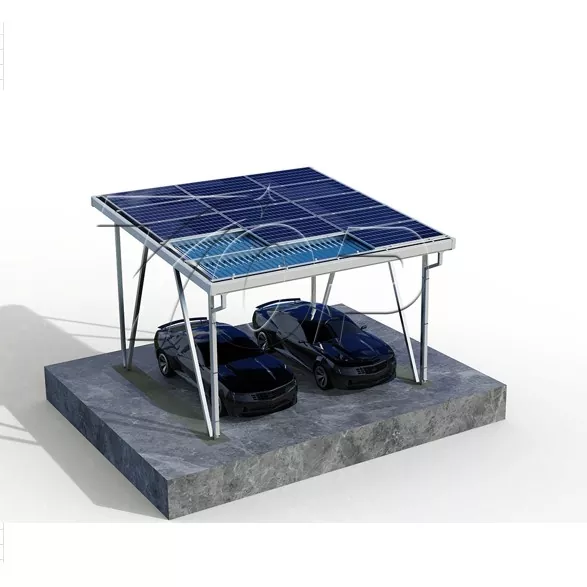
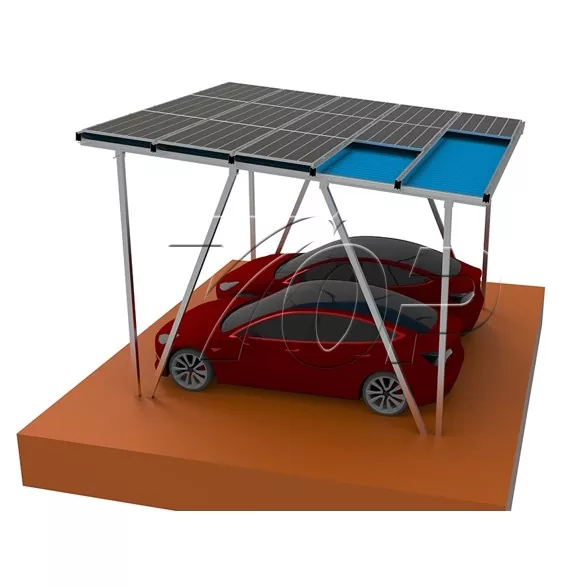
These systems utilize raised mounting structures that create sufficient clearance for crops, livestock, or agricultural equipment to operate beneath the solar array. Elevated systems are among the most common agrivoltaic designs because they provide flexibility across multiple agricultural applications.
Single-Axis Tracking Agrivoltaics
Tracking systems can improve energy production while dynamically managing shading patterns throughout the day. This approach is increasingly being studied for specialty crops where controlled sunlight exposure can improve growing conditions.
Orchard Solar Systems
Fruit orchards often benefit from carefully designed solar canopies. These structures can provide partial shading that helps reduce heat stress while generating renewable energy.
Livestock-Based Agrivoltaics
Sheep grazing beneath solar arrays has become particularly popular in North America and Europe. Livestock help control vegetation growth while farmers maintain agricultural income from grazing operations.
The Engineering Principle Behind Agrivoltaics
The fundamental engineering concept behind agrivoltaics is not simply placing solar panels above crops. The real objective is maximizing overall land productivity.
Traditional project evaluation often measures agricultural yield and solar output separately. Agrivoltaics requires a different perspective because the land simultaneously produces multiple outputs.
This is where the concept of Land Equivalent Ratio (LER) becomes important.
Understanding Land Equivalent Ratio (LER)
LER is one of the most widely used indicators for evaluating agrivoltaic performance.
The metric compares the combined productivity of an agrivoltaic site against separate agricultural and solar sites occupying the same total land area.
An LER value greater than 1.0 indicates that the agrivoltaic system is using land more efficiently than separate land-use approaches.
For example:
LER = 1.30
This means one hectare of agrivoltaics delivers the equivalent output of 1.3 hectares managed separately for farming and solar generation.
Numerous field studies have demonstrated LER values exceeding 1.2 and, in some cases, reaching 1.5 or higher depending on crop type, climate conditions, and system design.
Why Agrivoltaics Can Increase Total Land Value
The attractiveness of agrivoltaics extends beyond electricity production. The approach creates multiple value streams from the same land asset.
- Agricultural income remains active.
- Renewable electricity creates additional revenue.
- Landowners diversify business risk.
- Carbon reduction objectives are supported.
- Rural economic activity is preserved.
- Community acceptance often improves.
From an investment perspective, the ability to generate both agricultural and energy revenue from a single parcel of land is one of the strongest arguments supporting agrivoltaic development. Instead of competing for land resources, agriculture and solar infrastructure become complementary assets working together to maximize overall productivity.
However, successful implementation depends heavily on engineering design. Structural height, row spacing, foundation selection, wind resistance, machinery access, and long-term durability all play critical roles in determining whether an agrivoltaic project delivers its intended performance.
In the next section, we will examine real-world agrivoltaic projects from Germany, France, Japan, and the United States, and analyze the engineering lessons these projects provide for EPC contractors, developers, and agricultural investors.
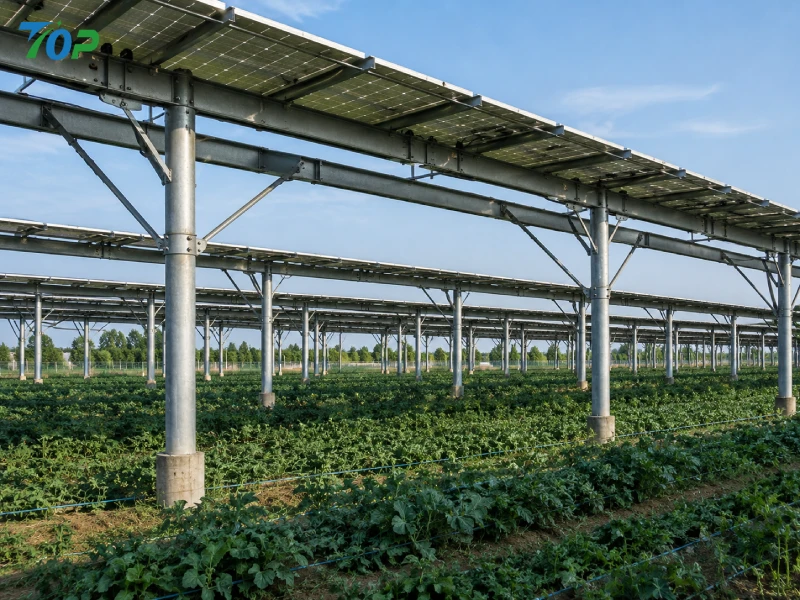
Real-World Agrivoltaic Projects That Prove the Model Works
One of the reasons agrivoltaics has gained credibility among policymakers, investors, and EPC contractors is that it is no longer a theoretical concept. Over the past decade, numerous commercial and research-scale projects have demonstrated that properly designed dual-use solar systems can generate electricity while maintaining productive agricultural operations.
For project developers evaluating the feasibility of agrivoltaics, real-world performance data is often far more valuable than conceptual discussions. The following projects are frequently referenced within the industry because they provide measurable evidence of how agrivoltaic systems perform under actual operating conditions.
Germany: The Heggelbach Agrivoltaic Research Project
Germany is widely recognized as one of the pioneers of modern agrivoltaics. One of the most influential projects was developed by Fraunhofer ISE in Heggelbach, located in southern Germany.
The pilot project combined crop cultivation with elevated photovoltaic structures installed above agricultural land. Researchers evaluated crop performance, energy generation, and overall land productivity over multiple growing seasons.
The results attracted global attention because they demonstrated that dual-use systems could significantly increase overall land efficiency.
| Key Indicator | Result |
|---|---|
| Location | Heggelbach, Germany |
| Research Organization | Fraunhofer ISE |
| System Type | Elevated Agrivoltaic Structure |
| Land Equivalent Ratio (LER) | Approximately 1.6 |
| Outcome | Higher overall land productivity |
An LER of approximately 1.6 means that one hectare of agrivoltaics delivered a combined output equivalent to roughly 1.6 hectares managed separately for farming and solar generation. For developers facing land constraints, this level of efficiency represents a substantial advantage.
The project also highlighted an important engineering lesson. Success was not achieved simply by installing solar panels above crops. The array height, module spacing, row orientation, and light transmission characteristics were carefully optimized to balance agricultural and energy production.
France: Sun'Agri Vineyard Projects
France has emerged as another major center of agrivoltaic innovation, particularly in high-value agricultural sectors such as vineyards and fruit production.
One of the most widely discussed examples involves Sun'Agri's dynamic agrivoltaic systems installed above vineyards. Unlike traditional fixed structures, these projects utilize solar tracking technology that adjusts panel positioning throughout the day.
The objective is not merely maximizing electricity generation. Instead, the tracking algorithm manages sunlight exposure to create a more favorable microclimate for grape production.
Researchers observed several important benefits:
- Reduced heat stress during extreme summer temperatures
- Lower water consumption requirements
- Improved resilience during drought conditions
- Better crop protection against climate variability
- Additional energy revenue for agricultural operators
As climate change increases weather volatility across Europe, these findings are becoming increasingly relevant. In some regions, agrivoltaics is now viewed not only as an energy solution but also as an agricultural adaptation strategy.
Japan: Solar Sharing and Farmland Preservation
Japan provides perhaps one of the clearest examples of how agrivoltaics can address land scarcity.
The country has limited arable land, a dense population, and significant renewable energy targets. Following the Fukushima nuclear disaster in 2011, interest in distributed solar generation increased dramatically. However, the lack of available development land quickly became a major challenge.
To address this issue, Japan promoted what is commonly referred to as "Solar Sharing," a form of agrivoltaics where elevated solar structures are installed above active farmland.
Under Japanese regulations, agricultural activity generally must continue beneath the solar installation. This requirement helps preserve food production while enabling renewable energy development.
Today, thousands of agrivoltaic projects operate across Japan, supporting crops such as:
- Tea
- Rice
- Mushrooms
- Spinach
- Peanuts
- Various vegetables
For EPC contractors, Japan's experience demonstrates how supportive policy frameworks can accelerate agrivoltaic deployment when land preservation and renewable energy goals are aligned.
United States: Livestock Grazing and Pollinator-Friendly Solar
Agrivoltaics in the United States has developed along a somewhat different path. Instead of focusing primarily on crop production, many projects integrate livestock grazing and ecological land management practices.
Sheep grazing beneath solar arrays has become increasingly common because it creates operational benefits for both solar operators and farmers.
Traditionally, utility-scale solar facilities require vegetation management through mechanical mowing or herbicide application. Grazing animals can significantly reduce these maintenance costs while generating additional agricultural income.
Benefits observed in grazing-based solar projects include:
- Reduced vegetation maintenance expenses
- Lower equipment operating costs
- Additional revenue opportunities for local farmers
- Improved community acceptance
- Enhanced biodiversity management
Pollinator-friendly solar initiatives are also expanding. Native grasses and flowering plants are established around solar installations to support bees, butterflies, and other pollinators while improving environmental performance.
Why Agrivoltaics Improves Solar Project Approval Rates
For many developers, obtaining permits can be more difficult than constructing the solar facility itself. Land-use conflicts often create delays that extend project schedules by months or even years.
One of the most overlooked advantages of agrivoltaics is its ability to improve project acceptance among regulators, local communities, and agricultural stakeholders.
Preserving Agricultural Activity Instead of Replacing It
The primary reason many solar projects encounter opposition is that they are perceived as replacing agriculture.
Agrivoltaics fundamentally changes that narrative.
Rather than removing farmland from production, agrivoltaic systems maintain agricultural activity while introducing a second revenue stream. This distinction can significantly improve stakeholder perception.
Farmers remain active. Crops continue growing. Livestock operations continue functioning. Rural employment opportunities remain intact.
Supporting Government Sustainability Objectives
Governments increasingly seek solutions that balance multiple policy objectives simultaneously.
Agrivoltaics supports several goals at once:
- Renewable energy deployment
- Agricultural preservation
- Rural economic development
- Climate resilience
- Carbon reduction targets
Because agrivoltaics aligns with multiple policy priorities, projects may receive stronger support than conventional solar developments occupying the same land area.
Reducing Community Opposition
Community concerns frequently focus on the perception that solar development permanently changes local land use.
Agrivoltaics provides a compelling alternative message:
The land continues producing food while simultaneously generating clean energy.
This approach often resonates more effectively with local stakeholders than traditional solar proposals, particularly in rural regions where agriculture remains a significant economic activity.
Lower Long-Term Regulatory Risk
Land-use regulations continue evolving around the world. In many countries, farmland protection policies are becoming stricter rather than more flexible.
Projects designed around dual-use principles may be better positioned to comply with future land management requirements because they preserve agricultural functionality from the outset.
For investors evaluating long-term infrastructure assets, reduced regulatory uncertainty can be a significant advantage.
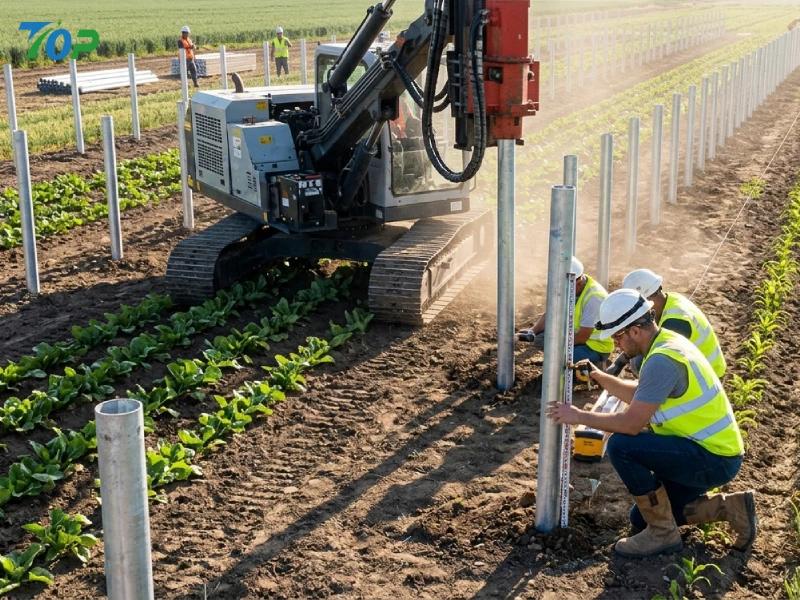
Agrivoltaic Structural Design: The Engineering Challenges Most Developers Underestimate
Although agrivoltaics offers compelling benefits, successful implementation requires considerably more engineering expertise than a conventional ground-mounted solar project.
Many developers initially focus on the agricultural concept while underestimating the structural demands created by elevated solar arrays. In practice, the mounting system often becomes one of the most critical factors determining project success.
Challenge 1: Increased Structural Height
Conventional ground-mounted systems are typically designed with relatively low clearances to reduce material consumption and improve structural efficiency.
Agrivoltaic projects are different.
Agricultural operations require adequate clearance beneath the solar array for crops, workers, livestock, and machinery.
| Agricultural Application | Typical Clearance Requirement |
|---|---|
| Sheep Grazing | 1.5–2.0 m |
| Vegetable Farming | 2.5–3.0 m |
| Small Machinery Access | 3.0–4.0 m |
| Tractor Operations | 4.0–5.0 m+ |
As structure height increases, engineering complexity increases as well. Taller support systems experience greater bending moments, higher wind exposure, and increased foundation demands.
Challenge 2: Wind Loads Increase Significantly
Wind loading is often one of the governing design factors for agrivoltaic structures.
Elevating the array increases the exposed surface area and creates larger overturning forces acting on support columns and foundations.
In typhoon-prone regions, coastal environments, and open agricultural fields, wind engineering becomes especially important.
Engineers must evaluate:
- Basic wind speed
- Terrain category
- Topographic amplification effects
- Array elevation
- Module inclination angle
- Structural dynamic behavior
Insufficient attention to these factors can lead to excessive deflection, fatigue issues, or long-term structural reliability concerns.
Challenge 3: Foundation Design Becomes More Critical
Foundation selection directly affects project cost, installation speed, and long-term performance.
Because agrivoltaic structures are taller and experience higher loading conditions, foundation design requires detailed geotechnical analysis.
Driven Pile Foundations
Driven piles remain one of the most widely used foundation solutions for utility-scale agrivoltaic projects.
Advantages include:
- Fast installation
- Minimal excavation
- Lower labor requirements
- Reduced concrete consumption
- Minimal disturbance to agricultural soil
For large projects where preserving soil quality is important, pile foundations often provide an effective balance between structural performance and construction efficiency.
Ground Screw Foundations
Ground screws may be suitable for smaller installations or sites where rapid installation and removability are priorities. However, their applicability depends heavily on soil conditions and project loading requirements.
Concrete Foundations
Concrete foundations are typically reserved for locations with poor soil conditions, exceptionally high structural loads, or site-specific engineering constraints.
Although highly robust, concrete foundations generally involve higher installation costs and greater site disturbance compared with pile-based systems.
In the next section, we will examine how to select the most suitable agrivoltaic mounting system, compare different structural solutions, and analyze the financial performance and ROI potential of modern agrivoltaic projects.
Agrivoltaic Solar Mounting Systems: Which Structure Is Best?
Selecting the right mounting structure is one of the most important decisions in any agrivoltaic project. While photovoltaic modules and inverters often receive the most attention during project planning, the mounting system ultimately determines whether agricultural activities can coexist efficiently with solar generation.
Unlike conventional ground-mounted solar farms, agrivoltaic systems must satisfy two separate operational requirements simultaneously. The structure must provide long-term structural reliability while also supporting farming activities beneath or around the array. Poor structural design can restrict machinery access, reduce crop productivity, increase maintenance costs, and negatively affect project economics.
For EPC contractors and project developers, selecting the correct structural solution requires balancing multiple variables including crop type, agricultural equipment requirements, site conditions, wind loads, foundation costs, and expected energy production.
Elevated Fixed-Tilt Agrivoltaic Systems
Elevated fixed-tilt systems are currently the most common agrivoltaic structure worldwide. These systems utilize higher support columns than conventional solar farms, allowing crops, livestock, or agricultural machinery to operate beneath the array.
The primary advantage of fixed-tilt systems is simplicity. With fewer moving parts than tracking systems, they generally offer lower maintenance requirements and reduced mechanical complexity.
Typical applications include:
- Vegetable cultivation
- Grain production
- Livestock grazing
- Mixed agricultural operations
- Large-scale agricultural parks
From an engineering perspective, fixed-tilt systems also simplify structural analysis and can often achieve lower lifecycle costs than more complex alternatives.
Single-Axis Tracking Agrivoltaic Systems
Tracking systems are increasingly being integrated into agrivoltaic projects where maximizing energy production is a priority.
Single-axis trackers rotate throughout the day, allowing photovoltaic modules to follow the sun's movement and increase energy yield compared with fixed-tilt installations.
Depending on site conditions, single-axis tracking systems may increase annual electricity production by approximately 15% to 25% compared with fixed structures.
In agrivoltaic applications, trackers offer an additional advantage: dynamic shading control.
By adjusting panel orientation, operators can influence the amount of sunlight reaching crops during critical growth periods. This capability may become increasingly valuable in regions experiencing extreme heat events and water stress.
However, developers must also consider:
- Higher CAPEX
- More complex maintenance requirements
- Additional foundation loading
- Greater mechanical complexity
- Increased O&M planning requirements
Solar Fence Systems for Agricultural Applications
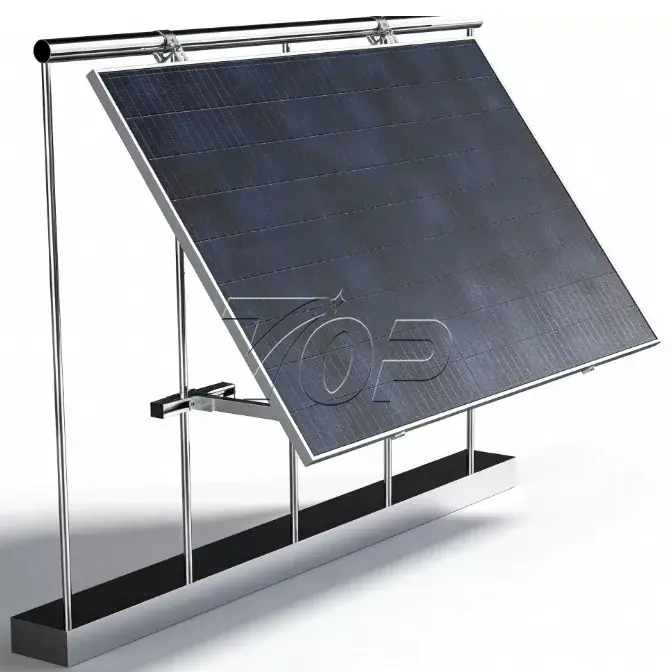
An emerging category within agrivoltaics involves vertical solar fence systems. Unlike traditional horizontal arrays, solar fence structures install photovoltaic modules vertically along agricultural boundaries, livestock enclosures, orchards, and rural infrastructure corridors.
This approach offers several unique benefits.
- Minimal occupation of productive farmland
- Dual-use functionality as both fence and power generator
- Simplified maintenance access
- Enhanced site security
- Reduced shading impact on crops
For agricultural facilities where land utilization is critical, solar fencing can transform otherwise non-productive boundary areas into revenue-generating assets.
Although energy production per installed megawatt may differ from traditional layouts, solar fencing can provide an attractive solution where space optimization is a primary objective.
Comparison of Common Agrivoltaic Structure Types
| Criteria | Fixed-Tilt Elevated | Single-Axis Tracker | Solar Fence |
|---|---|---|---|
| Installation Cost | Medium | High | Medium |
| Energy Yield | Good | Excellent | Moderate |
| Agricultural Compatibility | Excellent | Excellent | Good |
| Maintenance Complexity | Low | Higher | Low |
| Expected Service Life | 25-35 Years | 25-30 Years | 25-35 Years |
Agrivoltaics ROI Analysis: Is It Financially Worth It?
No matter how innovative a technology appears, large-scale adoption ultimately depends on economics.
For developers, investors, and agricultural landowners, the central question remains straightforward:
Can agrivoltaics generate better long-term returns than conventional solar or traditional farming alone?
While project economics vary by country, electricity prices, crop selection, and policy incentives, the overall financial case for agrivoltaics has strengthened considerably in recent years.
CAPEX Comparison: Traditional Solar vs Agrivoltaics
Agrivoltaic projects generally require higher upfront investment than conventional ground-mounted solar systems.
The primary cost drivers include:
- Taller support structures
- Additional steel consumption
- Larger foundations
- Wider spans
- Agricultural access requirements
Industry studies commonly estimate agrivoltaic structures may increase mounting system costs by approximately 20% to 60% depending on design requirements.
However, focusing solely on initial CAPEX can be misleading because agrivoltaics creates additional revenue streams that conventional solar farms cannot access.
Revenue Diversification Creates Stronger Financial Stability
Traditional solar projects rely almost entirely on electricity sales.
Agrivoltaic projects can generate revenue from multiple sources simultaneously:
- Electricity sales
- Crop production
- Livestock operations
- Land lease income
- Carbon reduction incentives
- Agricultural sustainability programs
This diversification helps reduce exposure to fluctuations in energy markets and agricultural commodity prices.
Example Financial Model: 10 MW Agrivoltaic Project
The following simplified example illustrates how dual-use land management can influence project economics. Actual project results will vary depending on local conditions.
| Project Parameter | Typical Value |
|---|---|
| Installed Capacity | 10 MW |
| Land Area | Approximately 40-60 Acres |
| Annual Energy Production | 14-18 GWh |
| Agricultural Activity | Vegetables, Grazing, Orchard |
| Project Lifetime | 25+ Years |
| Potential Revenue Sources | Electricity + Agriculture |
Although the structural investment may be higher, many developers find that dual revenue streams improve long-term financial resilience and support stronger overall project valuations.
Long-Term Investment Advantages
- Diversified income generation
- Improved land utilization efficiency
- Reduced permitting risk
- Stronger ESG credentials
- Potential access to agricultural incentives
- Greater stakeholder acceptance
For institutional investors increasingly focused on sustainability metrics, agrivoltaics often aligns well with environmental and social investment criteria.
Agrivoltaic Project Planning Checklist for EPC Contractors
Many agrivoltaic projects succeed or fail long before construction begins. Early-stage planning decisions often determine long-term performance, agricultural compatibility, and financial outcomes.
The following checklist can help EPC contractors identify critical project considerations during feasibility and design phases.
Site Assessment Checklist
- Evaluate annual solar irradiation levels.
- Conduct detailed geotechnical investigations.
- Analyze drainage conditions.
- Assess flood risk exposure.
- Review local wind and snow loading requirements.
- Identify agricultural operations currently conducted on-site.
- Determine machinery dimensions and access requirements.
- Verify utility interconnection feasibility.
- Assess long-term land-use restrictions.
Crop Selection Assessment
Not all crops respond equally to partial shading. Crop selection should be integrated into project design from the beginning rather than treated as a secondary consideration.
Common agrivoltaic crop categories include:
- Leafy greens
- Root vegetables
- Berries
- Forage crops
- Vineyards
- Fruit orchards
Local climate conditions and agricultural expertise should always guide final crop selection decisions.
Structural Engineering Checklist
- Verify design wind speeds.
- Determine required ground clearance.
- Optimize row spacing.
- Evaluate pile embedment depth.
- Analyze structural deflection limits.
- Review maintenance access routes.
- Specify corrosion protection requirements.
- Assess module loading conditions.
- Confirm long-term durability targets.
Corrosion Protection Checklist
Agricultural environments often expose structures to moisture, fertilizers, animal waste, and chemical residues. Corrosion protection therefore becomes a critical lifecycle consideration.
Recommended engineering practices commonly include:
- Hot-dip galvanized structural steel
- Zn-Al-Mg coated steel components
- SUS304 stainless steel fasteners
- Enhanced coating specifications for coastal projects
- Periodic inspection programs
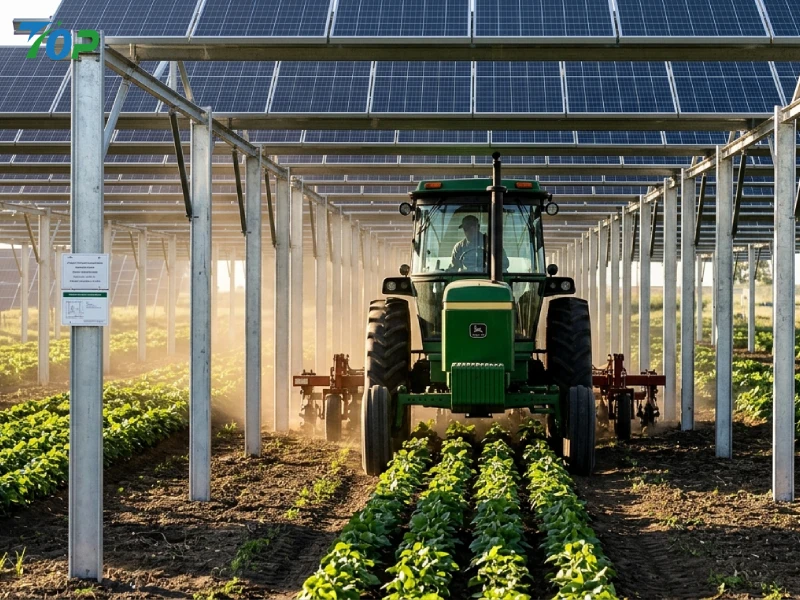
Future Trends: Where Agrivoltaics Is Heading by 2030
Agrivoltaics remains a relatively young industry compared with conventional photovoltaic development. Nevertheless, technological advances and policy support are accelerating deployment worldwide.
Several trends are expected to shape the sector over the coming decade.
AI-Assisted Agricultural Monitoring
Artificial intelligence and sensor networks are increasingly being used to monitor crop health, soil moisture, and environmental conditions beneath solar arrays.
Future systems may dynamically optimize both agricultural productivity and electricity generation using real-time environmental data.
Advanced Solar Tracking Systems
Next-generation trackers are expected to improve crop-specific shading management while increasing energy output.
Rather than maximizing electricity production alone, future algorithms may optimize total land productivity by balancing agricultural and energy objectives simultaneously.
Water-Saving Agrivoltaics
Water scarcity is becoming a major challenge across many agricultural regions.
Research indicates that partial shading created by photovoltaic modules can reduce soil evaporation and improve water-use efficiency in certain crop systems.
As drought risks increase globally, water-efficient agrivoltaic designs are likely to become increasingly valuable.
Utility-Scale Agricultural Solar Parks
The industry is gradually moving beyond pilot projects toward utility-scale deployment.
Large agricultural solar parks combining energy generation, food production, water management, and rural economic development are already being planned in multiple countries.
For EPC contractors and mounting structure manufacturers, this transition represents a significant long-term growth opportunity.
Conclusion
The debate between food production and solar development has often been framed as a choice between two competing priorities. However, the rapid evolution of agrivoltaics demonstrates that this assumption is increasingly outdated.
Modern agrivoltaic systems enable agricultural production and renewable energy generation to coexist on the same land, creating a practical pathway for addressing some of the most pressing challenges facing both sectors. Real-world projects in Germany, France, Japan, and the United States have shown that dual-use solar systems can improve land productivity, strengthen rural economies, and support long-term sustainability objectives.
For EPC contractors, developers, and investors, the opportunity extends beyond environmental benefits. Agrivoltaics can reduce permitting risks, improve stakeholder acceptance, diversify revenue streams, and unlock new project opportunities in regions where conventional solar development faces increasing land-use constraints.
Success, however, depends heavily on engineering execution. Structural reliability, foundation selection, wind resistance, corrosion protection, agricultural compatibility, and long-term durability must all be carefully integrated into project design. As agrivoltaic deployment continues to scale globally, the quality of the mounting system and supporting infrastructure will play a decisive role in project performance.
For organizations seeking to maximize land value while maintaining agricultural productivity, agrivoltaics is no longer an experimental concept. It is rapidly becoming one of the most practical and economically compelling solutions for the future of renewable energy development.
Frequently Asked Questions (FAQ)
Q1. What is agrivoltaics?
Agrivoltaics is a dual-use land management approach that combines agricultural production and photovoltaic electricity generation on the same site. Crops, livestock, or other agricultural activities continue operating beneath or around solar arrays.
Q2. How much land can agrivoltaics save?
The exact savings depend on project design and crop selection. Many studies report Land Equivalent Ratio (LER) values greater than 1.0, indicating that agrivoltaic systems produce more combined value per hectare than separate agricultural and solar land uses.
Q3. Does agrivoltaics reduce crop yield?
Not necessarily. Certain crops may experience reduced yields if shading is excessive, while others benefit from moderated temperatures and reduced water stress. Results depend on crop type, climate, array spacing, and system design.
Q4. What crops grow best under solar panels?
Leafy greens, berries, forage crops, root vegetables, and certain specialty crops often perform well in agrivoltaic environments. Site-specific agricultural analysis is recommended before project development.
Q5. Are agrivoltaic projects more expensive?
Initial construction costs are typically higher due to elevated structures and more complex engineering requirements. However, additional agricultural revenue and improved land utilization may enhance long-term project economics.
Q6. What is the ROI of an agrivoltaic solar farm?
ROI varies according to electricity prices, agricultural revenue, incentives, project scale, and financing structure. Many investors view agrivoltaics favorably because it diversifies income sources and reduces land-use related risks.
Q7. What type of solar mounting structure is best for agrivoltaics?
There is no universal solution. Elevated fixed-tilt systems, tracking systems, and solar fence structures each offer advantages depending on agricultural activities, site conditions, and project objectives.
Q8. Can pile foundations be used in agrivoltaic projects?
Yes. Driven pile foundations are among the most widely used solutions for utility-scale agrivoltaic installations because they provide strong structural performance, rapid installation, and minimal disturbance to agricultural soil.
Design More Profitable Agrivoltaic Projects with Engineering-Grade Solar Mounting Systems
As agrivoltaic projects continue expanding worldwide, selecting the right mounting structure has become critical to long-term project success. Poorly designed systems can restrict agricultural operations, increase wind-load risks, complicate foundation installation, and reduce overall project ROI. TOPFENCE provides customized agrivoltaic solar mounting systems engineered for crop cultivation, livestock grazing, orchards, and utility-scale agricultural solar developments. Our solutions feature high-clearance structural designs, hot-dip galvanized steel components, driven pile foundation compatibility, and project-specific wind load optimization to support both agricultural productivity and solar energy generation. Reduce permitting challenges, improve installation efficiency, and maximize land-use value with reliable agrivoltaic infrastructure.
Request Agrivoltaic Mounting Design, Structural Calculations & EPC PricingRelated News
- The Global EPC Sourcing Checklist: Managing Lead Times and Logistics for Solar Mounting Systems
- BIPV & Commercial Rooftops: Solving Waterproofing and Structural Integrity Challenges in Urban Solar
- Navigating Solar Certifications: Why UL 2703 and International Standards Matter for Project Bankability
- Maximizing Yield with Bifacial Modules: How to Select the Optimal Tracker for Enhanced Energy Output
- Wind Load and Coastal Engineering: Ensuring Your Ground-Mounted Solar Array Survives Extreme Weather
- Aluminum vs. Galvanized Steel: Choosing the Right Solar Mounting Structure for High-Corrosivity Environments
Leave me a message