Why FRP Grating is the Best Material for PV O&M Walkways (FRP Solar Grating vs Metal)
The Hidden Cost of Walkway Material Choices in Solar Projects
Rising EPC costs, tighter project timelines, and increasing pressure to deliver long-term ROI are forcing solar developers and contractors to scrutinize every component in a PV system—including often-overlooked walkway materials. For professional solar installers, EPC contractors, and distributors, choosing between FRP solar grating vs metal is no longer a minor design decision—it directly impacts installation efficiency, maintenance frequency, and lifecycle cost. Traditional metal walkways, while familiar, often lead to corrosion issues, structural deformation, and increased after-sales service, especially in coastal or high-humidity environments. In contrast, FRP solar grating vs metal comparisons are increasingly favoring FRP solutions for their durability, lightweight properties, and long-term cost advantages. This article provides a technical, engineering-focused analysis to help B2B decision-makers optimize both performance and ROI.
What is FRP Grating? A Technical Overview for Solar Applications
Composition and Manufacturing Process
Fiber Reinforced Plastic (FRP) grating is a composite material engineered from high-strength glass fibers embedded within a thermosetting resin matrix. The two most common manufacturing methods include:
- Molded FRP Grating: Produced through a casting process, offering bi-directional strength and superior corrosion resistance.
- Pultruded FRP Grating: Manufactured through continuous fiber pulling, delivering higher load-bearing capacity in one direction.
The resin systems typically include polyester, vinyl ester, and phenolic formulations, each tailored for specific environmental conditions such as chemical exposure, UV radiation, and fire resistance. This engineered composition enables FRP grating to outperform traditional materials in demanding PV environments.
Key Mechanical and Physical Properties
FRP grating exhibits a unique combination of mechanical strength and environmental resilience, making it highly suitable for photovoltaic O&M walkways:
- High Strength-to-Weight Ratio: Up to 70% lighter than steel while maintaining structural integrity.
- Corrosion Resistance: Immune to rust, ideal for coastal, agricultural, and industrial environments.
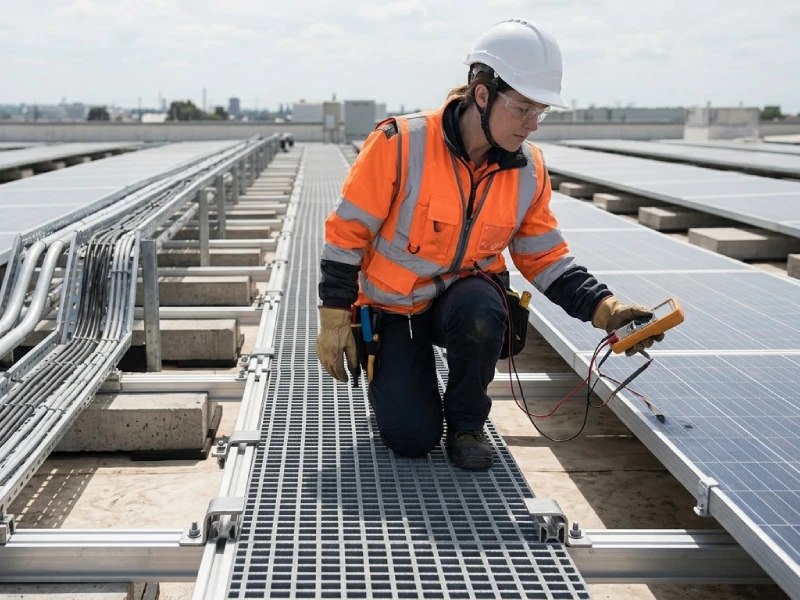
- Electrical Insulation: Non-conductive, reducing safety risks during maintenance.
- Thermal Stability: Low thermal conductivity minimizes heat transfer.
- UV Resistance: Designed for long-term outdoor exposure.
Why FRP is Naturally Suitable for PV O&M Walkways
Photovoltaic systems require safe, durable, and low-maintenance access paths for inspection and servicing. FRP grating meets these requirements through:
- Non-slip Surface: Integrated grit surface enhances technician safety.
- Lightweight Structure: Reduces rooftop load and simplifies installation.
- Non-corrosive Performance: Maintains integrity over decades without protective coatings.
- Compatibility: Easily integrates with aluminum mounting systems and stainless steel fasteners.
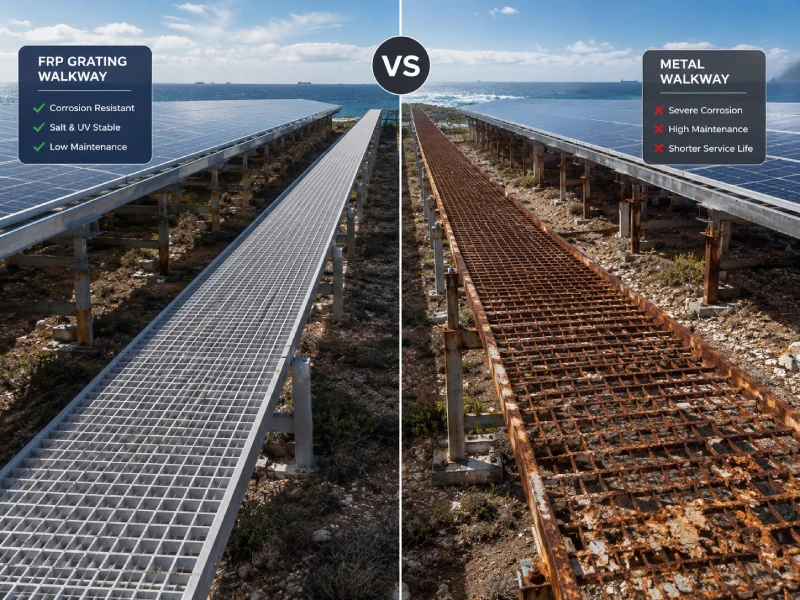
FRP Solar Grating vs Metal: A Complete Engineering Comparison
Structural Strength and Load-Bearing Performance
In the debate of FRP solar grating vs metal, structural performance is often the first concern for EPC engineers. While steel offers high absolute strength, FRP provides sufficient load-bearing capacity for walkway applications with significantly lower weight. Properly designed FRP grating can support maintenance loads, distributed weight, and equipment transport without excessive deflection.
Additionally, FRP exhibits better impact resistance and does not suffer from permanent deformation under typical operational loads, unlike thinner metal sheets that may bend over time.
Corrosion Resistance in Harsh Environments
One of the most critical differences in the FRP solar grating vs metal comparison lies in environmental durability. Metal walkways—especially galvanized steel—are vulnerable to:
- Salt spray corrosion in coastal regions
- Chemical exposure in industrial zones
- Ammonia degradation in agricultural PV installations
FRP grating, by contrast, is inherently resistant to these corrosive agents due to its non-metallic composition. This eliminates the need for repainting, anti-rust treatments, or frequent replacement.
Installation Efficiency and Labor Cost
From an EPC perspective, installation efficiency directly impacts project timelines and labor costs. Compared to metal systems, FRP grating offers:
- Lightweight panels for easy manual handling
- No need for heavy lifting equipment
- Simple cutting and on-site customization using standard tools
- Faster installation cycles
These advantages translate into reduced labor hours and improved project delivery speed—key factors for large-scale solar deployments.
Lifecycle Cost (LCOE Impact)
While initial material costs may vary, the total cost of ownership strongly favors FRP in the FRP solar grating vs metal analysis. Metal walkways often incur:
- Maintenance and repainting costs
- Replacement due to corrosion or deformation
- Increased downtime during repairs
FRP grating minimizes these expenses through long service life and minimal maintenance requirements, ultimately reducing the Levelized Cost of Electricity (LCOE) for PV projects.
Safety Performance (Anti-slip & Electrical Safety)
Safety is a non-negotiable factor in PV system design. FRP grating offers clear advantages:
- Slip Resistance: Molded grit surfaces provide superior traction in wet conditions
- Electrical Insulation: Eliminates risk of electric shock
- No Sharp Edges: Reduces injury risk during installation and maintenance
In contrast, metal walkways can become slippery, conductive, and hazardous without additional treatments or coatings.
Technical Specifications of FRP Grating for PV Walkways
Standard Dimensions and Load Ratings
For EPC contractors and procurement managers, understanding the technical parameters of FRP grating is essential to ensure structural reliability and compliance with project specifications. In practical PV applications, FRP walkway grating is typically supplied in standardized panel sizes such as 1220 × 3660 mm or 1000 × 4000 mm, allowing efficient transportation and modular installation.
Thickness options commonly include:
- 25 mm: Suitable for light-duty rooftop maintenance walkways
- 30 mm: Balanced performance for commercial and industrial PV systems
- 38 mm: Heavy-duty applications requiring higher load-bearing capacity
Load ratings are typically defined based on span distance and deflection limits. For example:
- Uniform load capacity: 2.5–5.0 kN/m² (depending on thickness and support spacing)
- Recommended support span: 300–500 mm for standard O&M walkways
- Deflection limit: L/200 or better for safe walking performance
Compared to traditional materials, the FRP solar grating vs metal evaluation shows that FRP delivers sufficient structural performance for maintenance operations while significantly reducing dead load on rooftops—an important factor for projects with strict structural limits.
Resin Types and Environmental Suitability
The choice of resin system directly impacts the long-term durability and performance of FRP grating in photovoltaic environments. Selecting the appropriate resin is not just a material decision—it is a strategic engineering choice that affects maintenance cycles and ROI.
- Orthophthalic Polyester Resin: Cost-effective solution for standard environments with moderate exposure conditions.
- Isophthalic Polyester Resin: Enhanced corrosion resistance and improved mechanical properties for industrial rooftops.
- Vinyl Ester Resin: Superior resistance to chemicals, salt spray, and high humidity—ideal for coastal and offshore PV systems.
- Phenolic Resin: Fire-retardant properties with low smoke generation, suitable for projects with strict fire safety requirements.
In the context of FRP solar grating vs metal, this flexibility in material engineering gives FRP a clear advantage. Metal systems cannot be easily customized at the material level to adapt to different environmental stressors, whereas FRP can be tailored to specific project conditions.
Compliance and Certifications
For B2B buyers, especially distributors and large-scale EPC contractors, compliance with international standards is a key procurement criterion. High-quality FRP grating products are typically tested and certified according to:
- ASTM D635: Flammability testing
- ASTM E84: Surface burning characteristics (fire rating)
- ASTM D790: Flexural strength and modulus
- ISO 9001: Quality management systems
- UV Resistance Testing: Ensures long-term outdoor durability
While metal materials such as aluminum or galvanized steel may comply with structural standards, they often require additional coatings or treatments to meet corrosion and safety requirements. This adds complexity and cost, further strengthening the case in the FRP solar grating vs metal comparison.
Application Scenarios: Where FRP Outperforms Metal in Solar Projects
Coastal Solar Farms (Salt Corrosion Resistance)
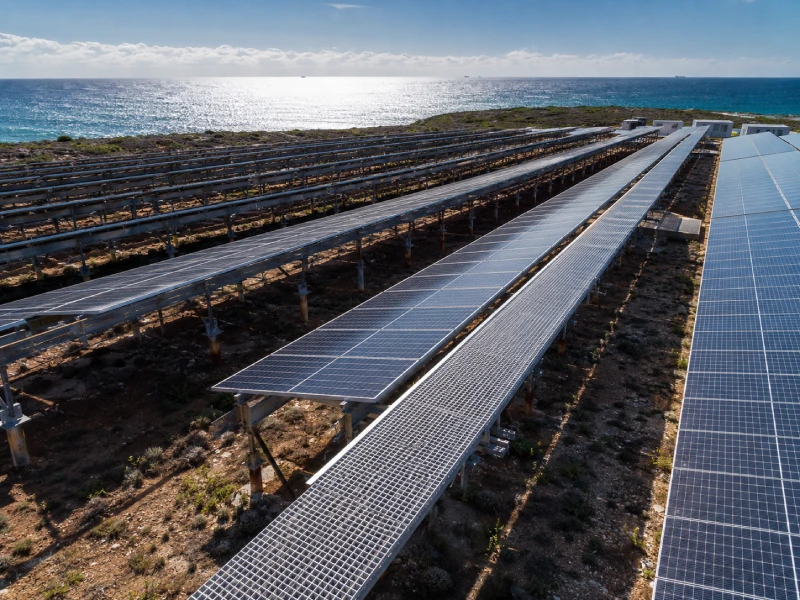
Coastal PV installations are exposed to high levels of salt spray, which accelerates corrosion in metal structures. Even hot-dip galvanized steel can degrade over time, leading to structural weakening and increased maintenance costs.
FRP grating, being inherently corrosion-resistant, maintains its structural integrity without protective coatings. This makes it a preferred solution for coastal solar farms where long-term durability and reduced maintenance are critical for ROI.
Industrial Rooftops (Chemical Exposure)
Industrial environments often involve exposure to chemicals, oils, and airborne pollutants that can degrade metal surfaces. In such conditions, metal walkways require regular inspection and protective maintenance.
FRP grating, especially when manufactured with vinyl ester resin, offers excellent chemical resistance. This ensures consistent performance and minimizes operational disruptions, making it a more reliable choice in the FRP solar grating vs metal evaluation.
Agricultural PV (Ammonia and Moisture Resistance)
Agricultural PV systems, such as those installed above livestock facilities, are exposed to ammonia and high humidity levels. These conditions can rapidly corrode metal components.
FRP grating is unaffected by ammonia exposure and does not rust, providing a long-lasting solution for agricultural solar applications. This significantly reduces maintenance requirements and enhances system reliability.
Floating Solar Systems (Lightweight + Anti-corrosion)
Floating PV systems present unique challenges, including constant exposure to water, humidity, and dynamic loads. Weight reduction is also critical to maintain buoyancy and structural stability.
FRP grating’s lightweight and non-corrosive properties make it an ideal choice for floating solar walkways. Compared to metal, it reduces structural stress on floating platforms while ensuring long-term durability.
Common Engineering Challenges and How FRP Solves Them
In real-world PV projects, walkway design is not just about material selection—it must address multiple engineering challenges simultaneously. The FRP solar grating vs metal comparison becomes particularly relevant when evaluating how each material performs under these constraints.
Waterproofing Integration with Mounting Systems
Rooftop solar installations often require strict waterproofing measures to prevent leakage. Traditional metal walkways may require drilling or welding, increasing the risk of roof penetration and water ingress.
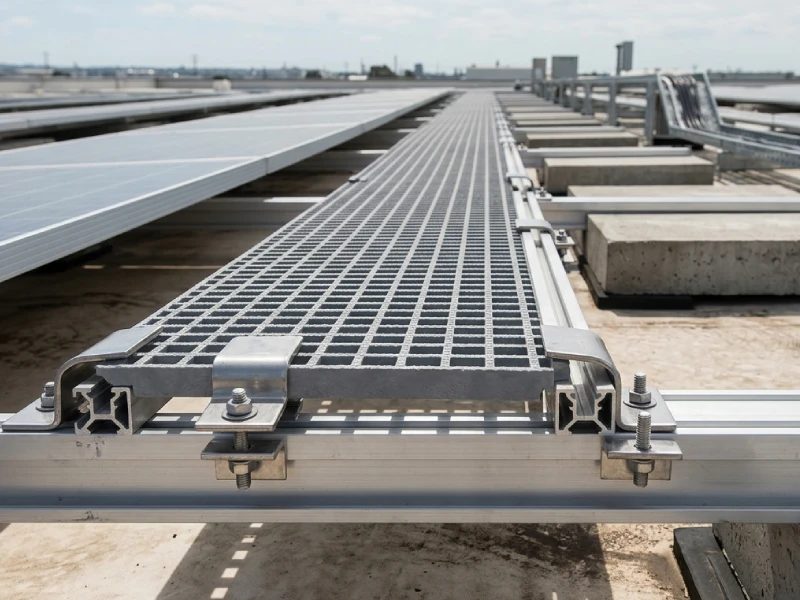
FRP grating can be installed using clamp-based or non-penetrating fixing systems, preserving the integrity of waterproof layers and reducing long-term risk.
Avoiding Roof Penetration Risks
Minimizing roof penetration is a key priority for EPC contractors. FRP’s lightweight nature allows for flexible installation methods that reduce or eliminate the need for structural penetration, improving both safety and installation speed.
Compatibility with Aluminum Rails and SUS304 Fasteners
Modern PV mounting systems typically use aluminum rails and stainless steel (SUS304) fasteners. FRP grating is highly compatible with these materials, avoiding galvanic corrosion issues that can occur when dissimilar metals are in contact.
Thermal Expansion Considerations
Thermal expansion can cause deformation and stress in metal walkways, especially in regions with significant temperature fluctuations. FRP materials exhibit lower thermal conductivity and more stable dimensional behavior, reducing the risk of structural distortion over time.
Professional Installation Recommendations for EPC Contractors
To maximize the performance advantages identified in the FRP solar grating vs metal comparison, proper installation practices are essential. The following recommendations are based on field-proven engineering experience:
Best Practices for FRP Walkway Layout Design
- Align walkways with maintenance access routes and inverter locations
- Ensure sufficient width (typically 300–600 mm) for safe technician movement
- Optimize layout to minimize material waste and cutting
Fixing Methods (Clamps vs Bolts)
- Use stainless steel clamps for non-penetrating installations
- Apply anti-loosening mechanisms for long-term stability
- Avoid over-tightening to prevent material stress
Recommended Support Spacing
- Maintain support spacing within 300–500 mm depending on load requirements
- Use additional supports in high-traffic areas
Integration with PV Mounting Structures
- Ensure compatibility with existing aluminum rail systems
- Coordinate walkway installation with module layout to avoid shading
On-site Safety and Installation Workflow Optimization
- Pre-cut panels where possible to reduce on-site labor
- Implement standardized installation procedures for faster deployment
- Train installation teams on FRP-specific handling techniques
CTA for EPC Contractors: For project-specific engineering support, customized walkway design, or installation guidance, contact our technical team to receive detailed drawings and optimization recommendations.
Bulk Procurement Guide for Distributors & EPC Buyers
How to Evaluate FRP Grating Suppliers
For distributors and EPC procurement managers, supplier selection is a critical factor that directly affects product consistency, project timelines, and long-term system reliability. In the context of FRP solar grating vs metal, while FRP offers clear technical advantages, the actual performance depends heavily on manufacturing quality and process control.
- Manufacturing Capability: Assess whether the supplier has in-house production facilities, automated molding or pultrusion lines, and strict quality control systems.
- Fiber Content Ratio: High-quality FRP grating typically contains 30–35% glass fiber by weight, ensuring optimal strength and durability.
- Resin Quality: Verify the type and grade of resin used (e.g., vinyl ester for corrosion resistance).
- Testing and Certification: Ensure compliance with ASTM, ISO, or equivalent international standards.
- Project Experience: Suppliers with proven EPC project references can provide more reliable technical support.
Unlike metal products, where quality differences are often visible, FRP performance depends on internal composition and curing processes—making supplier evaluation even more critical.
Customization and Inventory Standardization
One of the major advantages of FRP over traditional materials in the FRP solar grating vs metal comparison is its flexibility in customization. For distributors managing inventory across multiple projects, standardization strategies can significantly improve efficiency.
- Modular Sizing: Use standardized panel sizes that fit most PV mounting systems to reduce SKU complexity.
- Color Coding: Yellow or gray FRP grating improves visibility and safety on-site.
- Surface Options: Choose between concave, grit, or covered surfaces based on project requirements.
- Cut-to-Size Services: Pre-fabricated panels reduce on-site labor and installation time.
This level of customization is difficult to achieve with metal walkways without increasing fabrication complexity and cost.
Cost Optimization Strategies for Large Projects
For utility-scale solar projects, procurement strategy plays a key role in overall project profitability. While the upfront cost comparison in FRP solar grating vs metal may vary depending on market conditions, several strategies can optimize total cost:
- Bulk Ordering (MOQ Optimization): Larger orders reduce unit cost and improve production efficiency.
- Logistics Planning: Stackable FRP panels reduce shipping volume compared to bulky metal structures.
- Reduced Installation Labor: Lightweight FRP lowers handling and installation costs.
- Lower Maintenance Budget: Eliminates repainting, anti-corrosion treatment, and frequent replacement.
When evaluated from a lifecycle perspective, FRP consistently delivers a lower total cost of ownership, reinforcing its advantage over metal alternatives.
FRP Solar Grating vs Metal: Final Verdict for B2B Buyers
After a comprehensive evaluation of engineering performance, installation efficiency, environmental durability, and lifecycle cost, the conclusion in the FRP solar grating vs metal debate becomes clear: FRP grating is the superior choice for most photovoltaic O&M walkway applications.
- Performance: Adequate load-bearing capacity with superior corrosion resistance
- Efficiency: Faster installation and reduced labor requirements
- Durability: Long service life with minimal maintenance
- Safety: Non-slip and non-conductive properties
- ROI: Lower lifecycle cost and improved system reliability
However, it is important to recognize that metal walkways may still be applicable in specific edge cases, such as:
- Projects requiring extremely high point-load capacity beyond FRP design limits
- Environments with minimal corrosion risk and existing metal infrastructure compatibility
Even in these scenarios, the long-term advantages of FRP often outweigh the short-term familiarity of metal solutions. As a result, FRP grating is rapidly becoming the industry standard for modern solar installations.
Request a Sample or Get a Bulk Quote
For EPC contractors, distributors, and project developers looking to optimize their solar installations, selecting the right walkway material is a strategic decision. If you are evaluating FRP solar grating vs metal for your next project, we invite you to take the next step:
- Request Free Samples: Test FRP grating performance in your specific environment
- Get Engineering Drawings: Receive customized walkway layout designs tailored to your project
- Bulk Pricing Consultation: Optimize procurement costs for large-scale installations
- Lead Time & Logistics Support: Ensure timely delivery for global EPC projects
Our technical team provides end-to-end support—from material selection to installation optimization—helping you reduce risk and maximize ROI.
FAQ: FRP Solar Grating vs Metal in PV Applications
Q1: Is FRP grating strong enough for heavy maintenance loads?
Yes. Properly specified FRP grating can support typical maintenance loads, including personnel and equipment. Load capacity depends on thickness, panel design, and support spacing. For most PV O&M applications, FRP provides more than sufficient strength.
Q2: How long does FRP grating last in outdoor PV environments?
FRP grating typically has a service life of 20–30 years or more, depending on environmental conditions and resin type. Its resistance to corrosion, UV exposure, and chemicals ensures long-term durability with minimal maintenance.
Q3: Can FRP grating be used with standard solar mounting systems?
Yes. FRP grating is fully compatible with aluminum mounting rails and SUS304 stainless steel fasteners. It can be easily integrated into existing PV system designs without major modifications.
Q4: Is FRP more cost-effective than galvanized steel in the long run?
In most cases, yes. While initial costs may be comparable or slightly higher, FRP eliminates maintenance, repainting, and replacement costs, resulting in a lower total cost of ownership over the system’s lifecycle.
Q5: Does FRP grating meet fire safety standards?
High-quality FRP grating can be manufactured with fire-retardant resins and tested according to standards such as ASTM E84. This ensures compliance with fire safety requirements in commercial and industrial installations.
Q6: How does FRP perform compared to aluminum walkways?
In the FRP solar grating vs metal comparison, aluminum offers lightweight properties but lacks the corrosion resistance and anti-slip performance of FRP. Additionally, aluminum remains conductive, posing potential safety risks in electrical environments.
Q7: What maintenance is required for FRP grating?
FRP grating requires minimal maintenance. Periodic cleaning to remove dirt or debris is typically sufficient. Unlike metal, it does not require painting, coating, or anti-corrosion treatments.
Q8: Is FRP environmentally sustainable?
FRP contributes to sustainability by reducing material replacement frequency and maintenance-related resource consumption. Its long lifespan aligns with the long-term operational goals of solar energy systems.
Conclusion: Engineering Smarter Walkways for Higher ROI
As the solar industry continues to evolve toward higher efficiency and lower lifecycle costs, every component in a PV system must be optimized—including O&M walkways. The comprehensive analysis of FRP solar grating vs metal demonstrates that FRP is not just an alternative material, but a strategic upgrade that enhances installation efficiency, improves safety, and delivers superior long-term value.
For EPC contractors and distributors aiming to stay competitive in a rapidly growing market, adopting FRP grating solutions is a forward-looking decision that aligns with both engineering best practices and financial performance goals.
FRP Solar Grating vs Metal — Upgrade PV Walkways for Higher ROI
Still evaluating FRP solar grating vs metal for your PV project? In coastal, industrial, and high-humidity environments, metal walkways often suffer from corrosion, higher maintenance costs, and reduced structural reliability. FRP grating provides a lightweight, non-corrosive, and non-conductive alternative that significantly improves installation efficiency and long-term system performance. TOPFENCE supports EPC contractors and distributors with engineered FRP walkway systems, modular installation solutions, and project-specific technical support to optimize ROI and reduce lifecycle cost.
Request FRP Walkway Design, Samples & Bulk Pricing
Related News
- The Global EPC Sourcing Checklist: Managing Lead Times and Logistics for Solar Mounting Systems
- BIPV & Commercial Rooftops: Solving Waterproofing and Structural Integrity Challenges in Urban Solar
- Navigating Solar Certifications: Why UL 2703 and International Standards Matter for Project Bankability
- Maximizing Yield with Bifacial Modules: How to Select the Optimal Tracker for Enhanced Energy Output
- Wind Load and Coastal Engineering: Ensuring Your Ground-Mounted Solar Array Survives Extreme Weather
- Aluminum vs. Galvanized Steel: Choosing the Right Solar Mounting Structure for High-Corrosivity Environments
Leave me a message