Non-Penetrating Flat Roof Solar Ballast Mounting System: Engineering-Grade Waterproof Solution for Commercial Rooftop PV Projects
Why Flat Roof Solar Ballast Mounting Systems Are Replacing Penetrating Rooftop PV Structures
In commercial rooftop photovoltaics, the flat roof solar ballast mounting system has become one of the fastest-growing installation solutions for EPC contractors, solar installers, and industrial building owners. As more factories, warehouses, logistics parks, and shopping centers adopt rooftop solar, the industry is shifting away from traditional roof-penetrating structures toward non-drilling systems that reduce waterproofing risks and improve construction efficiency.
For many EPC companies, roof leakage claims are no longer a small after-sales issue. A single waterproof failure can create expensive maintenance costs, interrupt factory operations, and damage long-term customer trust. This is exactly why the flat roof solar ballast mounting system is now widely preferred in commercial and industrial rooftop projects. By using ballast weight instead of roof penetration, the system helps protect waterproof membranes while shortening installation timelines.
At the same time, modern ballast solar racking systems are no longer just “simple no-drill structures.” Engineering standards have evolved quickly over the last few years. Wind uplift resistance, rooftop load optimization, drainage clearance, corrosion protection, and aerodynamic stability are now central design factors, especially for large-scale commercial PV installations.
This article explains how non-penetrating rooftop solar mounting systems work, why EPC contractors increasingly prefer them, and what engineering details actually matter in real-world commercial rooftop projects.
Why Commercial Rooftop Solar Projects Are Moving Toward Non-Penetrating Ballast Mounting Systems
Ten years ago, many rooftop solar systems still relied heavily on penetrating anchor connections. Drilling into concrete roofs was considered normal practice. But commercial roofing standards have changed, and building owners today are far more sensitive to waterproofing risks than before.
In many industrial facilities, the roof itself protects millions of dollars worth of production equipment and inventory. A leakage issue above an automated production line, cold storage warehouse, or electronics factory can quickly become a major operational problem. In some projects, the repair cost from water ingress is actually higher than the original mounting structure cost.
Because of this, non-penetrating solar mounting systems are now seen less as an alternative solution and more as a risk-control strategy.
Rising Pressure on EPC Contractors
EPC contractors today are under pressure from several directions:
- Shorter project schedules
- Increasing labor costs
- Higher waterproofing liability risks
- Stricter rooftop structural reviews
- Growing owner expectations for long-term reliability
Traditional roof penetration often creates additional approval procedures. Waterproof inspections, membrane repairs, and structural reinforcement may all increase project complexity. A non-penetrating ballast solar mounting system helps simplify these workflows.
For installers managing multiple MW-scale rooftop projects simultaneously, reducing installation steps can directly improve project turnover speed and labor efficiency.
The Shift Toward Existing Building Retrofit Projects
Another reason ballast structures are growing rapidly is the expansion of retrofit rooftop solar projects.
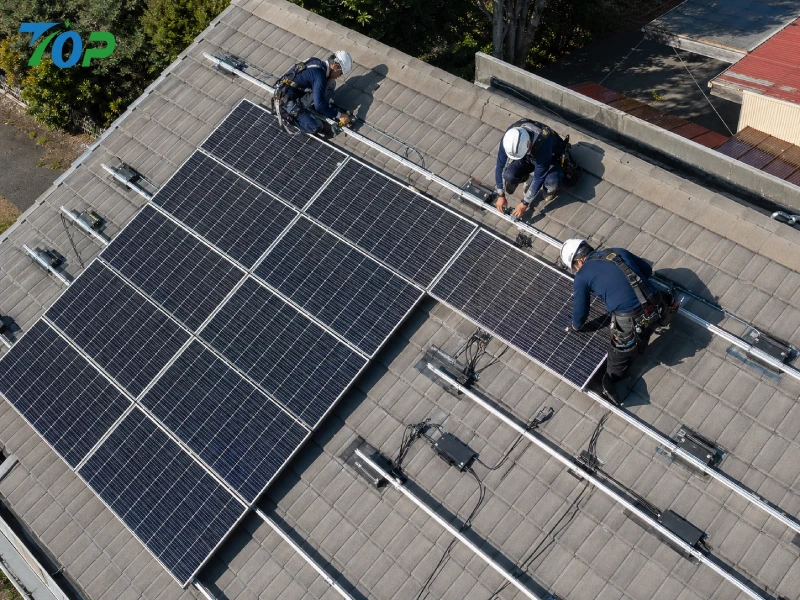
Many commercial buildings were never originally designed for photovoltaic systems. Some roofs are already 8–15 years old, with aging waterproof layers or uncertain structural documentation. In these cases, building owners are often unwilling to allow additional drilling into the roof membrane.
A no-drill solar roof mounting approach reduces concerns during the approval process and gives EPC contractors a more practical solution for older buildings.
Waterproofing Is No Longer a “Minor Issue”
In the past, waterproofing discussions were sometimes treated as secondary compared with energy generation performance. That mentality has changed quite a lot.
Today, many commercial clients evaluate rooftop solar proposals using three priorities:
- Roof safety
- System reliability
- Long-term operational risk
Generation yield still matters, of course. But preventing roof leakage has become equally important, especially for logistics warehouses, pharmaceutical factories, food processing facilities, and data centers.
This is one of the strongest drivers behind the adoption of ballast solar racking systems globally.
What Is a Flat Roof Solar Ballast Mounting System?
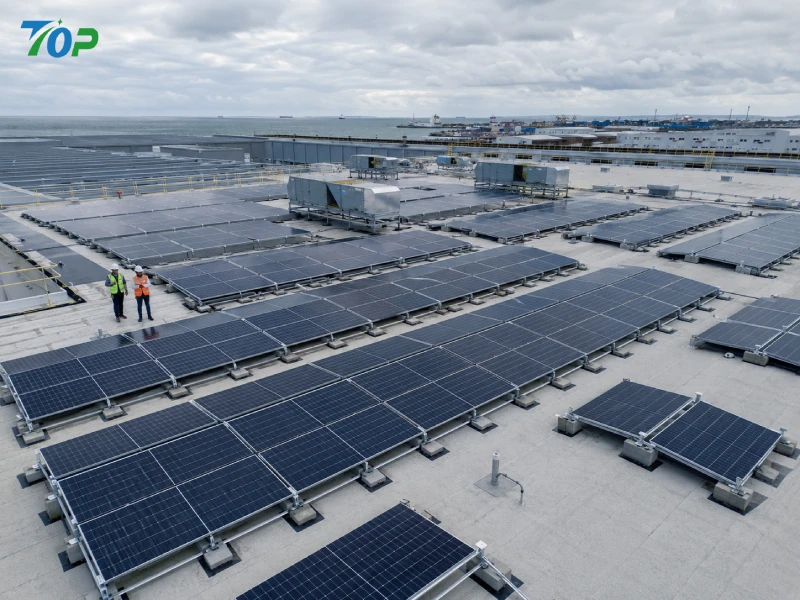
A flat roof solar ballast mounting system is a non-penetrating photovoltaic support structure that secures solar panels using weighted ballast blocks rather than mechanical roof anchors.
Instead of drilling into the roof surface, the system relies on calculated ballast weight, aerodynamic design, and friction-based stability to resist wind uplift and maintain structural integrity.
These systems are commonly used on commercial and industrial flat rooftops where preserving waterproof performance is critical.
Basic Structural Working Principle
The operating principle is relatively straightforward, although the engineering calculations behind it can become quite sophisticated.
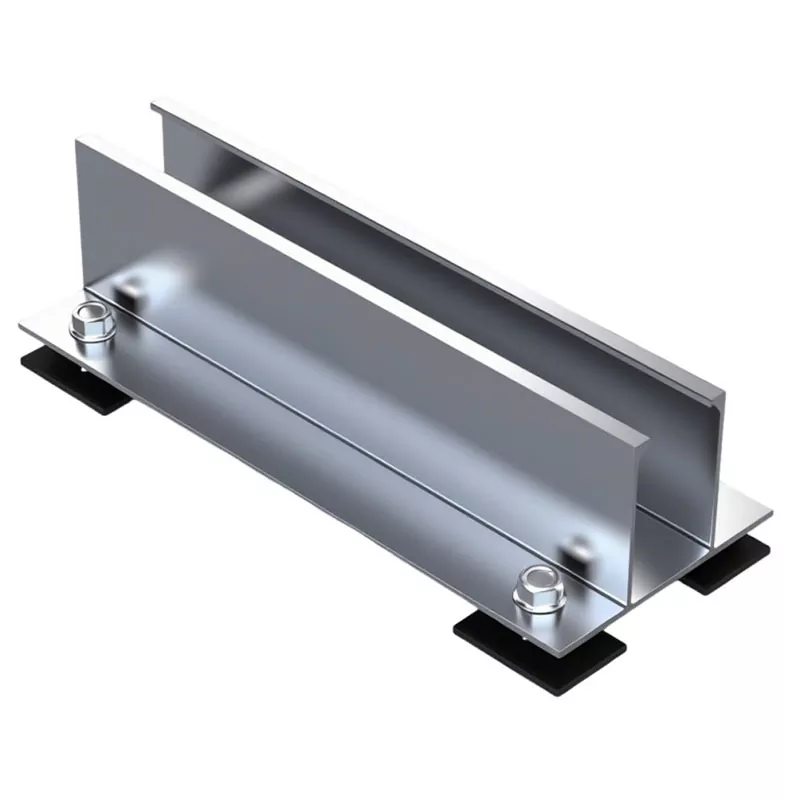
The mounting structure distributes loads across the roof surface through ballast trays, support legs, and protective pads. Wind uplift forces are counteracted by a combination of:
- Ballast weight
- Aerodynamic wind deflectors
- Optimized tilt angles
- Friction between protective pads and roof membrane
Unlike penetrating systems, there are no anchor bolts breaking through the waterproof layer.
This is especially important for TPO, PVC, and EPDM membrane roofs where waterproof integrity is highly sensitive to penetration points.
Main Components of a Ballast Solar Mounting System
Although designs vary between manufacturers, most commercial rooftop ballast systems include several common structural components.
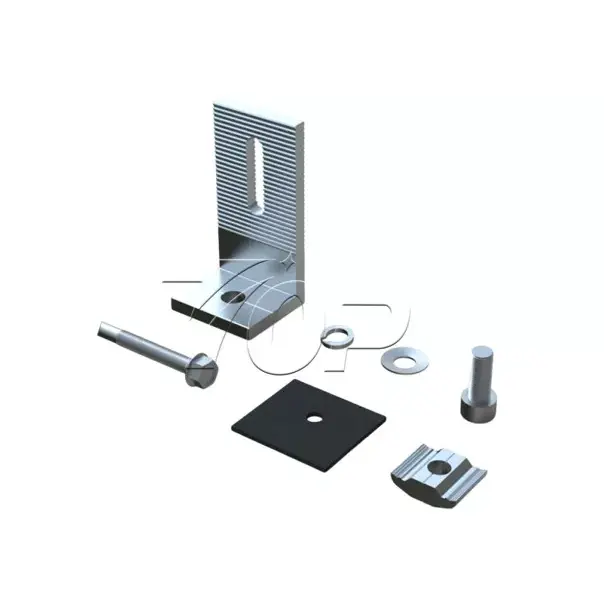
AL6005-T5 Aluminum Rails
High-strength aluminum rails support the solar modules and transfer loads throughout the structure.
AL6005-T5 aluminum alloy is widely used because it provides:
- Good corrosion resistance
- High structural strength
- Lightweight handling
- Long outdoor service life
Compared with heavier steel systems, aluminum structures are easier to transport and install on rooftops.
Front and Rear Support Legs
Support legs determine module tilt angle and structural geometry. Depending on the project, systems may use:
- South-facing tilt design
- East-West low tilt configuration
- Aerodynamic low-profile arrangement
The rear support structure often integrates wind deflectors to improve uplift resistance.
Ballast Trays
Ballast trays hold concrete blocks or other weighted materials that stabilize the system against wind loads.
The ballast requirement depends on multiple engineering variables:
- Roof height
- Local wind speed
- Building exposure category
- Module tilt angle
- Roof edge zones
- System aerodynamic performance
In high-wind coastal areas, ballast calculations become significantly more complex.
SUS304 Stainless Steel Fasteners
Fasteners are often overlooked in low-quality rooftop projects, but they directly affect long-term reliability.
SUS304 stainless steel hardware provides:
- Strong anti-corrosion performance
- Long service life
- Reduced maintenance risk
- Stable outdoor durability
This becomes especially important in coastal or humid industrial environments.
EPDM Rubber Pads
Protective rubber pads are installed between the mounting structure and roof membrane.
Their functions include:
- Increasing friction
- Protecting waterproof layers
- Reducing direct pressure concentration
- Improving rooftop compatibility
Without proper membrane protection, even non-penetrating systems may still damage roofing materials over time.
How Non-Penetrating Solar Mounting Systems Protect Roof Waterproofing
One of the biggest advantages of a flat roof solar ballast mounting system is waterproof protection.
For commercial building owners, this often matters more than many installers initially expect.
A rooftop leak may seem small during installation, but over several rainy seasons the problem can expand quickly, especially in large industrial facilities.
The Hidden Risk of Roof Penetration
Every roof penetration creates a potential long-term failure point.
Even when waterproof sealants are properly applied during installation, materials naturally age due to:
- UV exposure
- Thermal expansion cycles
- Rainwater erosion
- Mechanical vibration
- Temperature fluctuations
After years of rooftop exposure, sealant degradation may allow moisture infiltration around anchor points.
This problem is especially common in regions with:
- Strong UV radiation
- Heavy rainfall
- Frequent typhoons
- Large seasonal temperature variation
Why Commercial Building Owners Are More Cautious Today
Building owners have become more experienced with rooftop solar over the last decade. Many already understand the long-term maintenance risks associated with roof penetration.
In fact, some industrial property owners now explicitly require non-penetrating mounting systems during EPC bidding.
This trend is becoming increasingly common in:
- Logistics parks
- Cold storage facilities
- Electronics manufacturing plants
- Food-grade production buildings
- Pharmaceutical factories
These industries cannot easily tolerate leakage-related operational risks.
Protecting Roof Warranty Integrity
Another important consideration is roof warranty protection.
Some roofing manufacturers may partially void waterproof warranties after uncontrolled roof penetration. This creates additional legal and financial concerns for both building owners and EPC contractors.
A ballast solar mounting system helps minimize this issue because the waterproof membrane remains largely intact.
This simplifies communication between:
- Roofing suppliers
- Building owners
- PV installers
- Insurance companies
Reduced After-Sales Maintenance Pressure
For EPC contractors, waterproofing claims can become extremely time-consuming.
Sometimes the actual leakage source is unrelated to the PV system, but once solar equipment exists on the roof, the installer often becomes involved in troubleshooting anyway.
Reducing penetration points lowers the probability of future disputes and helps protect long-term customer relationships.
This is one reason why many experienced EPC companies now standardize non-penetrating rooftop solar mounting systems across commercial projects whenever roof conditions allow it.
Engineering Advantages of Ballast Solar Mounting Systems
The popularity of ballast systems is not only about waterproofing. Engineering efficiency is another major reason.
Modern commercial rooftop projects are under constant pressure to reduce installation time while maintaining structural reliability. A properly designed ballast system helps achieve both goals.
Faster Installation Workflow
Compared with traditional anchor-based installation, ballast structures generally require fewer construction steps.
There is usually no need for:
- Roof drilling
- Chemical anchor curing
- Waterproof re-sealing
- Complex penetration inspection
This significantly reduces rooftop installation time.
Many systems also use pre-assembled structural components, allowing installers to complete module installation more quickly.
On large commercial rooftops, time savings become very noticeable.
Reduced Labor Requirements
Labor shortages are affecting solar installation markets in many countries.
Because ballast systems simplify installation procedures, EPC contractors can often reduce:
- Skilled labor dependency
- Roof waterproof specialists
- Installation training complexity
- Roof preparation work
This helps improve installation scalability for large project pipelines.
Improved Adaptability for Existing Buildings
Not all rooftops are ideal for penetrating systems.
Some existing buildings have:
- Limited structural documentation
- Aging waterproof layers
- Restricted drilling permissions
- Complex rooftop layouts
A non-penetrating flat roof solar ballast mounting system provides greater flexibility in these situations.
This adaptability is especially valuable for retrofit commercial rooftop projects.
Lower Long-Term Maintenance Costs
Long-term operational costs matter more than many project developers initially realize.
A low-cost mounting structure that later creates waterproofing issues can quickly become expensive over a 20-year project lifecycle.
Ballast systems help reduce:
- Leakage repair costs
- Waterproof membrane maintenance
- Corrosion-related replacement
- Roof access complications
Over time, this can improve total project ROI considerably.
Critical Engineering Design Considerations for Flat Roof Ballast PV Systems
A flat roof solar ballast mounting system may look mechanically simple from the outside, but the engineering behind a reliable commercial rooftop installation is actually quite demanding.
In many failed rooftop PV projects, the problem was not the solar module itself. The issue usually came from underestimated wind uplift, poor rooftop load analysis, drainage obstruction, or long-term structural fatigue that was ignored during early-stage design.
This is why experienced EPC contractors pay close attention to engineering calculations before installation even begins.
Roof Structural Load Capacity Assessment
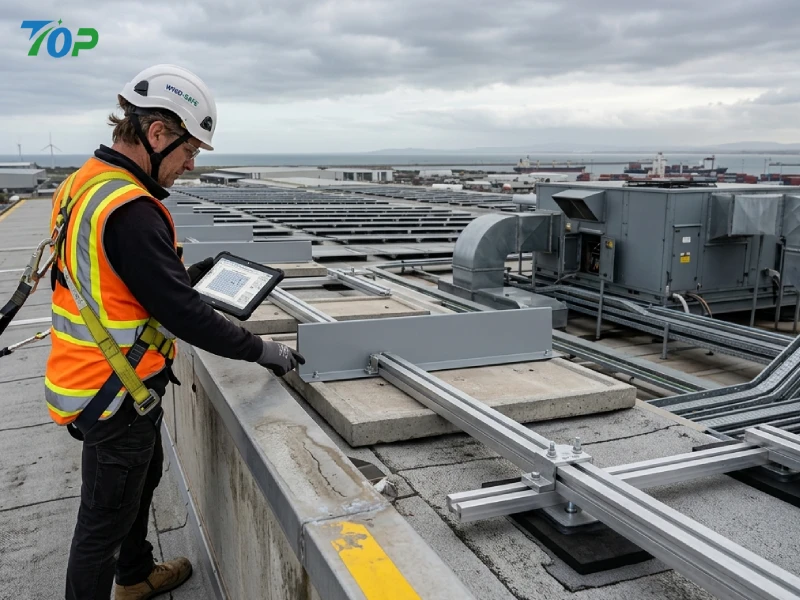
Before selecting any ballast solar racking system, the rooftop structural capacity must be evaluated carefully.
Unlike penetrating systems that transfer loads directly into structural anchor points, ballast systems distribute weight across the roof surface. This creates different loading characteristics that require detailed analysis.
Typical rooftop load considerations include:
- Dead load from the mounting structure
- Solar module weight
- Concrete ballast block weight
- Temporary maintenance load
- Wind-induced dynamic load
- Rainwater accumulation impact
In retrofit projects, structural documentation is sometimes incomplete or outdated. Older industrial buildings may have undergone renovations that changed original load conditions.
Because of this, EPC teams often conduct:
- On-site structural inspections
- Core sampling
- Steel thickness verification
- Concrete strength testing
- Roof deflection evaluation
One common mistake in low-budget projects is treating rooftop load calculations as a rough estimate instead of a real engineering task. This can become dangerous in large-scale installations where hundreds of tons of ballast are distributed across the roof.
Wind Load and Uplift Analysis
Wind uplift is one of the most critical engineering challenges for non-penetrating rooftop solar systems.
A solar array essentially behaves like a large aerodynamic surface exposed to external pressure. When wind moves across rooftop modules, uplift forces can become surprisingly high, especially near roof edges and corners.
This is why modern flat roof solar ballast mounting system design focuses heavily on aerodynamic optimization.
Professional wind load analysis generally considers:
- Regional wind speed data
- Building height
- Terrain exposure category
- Roof edge zones
- Parapet wall height
- Module tilt angle
- Array spacing
In high-wind regions, ballast requirements may increase dramatically if aerodynamic performance is poor.
For example, a poorly optimized 15° tilt structure can require significantly more ballast than a low-profile aerodynamic design with integrated wind deflectors.
This directly affects:
- Roof load pressure
- Transportation cost
- Installation labor
- Project economics
Modern engineering-grade systems attempt to reduce ballast demand through airflow management rather than simply adding more weight.
Why Roof Edge Zones Require Extra Attention
Not all rooftop areas experience the same wind pressure.
Roof corners and perimeter zones are exposed to stronger uplift forces because airflow accelerates around building edges. These areas often require:
- Additional ballast
- Lower tilt angles
- Reinforced deflectors
- Reduced row spacing
Ignoring edge zone reinforcement is one of the more common design errors seen in inexperienced rooftop PV projects.
In typhoon-prone coastal regions, edge-zone failures can create cascading structural damage across the array.
Ballast Optimization Strategy
Many people assume ballast systems simply “add concrete blocks until the structure is stable.” In reality, professional ballast optimization is far more sophisticated.
Excessive ballast creates several problems:
- Higher roof load
- Increased logistics cost
- Longer installation time
- More difficult rooftop handling
- Higher structural reinforcement expense
A well-designed ballast solar mounting system aims to achieve stability with the minimum necessary ballast weight.
This is usually accomplished through:
- Aerodynamic rear deflectors
- Lower module tilt angles
- Improved airflow control
- Optimized row spacing
- Better structural geometry
In recent years, East-West low tilt systems have become increasingly popular because they often reduce ballast requirements while improving rooftop space utilization.
Drainage and Water Flow Planning
Drainage planning is sometimes underestimated during rooftop solar design.
A poorly positioned mounting structure can obstruct water flow and create ponding areas on flat roofs.
Over time, standing water may accelerate:
- Membrane aging
- Roof leakage
- Corrosion
- Structural deterioration
Professional rooftop PV layouts therefore maintain proper drainage pathways between mounting rows.
Important drainage considerations include:
- Roof slope direction
- Drain location
- Overflow pathways
- Maintenance access routes
- Debris accumulation risk
In heavy rainfall regions, drainage spacing becomes even more important.
Some EPC contractors have learned this the hard way after discovering blocked drainage systems months after project completion.
Thermal Expansion and Long-Term Structural Stability
Commercial rooftop solar systems experience continuous thermal cycling throughout their service life.
Metal structures expand during daytime heat exposure and contract during cooler nighttime conditions. Over 20–25 years, this repetitive movement can create fatigue stress at connection points.
AL6005-T5 aluminum offers good structural stability, but proper expansion management is still essential.
Professional designs typically include:
- Expansion gaps
- Sliding rail connections
- Controlled fastening torque
- Flexible joint structures
If thermal movement is ignored, long-term problems may include:
- Fastener loosening
- Rail deformation
- Stress cracking
- Module clamp displacement
These issues usually develop gradually rather than immediately, which is why engineering experience matters so much in rooftop PV structure design.
Fire Safety and Cable Management
As commercial rooftop PV capacity continues increasing, fire safety standards are becoming stricter in many countries.
Modern ballast solar racking systems must account for:
- Fire access corridors
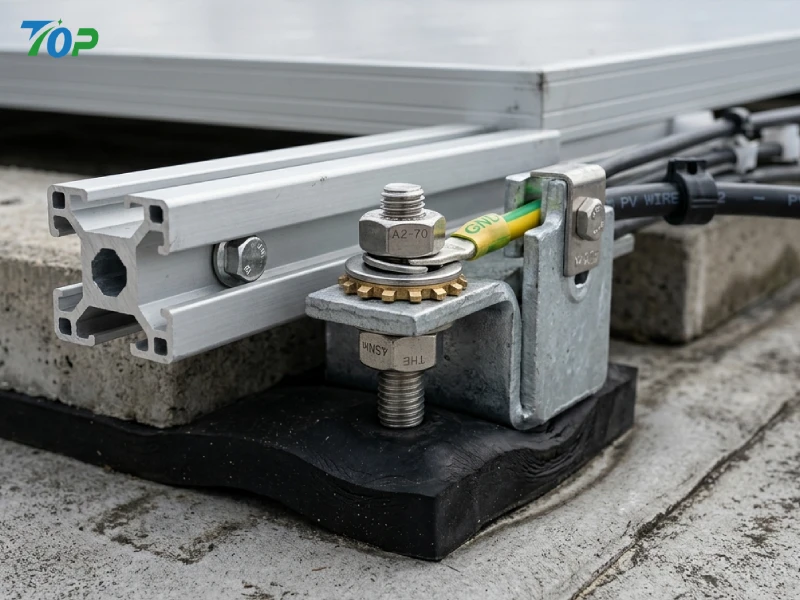
- Cable routing safety
- Grounding continuity
- Emergency maintenance access
Poor cable management remains surprisingly common in low-quality rooftop installations.
Loose cable routing may eventually cause:
- UV damage
- Insulation wear
- Water exposure
- Connector failure
Professional EPC installers generally integrate cable trays, UV-resistant clips, and elevated routing paths into the mounting system itself.
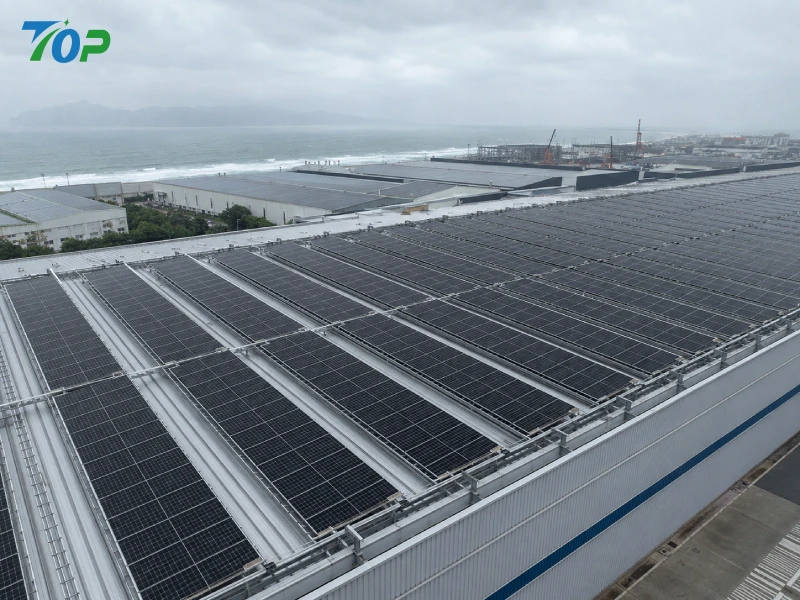
High-Wind and Coastal Rooftop Challenges: How Engineering-Grade Ballast Systems Reduce Risk
Not all rooftop solar environments are equally demanding.
Coastal regions and typhoon-prone markets place much higher stress on rooftop PV systems than inland low-wind areas. In these projects, the engineering quality of the mounting structure becomes especially important.
This is where major differences between low-cost mounting suppliers and engineering-focused manufacturers become very obvious.
Why Wind Resistance Is So Important in Rooftop Solar
Ground-mounted solar systems transfer loads directly into deep foundations. Rooftop systems operate differently.
On a flat roof, the solar array is fully exposed to external airflow while relying primarily on ballast weight and aerodynamic control for stability.
Under strong wind conditions, uplift pressure can increase rapidly.
Typhoon events create additional challenges because wind direction changes dynamically. This means rooftop arrays may experience:
- Negative pressure uplift
- Turbulent side loading
- Vibration fatigue
- Uneven pressure distribution
If the structural design lacks aerodynamic optimization, ballast requirements become excessively high.
Aerodynamic Wind Deflector Design
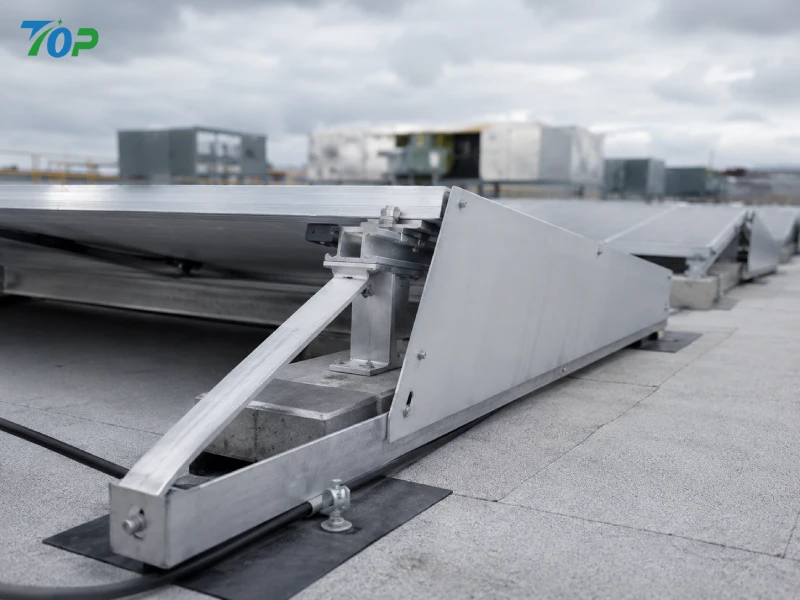
Modern non-penetrating rooftop solar mounting systems often use rear wind deflectors to improve airflow behavior.
The purpose of these deflectors is not merely cosmetic. Their function is to reduce turbulent airflow beneath the modules.
Without proper airflow control, wind can generate strong suction effects under the solar panels, increasing uplift forces dramatically.
Well-designed deflectors help:
- Reduce rear turbulence
- Lower uplift pressure
- Decrease ballast demand
- Improve structural stability
In some engineering studies, aerodynamic optimization reduced ballast requirements by more than 20%, although actual results vary by project condition.
Low Tilt Angle Design Trends
Many older rooftop PV systems used relatively steep tilt angles to maximize energy generation.
Today, commercial rooftop design priorities are changing.
For many industrial rooftops, EPC contractors now prefer:
- Lower tilt angles
- Higher module density
- Reduced wind exposure
- Lower ballast weight
This trend is especially visible in East-West rooftop solar layouts.
While low tilt systems may slightly reduce peak generation efficiency per module, they often improve total rooftop energy production by allowing higher installation density.
In commercial projects, total rooftop ROI is usually more important than theoretical module-level efficiency.
Corrosion Resistance in Coastal Environments
Coastal projects create another major challenge: corrosion.
Salt-laden air accelerates material degradation, particularly in metal fasteners and poorly protected steel components.
This is why high-quality rooftop PV systems commonly use:
- AL6005-T5 aluminum rails
- SUS304 stainless steel hardware
- Anodized surface treatment
- Corrosion-resistant coatings
Low-grade fasteners may initially appear acceptable during installation but deteriorate much faster under humid saline conditions.
Once corrosion develops around connection points, long-term structural reliability decreases quickly.
Real Engineering Measures Used in High-Wind Rooftop Projects
Experienced EPC contractors usually apply multiple engineering strategies simultaneously rather than relying on ballast weight alone.
Typical reinforcement approaches include:
- Enhanced perimeter ballast
- Additional wind deflectors
- Reduced module tilt angle
- Optimized row spacing
- Strengthened rail connections
- Improved structural bracing
In some coastal projects, engineers also divide rooftop arrays into separate aerodynamic zones to better manage pressure distribution.
This type of project-specific engineering optimization is becoming increasingly important as commercial rooftop PV systems continue scaling larger.
East-West vs South-Facing Ballast Layout: Which Design Is Better?
Choosing the correct array layout has a major impact on rooftop performance, ballast demand, installation density, and project economics.
For commercial rooftops, the two most common approaches are:
- South-facing tilt systems
- East-West low tilt systems
Neither approach is universally superior. The best solution depends on project priorities and rooftop conditions.
South-Facing Layout Advantages
South-facing arrays traditionally dominated commercial rooftop PV projects because they maximize solar exposure during peak sunlight hours.
Advantages include:
- Higher peak generation output
- Strong winter production performance
- Familiar engineering design standards
- Simple electrical planning
However, south-facing systems generally require:
- Larger row spacing
- Higher tilt angles
- More ballast weight
- Greater wind exposure
These limitations become more noticeable on space-constrained commercial rooftops.
East-West Ballast Layout Advantages
East-West systems have become increasingly popular for large commercial and industrial rooftops.
This layout positions modules back-to-back at relatively low tilt angles.
The design offers several important advantages:
- Higher rooftop utilization
- Reduced inter-row shading
- Lower ballast requirements
- Improved aerodynamic behavior
- More balanced daily power output
Because row spacing can be reduced significantly, total installed rooftop capacity often increases.
For logistics centers and factory rooftops, this can improve overall project economics substantially.
Commercial Rooftop ROI Considerations
In utility-scale ground solar projects, maximizing individual module output is often the primary goal.
Commercial rooftops operate differently.
Most C&I rooftop projects are limited by available roof area rather than module availability.
Because of this, EPC contractors increasingly evaluate:
- Total rooftop generation
- Installation density
- Structural load efficiency
- Self-consumption matching
- Project payback period
East-West systems often perform well in these categories, especially for daytime industrial electricity consumption profiles.
Which Layout Is More Common Today?
Current market trends show growing adoption of East-West ballast solar mounting systems for large commercial rooftops.
This is especially true in:
- Warehouse rooftops
- Distribution centers
- Large manufacturing plants
- Flat logistics facilities
That said, south-facing systems still remain common where:
- Roof area is sufficient
- Maximum peak production is prioritized
- Snow shedding is important
- Local electricity pricing favors midday generation
Ultimately, professional rooftop PV design should evaluate both layouts during the engineering phase rather than applying a standard solution to every project.
Certifications and Material Standards That B2B Buyers Should Verify
In commercial rooftop PV projects, the mounting structure is expected to remain operational for more than 20 years under continuous outdoor exposure. Yet many procurement decisions are still made primarily on short-term price comparison.
Experienced EPC contractors know this approach can become expensive later.
Material quality, manufacturing consistency, and certification standards directly affect:
- Structural reliability
- Installation efficiency
- Long-term corrosion resistance
- Maintenance frequency
- Project warranty risk
For this reason, engineering-focused buyers usually evaluate much more than the basic quotation price.
Why Material Quality Directly Impacts Lifecycle Cost
A rooftop solar mounting system operates continuously under UV exposure, thermal cycling, rainwater, wind vibration, and environmental pollution.
Inferior materials may still pass short-term installation inspections while slowly deteriorating over time.
Common long-term issues caused by low-quality components include:
- Fastener corrosion
- Rail deformation
- Clamp cracking
- Connection loosening
- Galvanic corrosion
- Premature structural fatigue
Once rooftop corrosion begins, maintenance becomes much more complicated because rooftop access itself creates labor and safety costs.
This is why commercial rooftop projects increasingly prioritize lifecycle value instead of only initial procurement savings.
Advantages of AL6005-T5 Aluminum Alloy
AL6005-T5 aluminum alloy is widely used in engineering-grade ballast solar mounting systems because it offers a strong balance between structural performance and weight efficiency.
Compared with conventional carbon steel structures, aluminum provides several advantages for rooftop installations.
- Lower transportation weight
- Easier rooftop handling
- Strong corrosion resistance
- Good mechanical strength
- Long outdoor durability
For installers, lighter structural components also improve installation speed and reduce worker fatigue during rooftop deployment.
Another important advantage is corrosion behavior. Aluminum naturally forms an oxide protection layer, helping improve long-term outdoor stability in humid environments.
This becomes especially valuable in coastal industrial projects where corrosion exposure is significantly more aggressive.
Why SUS304 Stainless Steel Fasteners Matter
Fasteners are among the smallest components in a rooftop solar system, but they are also among the most important.
Low-grade bolts may initially look identical during installation, yet their long-term performance can differ dramatically.
SUS304 stainless steel hardware is commonly preferred because it provides:
- Excellent anti-rust performance
- High outdoor durability
- Stable mechanical strength
- Reduced maintenance risk
In commercial rooftop projects, connection reliability matters heavily because vibration, thermal expansion, and wind loading continuously stress fastening points.
If fasteners corrode or loosen over time, structural stability gradually decreases.
For coastal installations, some projects may even upgrade to higher corrosion-resistance materials depending on environmental exposure conditions.
Key Certifications for International Commercial Solar Projects
Global EPC contractors and distributors increasingly require internationally recognized certifications before approving mounting system suppliers.
These certifications help verify:
- Manufacturing quality control
- Material consistency
- Structural safety standards
- Testing compliance
- Traceability systems
Common certifications requested in international PV projects include:
- TUV certification
- ISO9001 quality management
- SGS material testing
- CE compliance
For many EPC companies, certification review is now a standard part of supplier qualification procedures.
In large commercial projects, documentation quality can influence procurement decisions almost as much as pricing.
Why Manufacturing Traceability Is Becoming More Important
As rooftop PV projects become larger and more technically demanding, buyers increasingly want production traceability.
This includes:
- Material batch records
- Extrusion quality control
- Surface treatment documentation
- Mechanical testing reports
- Fastener sourcing verification
Professional manufacturers typically maintain strict QC systems throughout production rather than relying only on final inspections.
This is especially important for distributors and EPC contractors managing multi-MW project pipelines across multiple countries.
Common Mistakes in Flat Roof Ballast Solar Projects
Commercial rooftop solar systems have improved significantly over the last decade, but installation mistakes still occur frequently, especially in aggressively low-cost projects.
Many of these problems are avoidable with proper engineering planning.
Ignoring Roof Load Limits
One of the most serious mistakes is underestimating rooftop load restrictions.
Because ballast systems rely on distributed weight, installers sometimes assume “the roof can probably handle it.”
This is not a professional engineering approach.
Overloading risks become more serious when:
- Buildings are older
- Structural drawings are incomplete
- Previous rooftop modifications exist
- Water ponding already occurs
In some retrofit projects, excessive ballast loading has required expensive structural reinforcement after installation planning was already completed.
Incorrect Wind Zone Calculations
Wind loading mistakes remain one of the most common causes of rooftop solar structural failure worldwide.
Problems often occur when installers:
- Use generic ballast calculations
- Ignore roof edge uplift zones
- Underestimate local wind exposure
- Fail to optimize aerodynamic design
In typhoon-prone regions, even relatively small design miscalculations can produce very large uplift force differences.
Professional rooftop PV engineering should always use project-specific wind analysis rather than copied assumptions from previous installations.
Blocking Rooftop Drainage Systems
Drainage obstruction is another surprisingly common issue.
Poorly planned mounting layouts may interfere with:
- Drain pathways
- Overflow systems
- Maintenance access routes
This can eventually create standing water accumulation around the structure.
Long-term ponding may accelerate:
- Roof membrane aging
- Leakage development
- Corrosion
- Structural deterioration
Professional EPC teams generally inspect rooftop drainage behavior before finalizing layout design.
Using Low-Quality Fasteners
Fastener quality problems usually do not appear immediately after installation.
Instead, failures develop gradually over several years through:
- Corrosion
- Thermal cycling
- Wind vibration
- Moisture exposure
Inferior hardware may initially reduce procurement cost slightly, but long-term maintenance expenses can quickly exceed those savings.
For engineering-grade rooftop PV systems, fastener quality should never be treated as a secondary issue.
Poor Cable Management Planning
Cable management quality strongly affects long-term rooftop reliability.
Poor routing may expose cables to:
- Standing water
- UV radiation
- Mechanical abrasion
- Sharp metal edges
- Animal interference
Professional installations usually integrate:
- Elevated cable routing
- UV-resistant clips
- Dedicated cable trays
- Clear maintenance access paths
Well-organized rooftop cable management also improves future inspection efficiency.
How EPC Contractors Can Reduce Project Costs with Optimized Ballast Mounting Design
Reducing project cost does not always mean purchasing the cheapest mounting system.
In commercial rooftop solar, engineering optimization often produces larger long-term savings than low initial procurement pricing.
Reducing Installation Time per MW
Installation speed directly affects EPC profitability.
A well-designed flat roof solar ballast mounting system can reduce:
- Roof preparation work
- Installation complexity
- Waterproof treatment procedures
- Labor requirements
Pre-assembled structural components also improve deployment efficiency, especially in large warehouse rooftop projects.
For multi-MW commercial installations, even modest installation efficiency improvements can create meaningful labor savings.
Lower Waterproofing Repair Costs
Roof leakage disputes are expensive not only financially but also operationally.
After-sales waterproof troubleshooting may involve:
- Additional site inspections
- Roof membrane repair
- Operational interruption
- Customer relationship damage
Non-penetrating ballast systems help reduce these long-term liabilities significantly.
Simplified Logistics and Container Loading
Modern rooftop PV projects increasingly focus on logistics efficiency.
Optimized structural design can reduce:
- Shipping volume
- Container waste space
- Material handling difficulty
- On-site sorting time
For global EPC contractors managing international shipments, logistics optimization directly affects overall project cost control.
Standardized Component Inventory
Distributors and EPC companies prefer systems with high component compatibility because standardized inventory reduces operational complexity.
Using universal clamps, rails, and structural accessories across multiple rooftop projects helps simplify:
- Warehouse management
- Spare parts stocking
- Installer training
- Future maintenance support
This is one reason why modular ballast mounting systems continue gaining popularity in large-scale commercial deployment.
How to Choose a Reliable Ballast Solar Mounting Manufacturer
Not all solar mounting suppliers operate at the same engineering level.
Some manufacturers mainly compete on price, while others focus on long-term structural reliability and EPC project support.
For commercial rooftop projects, the difference becomes very important.
Engineering Capability Evaluation
A professional mounting manufacturer should provide more than basic product drawings.
Engineering support capabilities may include:
- Wind load calculations
- Structural analysis reports
- Project-specific ballast optimization
- CAD layout drawings
- BIM compatibility
- Drainage planning recommendations
Strong engineering support often reduces project risk significantly during both design and installation phases.
Manufacturing Quality Assessment
Production consistency directly affects installation quality.
Poor extrusion precision or inaccurate hole positioning may create:
- Installation delays
- Alignment issues
- Fastener stress problems
- Field modification requirements
Professional manufacturers usually maintain:
- Strict extrusion tolerances
- Surface treatment inspection
- Fastener quality verification
- Material traceability systems
Supply Chain Reliability
Delivery reliability matters heavily in commercial rooftop solar.
Construction schedules are often tightly coordinated with:
- Module delivery
- Inverter installation
- Electrical subcontractors
- Roof access windows
Delayed mounting structure delivery can affect the entire EPC schedule.
Because of this, many international buyers now evaluate:
- Production capacity
- Lead time stability
- Export experience
- Packaging standards
- Container loading optimization
Why EPC Contractors Prefer One-Stop Suppliers
Managing separate engineering firms, manufacturers, and logistics providers increases communication complexity.
One-stop solar mounting suppliers help simplify:
- Technical communication
- Engineering revisions
- Procurement coordination
- Shipping management
- After-sales support
For fast-moving commercial rooftop projects, integrated support can improve execution efficiency substantially.
Why Global EPC Contractors Choose TopFence Solar Mounting Systems
As rooftop PV projects become larger and more technically demanding, EPC contractors increasingly prefer suppliers that combine engineering capability with stable manufacturing quality.
TopFence focuses on commercial and industrial photovoltaic mounting systems designed for real-world installation conditions rather than purely theoretical structural models.
Engineering-Oriented Product Development
Modern rooftop projects require more than standard mounting hardware.
TopFence ballast solar mounting systems are developed with emphasis on:
- Installation efficiency
- Wind resistance optimization
- Waterproof roof protection
- Structural stability
- Long-term outdoor durability
The company continuously optimizes aerodynamic performance to help reduce unnecessary ballast demand while maintaining project safety.
High-Quality Material Standards
TopFence systems commonly utilize:
- AL6005-T5 aluminum alloy
- SUS304 stainless steel fasteners
- Corrosion-resistant surface treatment
- Strict quality control procedures
These material standards help improve long-term reliability in demanding rooftop environments, including coastal industrial regions.
Customized Structural Engineering Support
Commercial rooftop projects rarely follow identical conditions.
TopFence provides project-oriented engineering assistance including:
- Ballast optimization analysis
- Wind load calculations
- CAD structural layouts
- Container loading planning
- Installation recommendations
This support helps EPC contractors improve project efficiency while reducing installation uncertainty.
Global Supply Capability for EPC and Distributors
For distributors and large EPC contractors, supply stability matters heavily.
TopFence supports:
- Bulk commercial orders
- OEM/ODM cooperation
- International project delivery
- Optimized packaging solutions
- Large-scale rooftop deployment support
As commercial rooftop solar continues expanding globally, engineering-focused mounting solutions are becoming increasingly important for long-term project success.
FAQ — Flat Roof Solar Ballast Mounting Systems
Q1. Can solar panels be installed on a flat roof without drilling?
Yes. A flat roof solar ballast mounting system allows photovoltaic modules to be installed without penetrating the roof membrane. The structure uses ballast weight and aerodynamic stability instead of anchor bolts.
Q2. How much ballast weight is typically required?
Ballast requirements vary depending on wind speed, building height, roof exposure, tilt angle, and local engineering standards. Professional structural calculations are required for each project because rooftop conditions differ significantly.
Q3. Are ballast mounting systems safe in typhoon regions?
Engineering-grade ballast systems can perform safely in high-wind regions when designed correctly. Wind tunnel optimization, aerodynamic deflectors, edge-zone reinforcement, and proper ballast calculations are essential in typhoon-prone areas.
Q4. Will ballast systems damage roof membranes?
Properly designed systems use protective EPDM rubber pads to reduce direct pressure and friction damage. Compared with penetrating systems, ballast structures generally provide much lower waterproofing risk.
Which roof types are suitable for ballast solar mounting systems?
Ballast systems are commonly used on:
- Concrete flat roofs
- TPO membrane roofs
- PVC roofs
- EPDM roofs
- Bitumen flat roofs
However, structural load evaluation is always required before installation.
Why are East-West layouts becoming more popular?
East-West layouts improve rooftop utilization, reduce row spacing, and often lower ballast demand. For many commercial rooftops, they provide better total energy density and improved project ROI.
Conclusion
The commercial rooftop solar industry is evolving rapidly, and mounting system expectations are changing along with it.
Today, a flat roof solar ballast mounting system is no longer viewed simply as a “no-drill alternative.” It has become a comprehensive engineering solution focused on:
- Waterproof roof protection
- Installation efficiency
- Wind resistance optimization
- Long-term structural reliability
- Lifecycle cost reduction
For EPC contractors, choosing the right ballast solar racking system can significantly reduce project risk while improving construction efficiency and customer satisfaction.
For distributors and commercial building owners, engineering-grade mounting systems provide stronger long-term operational stability and lower maintenance exposure over the full PV project lifecycle.
As rooftop solar deployment continues expanding across factories, warehouses, logistics centers, and industrial facilities worldwide, professionally engineered non-penetrating mounting systems will play an increasingly important role in commercial photovoltaic infrastructure.
Need an Engineering-Grade Ballast Solar Mounting Solution for Your Next Rooftop PV Project?
TopFence provides customized non-penetrating rooftop solar mounting solutions for global EPC contractors, distributors, and commercial PV developers.
Support services include:
- Project-specific ballast optimization
- Wind load calculation support
- CAD layout drawings
- OEM/ODM manufacturing
- Container loading optimization
- Global logistics coordination
- Technical engineering consultation
Whether you are planning a warehouse rooftop installation, industrial factory solar project, or large-scale commercial PV deployment, choosing a reliable engineering partner can make a substantial difference in long-term project performance.
Reduce Rooftop Waterproof Risks with Engineering-Grade Ballast Solar Mounting Systems
Planning a commercial rooftop PV project with strict waterproofing and wind-load requirements? Conventional penetrating structures may increase long-term roof leakage risks, maintenance costs, and installation complexity for EPC contractors and distributors. TOPFENCE provides engineered flat roof solar ballast mounting systems designed for commercial and industrial rooftops, featuring non-penetrating installation, aerodynamic wind deflectors, AL6005-T5 anodized aluminum rails, SUS304 stainless steel fasteners, and optimized East-West low tilt configurations. Improve installation efficiency, reduce ballast weight, enhance rooftop waterproof protection, and deliver more reliable long-term ROI for large-scale rooftop photovoltaic projects.
Request Ballast Mounting Design, Wind Load Analysis & EPC PricingRelated News
- The Global EPC Sourcing Checklist: Managing Lead Times and Logistics for Solar Mounting Systems
- BIPV & Commercial Rooftops: Solving Waterproofing and Structural Integrity Challenges in Urban Solar
- Navigating Solar Certifications: Why UL 2703 and International Standards Matter for Project Bankability
- Maximizing Yield with Bifacial Modules: How to Select the Optimal Tracker for Enhanced Energy Output
- Wind Load and Coastal Engineering: Ensuring Your Ground-Mounted Solar Array Survives Extreme Weather
- Aluminum vs. Galvanized Steel: Choosing the Right Solar Mounting Structure for High-Corrosivity Environments
Leave me a message