How to Choose the Right Solar Roof Hook Based on Tile Type: An Engineering-Driven Guide for Solar Installers, EPC Contractors, and Procurement Teams
Why Solar Roof Hook Selection Is a Critical Engineering Decision
Selecting the correct solar roof hook for a tile roof solar mounting system is not a minor hardware decision—it directly determines structural stability, waterproof integrity, installation efficiency, and long-term asset reliability. In commercial and industrial rooftop projects, a poorly matched roof hook for tile roof solar mounting can lead to cracked tiles, water ingress, uplift failure under wind loads, and costly rework that affects project timelines and warranty exposure.
Unlike metal roofs or flat concrete roofs, tile roofs vary significantly in geometry, thickness, brittleness, load transfer behavior, and installation constraints. A universal hook approach is technically flawed. The correct method requires matching hook geometry, height adjustability, base plate design, and material grade to the specific tile type and rafter structure beneath it.
This technical guide provides a structured framework for choosing the right solar roof hook based on tile type. It integrates roofing mechanics, structural load considerations, material performance, and practical installation realities. The objective is to support engineering teams, procurement managers, and solar mounting system integrators in making data-driven decisions that reduce risk and improve project profitability.
1. Why Solar Roof Hook Selection Is a Structural Decision, Not Just a Component Choice
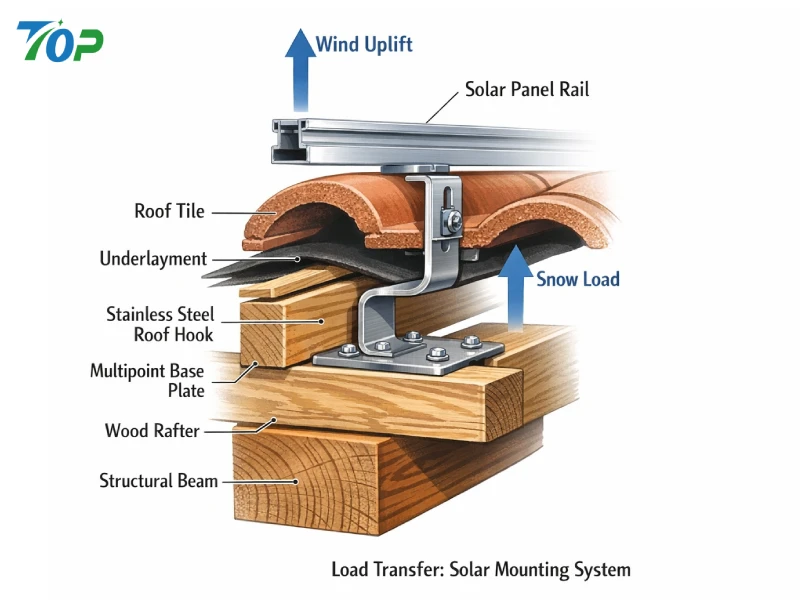
In a tile roof solar installation, the roof hook serves as the primary structural interface between the photovoltaic mounting rail and the building’s load-bearing rafters. The load path is as follows:
- Solar module → mounting rail → roof hook → structural rafter → building structure
The tile itself is not a structural load-bearing element. Most clay, concrete, and slate tiles are designed primarily for weatherproofing, not for concentrated mechanical loads. When a solar mounting for tile roof system is installed, the hook must transfer loads directly into rafters while avoiding excessive stress on the surrounding tiles.
From an engineering perspective, the hook must withstand:
- Dead load (modules + rails + mounting hardware)
- Wind uplift and suction loads
- Snow loads (where applicable)
- Thermal expansion stresses
- Dynamic fatigue over 25+ years
International structural standards such as ASCE 7 (American Society of Civil Engineers, 2022) emphasize that rooftop solar systems must be evaluated for wind loads considering building height, exposure category, and local wind speed. Roof hooks must therefore be selected with sufficient load-bearing capacity and tested performance data.
Ignoring these structural realities increases the risk of:
- Tile cracking due to point load concentration
- Hook deformation under uplift
- Fastener pull-out from undersized rafters
- Water intrusion due to improper tile clearance
Therefore, selecting a stainless steel roof hook is not simply about corrosion resistance—it is about ensuring structural compatibility with the roof system.
2. Understanding Common Tile Roof Types Used in Solar Projects
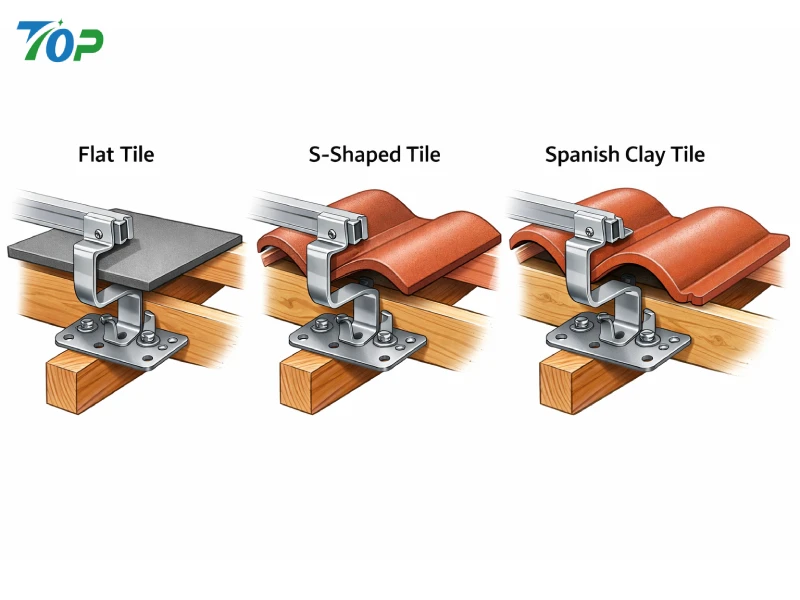
Different tile geometries require fundamentally different solar roof hook configurations. Below is a technical breakdown of common tile roof types encountered in residential, commercial, and light industrial solar projects.
2.1 Flat Concrete Tile Roof
Flat concrete tiles are widely used in Europe, Australia, and parts of Asia. They typically range from 10–15 mm in thickness and have overlapping interlock profiles.
Structural Characteristics:
- Relatively high compressive strength
- Moderate brittleness
- Uniform flat surface profile
- Fixed vertical tile spacing
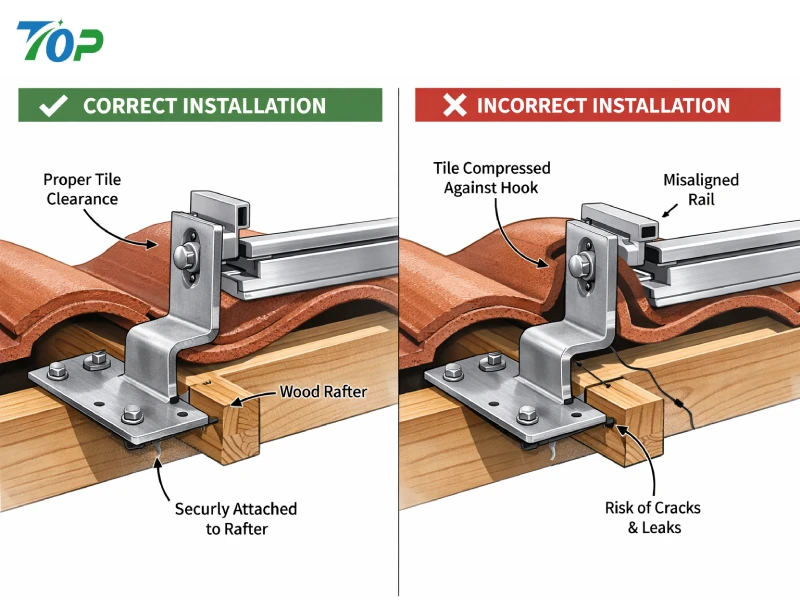
In solar mounting for flat tile roof applications, the main design challenge is ensuring sufficient clearance between the hook arm and the underside of the tile. If the hook height is insufficient, the tile will rest directly on the hook, creating concentrated stress points.
Recommended considerations:
- Adjustable-height roof hook
- Wide base plate for rafter anchoring
- Minimum 3–5 mm tile clearance
2.2 Spanish / Roman Curved Tile Roof
Spanish or Roman tiles have a wave-like profile with alternating convex and concave curves. These tiles are common in Mediterranean climates and high-end residential buildings.
Engineering Challenges:
- Non-flat surface contact
- Variable tile height
- Limited installation space between curves
- Higher breakage risk during lifting
For solar mounting for Spanish tile roof, a standard flat hook is often unsuitable. The hook must have:
- Extended vertical adjustment range
- Narrow upper arm to fit under curved tile
- Optimized lateral offset to align with rafter
Failure to match curvature geometry often leads to improper seating and water pathway exposure.
2.3 Slate Tile Roof
Slate is a natural stone roofing material known for durability and aesthetics but is extremely brittle under point loading.
Key Considerations:
- Low tolerance for drilling stress
- Thin tile thickness
- High replacement cost
In solar mounting for slate roof installations, ultra-thin hooks or specialized flashing systems are often required. Improper lifting of slate tiles can cause invisible micro-fractures that later propagate under thermal cycling.
Because slate has minimal flexural strength, base plate alignment must be precise to avoid torque transfer to the tile surface.
2.4 Clay Tile Roof
Clay tiles are lightweight but highly brittle. They exhibit good weather resistance but limited structural resilience to concentrated load.
Common risks in tile roof solar mounting systems using clay tiles include:
- Cracking due to overtightening
- Water ingress if tiles are not properly reseated
- Uneven tile spacing affecting hook placement
An adjustable roof hook for tile roof with reinforced lower arm and precise tile clearance is essential.
2.5 Asphalt Shingle Roof (Comparative Reference)
Although not a tile system, asphalt shingles are often compared with tile roofs. In shingle applications, L-feet with flashing are typically used instead of traditional tile hooks.
This distinction is critical. Attempting to use tile roof hooks on shingle systems—or vice versa—compromises waterproofing integrity and violates standard installation practices (International Code Council, 2021).
3. Core Engineering Criteria for Selecting the Correct Solar Roof Hook
When choosing a solar roof hook manufacturer or evaluating hook models, procurement and engineering teams should assess the following five technical dimensions.
3.1 Hook Height and Adjustable Range
Tile thickness and overlap height vary across manufacturers and regions. A non-adjustable hook risks insufficient clearance or excessive gap that compromises load transfer.
Best practice:
- Vertical adjustability ≥ 30–50 mm
- Clearance gap to prevent direct tile compression
- Compatibility with common rail systems
Adjustability improves field flexibility and reduces the need for multiple SKU inventories.
3.2 Base Plate Design and Load Distribution
The base plate anchors the hook to the rafter. A narrow or thin base increases fastener stress concentration and reduces pull-out resistance.
According to structural fastener research (American Wood Council, 2018), withdrawal capacity depends on embedment depth and wood density. Therefore:
- Base plate thickness ≥ 4–5 mm stainless steel
- Minimum two structural fasteners
- Edge distance compliance
3.3 Material Grade and Corrosion Resistance
Most premium stainless steel roof hooks use SUS304 or SUS316.
- SUS304: Suitable for inland environments
- SUS316: Recommended for coastal or high-salinity regions
Corrosion reduces cross-sectional strength over time. For 25-year design life systems, material selection must match environmental exposure category (ISO 9223).
3.4 Waterproof Integration
Tile lifting creates temporary exposure of the underlayment. Improper reseating or missing flashing increases leakage risk.
Best practice:
- EPDM sealing pads
- Compatible flashing where required
- Tile trimming instead of excessive force
3.5 Compatibility with Rafter Layout
Hook placement is constrained by rafter spacing, typically 400–600 mm. If hook geometry does not allow lateral offset, installation becomes inefficient and structurally compromised.
Advanced solar roof hook designs incorporate lateral adjustability to align with structural members without stressing tiles.
4. Risk Analysis: Consequences of Incorrect Roof Hook Selection
Improper tile roof solar mounting component selection increases:
- Installation time by 15–30%
- Material waste due to broken tiles
- Warranty exposure for leakage claims
- Structural liability under wind uplift events
Wind-induced failures have been documented in rooftop solar systems where inadequate attachment methods were used (Kopp et al., 2012). While modules often receive primary attention, attachment hardware frequently determines system survivability.
For procurement teams, the total installed cost must include risk mitigation—not just hardware unit price.
5. Strategic Procurement Considerations for Commercial Projects
For multi-site commercial projects, standardizing a solar mounting for tile roof solution improves:
- Inventory control
- Installation training efficiency
- Quality assurance consistency
- Long-term maintenance predictability
However, standardization must not override engineering compatibility. The correct approach is to select a manufacturer capable of:
- Providing structural test reports
- Offering adjustable hook designs
- Supporting customization for unique tile geometries
- Delivering batch consistency for large orders
In high-volume procurement environments, selecting the right solar roof hook manufacturer becomes a strategic partnership decision rather than a transactional purchase.
6. Solar Roof Hook Selection Matrix by Tile Type
For engineering teams managing multiple tile roof solar mounting projects across regions, a structured comparison tool significantly improves decision-making efficiency. Instead of selecting a solar roof hook based solely on appearance or price, the selection must consider geometry compatibility, load transfer behavior, environmental exposure, and installation tolerance.
The matrix below provides a practical reference framework for matching hook types to roof tile categories. Final engineering validation should always consider site-specific structural calculations in accordance with local building codes.
| Tile Type | Recommended Hook Configuration | Adjustability Requirement | Material Grade | Installation Risk Level | Engineering Notes |
|---|---|---|---|---|---|
| Flat Concrete Tile | Standard adjustable flat hook | 30–50 mm vertical adjustment | SUS304 (inland) / SUS316 (coastal) | Medium | Ensure tile clearance ≥3 mm to prevent compression stress |
| Spanish / Roman Curved Tile | Narrow-arm extended adjustable hook | 50 mm+ vertical range | SUS304 / SUS316 | High | Requires curvature-compatible upper arm and lateral offset |
| Slate Tile | Ultra-thin hook or flashing-integrated system | Minimal height, precise alignment | SUS316 preferred | Very High | Avoid point load on slate; consider flashing integration |
| Clay Tile | Reinforced lower-arm adjustable hook | 30–40 mm | SUS304 / SUS316 | High | Prevent overtightening; maintain uniform tile reseating |
This selection matrix demonstrates that there is no universal roof hook for tile roof applications. Each configuration must correspond to tile geometry and structural behavior.
7. Detailed Engineering Considerations by Tile Category
7.1 Flat Concrete Tile Roof: Structural Stability with Controlled Clearance
Flat tile systems are relatively installer-friendly compared to curved or slate roofs. However, improper hook height selection can still generate tile compression or uplift instability.
Key engineering focus areas:
- Hook arm thickness sufficient to resist bending under wind uplift
- Base plate width compatible with standard rafter spacing (400–600 mm)
- Minimum two structural lag screws per hook
- Compliance with ASCE 7 wind load calculation requirements
In high-wind zones, uplift forces can exceed 2.0 kPa depending on roof zone classification (ASCE, 2022). Therefore, verifying allowable pull-out resistance of fasteners is essential when selecting a solar mounting for flat tile roof.
7.2 Spanish / Roman Tile Roof: Managing Curvature and Load Transfer
Curved tile systems introduce asymmetric load paths. The hook must bridge between concave and convex tile surfaces without creating stress concentration.
Critical design parameters:
- Upper arm curvature tolerance
- Lateral adjustability for rafter alignment
- Extended vertical height to clear peak tile ridges
- Structural testing under eccentric loading conditions
Because curved tiles often have higher breakage rates during installation, selecting an adjustable solar roof hook reduces rework costs and shortens installation cycles.
7.3 Slate Tile Roof: Precision Engineering and Risk Mitigation
Slate roof installations demand the highest engineering discipline. Unlike clay or concrete, slate cannot tolerate impact or concentrated torque.
For solar mounting for slate roof systems, consider:
- Low-profile hook geometry
- Pre-drilling strategy with waterproof membrane protection
- Integration with metal flashing where permitted
- Use of corrosion-resistant SUS316 to ensure long-term durability
Installation errors in slate roofs frequently result in latent failures—micro-cracks that propagate due to freeze-thaw cycles (International Code Council, 2021).
7.4 Clay Tile Roof: Controlling Brittleness and Torque
Clay tiles exhibit low tensile strength and limited bending tolerance. Over-tightening fasteners is one of the most common causes of breakage.
Best practices:
- Torque-controlled fastening tools
- Uniform tile trimming for hook clearance
- Stress-distributing base plate design
- Visual inspection after tile reseating
Selecting a reinforced stainless steel roof hook improves structural reliability in clay roof systems.
8. Common Installation Mistakes That Increase Project Risk
Across commercial tile roof solar mounting projects, the following recurring mistakes contribute to cost overruns and long-term liability:
8.1 Using a Universal Hook for All Tile Types
Attempting to standardize using a single hook model often leads to misalignment and tile damage. Geometry-specific solutions are required.
8.2 Ignoring Wind Load Zone Variation
Roof corners and edges experience higher uplift forces. Hook spacing must reflect zone classification under structural codes.
8.3 Insufficient Tile Clearance
Direct tile-to-hook contact transfers load into brittle roofing materials, increasing fracture risk.
8.4 Inadequate Fastener Embedment Depth
Fastener pull-out capacity depends on embedment depth and wood density (American Wood Council, 2018). Underestimating these parameters reduces system safety margins.
8.5 Failure to Account for Thermal Expansion
Stainless steel and aluminum mounting rails expand at different rates. Improper design may introduce long-term stress into hook connections.
9. Installation Efficiency and Labor Cost Optimization
Selecting the correct solar roof hook manufacturer can significantly influence installation efficiency.
Features that improve field productivity:
- Pre-assembled adjustable components
- Clear structural load documentation
- Batch consistency for large procurement orders
- Compatible rail interface design
Studies in construction productivity show that installation simplification reduces labor time by 10–25% in repetitive systems (Gould & Joyce, 2014). In large rooftop solar portfolios, such savings materially impact project margins.
10. Engineering Load Verification and Documentation
For commercial solar developers and EPC contractors, documentation is essential. A reliable solar roof hook supplier should provide:
- Mechanical load testing reports
- Material certificates (SUS304 / SUS316)
- Finite element analysis data (if available)
- Corrosion resistance classification
- Quality control traceability records
Wind load testing research (Kopp et al., 2012) demonstrates that attachment integrity is often the limiting factor in rooftop system performance. Therefore, hook selection must be validated by mechanical evidence rather than assumptions.
11. Cost-Benefit Analysis: Beyond Unit Price
Procurement decisions should consider lifecycle value rather than initial unit cost. A lower-priced roof hook for tile roof that lacks adjustability or structural certification may result in:
- Higher tile replacement costs
- Extended installation duration
- Insurance disputes after weather events
- Reduced long-term reliability
A total cost approach includes:
- Material cost
- Labor cost
- Risk mitigation cost
- Warranty exposure
- Maintenance predictability
When evaluated holistically, engineered adjustable solar roof hook systems often produce better return on investment across large commercial portfolios.
12. How to Select the Right Solar Roof Hook Manufacturer for Large-Scale Projects
In commercial and portfolio-based rooftop solar development, selecting a solar roof hook manufacturer is a strategic engineering and risk management decision. The manufacturer’s design capability, production control, and documentation transparency directly influence installation efficiency, structural reliability, and long-term asset performance.
Beyond evaluating price and delivery time, procurement and engineering teams should assess the following dimensions when sourcing solar roof hook systems for tile roof solar mounting projects.
12.1 Engineering Capability and Structural Validation
A qualified manufacturer should provide mechanical validation data that demonstrates load-bearing capacity under simulated wind uplift and downward pressure conditions.
Key documents to request:
- Static load test reports
- Material tensile strength certification
- Finite element analysis (FEA) documentation
- Fastener compatibility validation
- Corrosion resistance classification under ISO 9223
Attachment systems are often the weakest link in rooftop solar installations. Wind engineering research confirms that rooftop-mounted systems must be evaluated as integrated structural assemblies rather than isolated components (Kopp et al., 2012). A supplier that cannot provide documented test evidence introduces avoidable project risk.
12.2 Material Quality and Traceability
Most high-performance stainless steel roof hooks are manufactured from SUS304 or SUS316 stainless steel. However, material grade alone is insufficient; traceability and consistency are equally important.
For portfolio-scale procurement, quality control systems should include:
- Batch-level material certification
- Dimensional tolerance inspection
- Surface finish consistency checks
- Weld integrity inspection (if applicable)
Corrosion reduces effective cross-sectional area and structural strength over time. For coastal or high-humidity regions, SUS316 is typically recommended to maintain 25-year design durability.
12.3 Adjustability and SKU Optimization
Manufacturers offering modular adjustable hook designs reduce inventory complexity. Instead of stocking multiple fixed-height models, adjustable roof hook for tile roof systems can cover flat, clay, and moderate curvature tiles.
This flexibility improves:
- Warehouse efficiency
- Installation adaptability
- Reduced field modifications
- Faster procurement cycles
From a lifecycle cost perspective, adaptable hook systems frequently deliver higher long-term value compared to low-cost fixed-geometry alternatives.
12.4 Production Capacity and Supply Stability
Large commercial solar portfolios require consistent delivery schedules. Supply disruption in mounting hardware can delay installation crews and affect commissioning timelines.
A reliable solar mounting for tile roof supplier should demonstrate:
- Scalable production lines
- Lead time transparency
- Export logistics capability
- Consistent dimensional repeatability
Consistency is particularly important because dimensional variation in hook height or base plate alignment can cause rail misalignment across long roof spans.
13. Engineering Collaboration Model for Commercial Installations
For commercial and multi-building rooftop portfolios, collaboration between the installer and the solar roof hook manufacturer should occur before finalizing bill of materials.
An optimized workflow typically includes:
- Roof structure documentation review
- Tile type identification and thickness measurement
- Wind and snow load calculation per local code
- Hook spacing layout planning
- Structural fastener specification
- Prototype validation (if required)
Integrating these steps during pre-construction reduces change orders and field adjustments. According to ASCE 7 (2022), rooftop systems must account for zone-specific wind uplift pressures. Engineering input at the attachment stage ensures compliance and improves structural resilience.
14. Long-Term Performance Considerations for Tile Roof Solar Mounting
When evaluating solar roof hook systems, long-term reliability is as important as initial installation performance.
14.1 Thermal Expansion and Fatigue
Solar mounting rails are typically aluminum, while hooks are stainless steel. Differential expansion between materials introduces cyclic stress at connection points. Over a 25-year service life, fatigue resistance becomes relevant.
14.2 Corrosion Environment Classification
ISO 9223 categorizes atmospheric corrosivity levels. Coastal environments (C4–C5 categories) require higher corrosion-resistant materials. In such cases, SUS316 is recommended to prevent pitting corrosion.
14.3 Maintenance Accessibility
Hooks should allow inspection access without full module removal. Efficient maintenance design improves long-term operational stability.
15. Frequently Asked Questions About Solar Roof Hooks
15.1 Can one solar roof hook fit all tile types?
No. Tile geometry varies significantly. Adjustable designs can cover multiple tile categories, but slate and highly curved Spanish tiles often require specialized configurations.
15.2 How do I measure tile height before selecting a hook?
Measure total tile thickness and overlap height. Ensure selected hook height provides adequate clearance without compressing the tile surface.
15.3 What material is best for coastal tile roof solar mounting?
SUS316 stainless steel is recommended for high-salinity or marine environments due to improved corrosion resistance.
15.4 How many roof hooks are required per kilowatt?
Hook quantity depends on wind zone classification, module size, and rail span. Structural calculations must follow ASCE 7 load criteria.
15.5 Do solar roof hooks require flashing?
In some tile roof systems, flashing or waterproof membrane integration is recommended to enhance long-term leak prevention.
15.6 What causes tile cracking during installation?
Common causes include insufficient clearance, overtightening, improper lifting technique, and uneven load distribution.
15.7 How can installation time be reduced?
Using adjustable pre-assembled hooks and standardized rail interfaces significantly improves installation efficiency.
16. Strategic Conclusion: Engineering Precision Drives Project Profitability
Choosing the correct solar roof hook for a tile roof solar mounting system is a multidimensional engineering decision. Tile geometry, load transfer behavior, corrosion environment, and installation workflow must all be evaluated together.
For commercial-scale projects, the attachment system determines:
- Structural compliance
- Installation productivity
- Warranty exposure
- Lifecycle maintenance cost
- Portfolio-level reliability
A well-designed adjustable roof hook for tile roof applications reduces field uncertainty, improves load distribution, and enhances waterproof integrity. When supported by documented structural validation and production consistency, such systems provide long-term stability and measurable cost advantages.
Engineering precision at the attachment level translates directly into improved project margins and reduced operational risk. For installers, EPC contractors, and procurement teams managing tile roof solar portfolios, selecting the right solar roof hook manufacturer is not simply a sourcing decision—it is a structural strategy.
References
- American Society of Civil Engineers. (2022). Minimum design loads and associated criteria for buildings and other structures (ASCE/SEI 7-22). ASCE.
- American Wood Council. (2018). National design specification for wood construction (NDS). American Wood Council.
- International Organization for Standardization. (2012). ISO 9223: Corrosion of metals and alloys — Corrosivity of atmospheres — Classification. ISO.
- International Code Council. (2021). International residential code (IRC). ICC.
- Kopp, G. A., Farquhar, S., & Morrison, M. (2012). Wind loads on rooftop solar panels. Journal of Wind Engineering and Industrial Aerodynamics, 111, 100–111.
Get Professional Solar Roof Hook Selection Support
Choosing the right solar roof hook for your tile roof solar mounting system is critical for structural safety and long-term performance.
Our engineering team provides project-specific recommendations, load verification support, and customized roof hook solutions for flat, clay, Spanish, and slate tile roofs.
Related News
- The Global EPC Sourcing Checklist: Managing Lead Times and Logistics for Solar Mounting Systems
- BIPV & Commercial Rooftops: Solving Waterproofing and Structural Integrity Challenges in Urban Solar
- Navigating Solar Certifications: Why UL 2703 and International Standards Matter for Project Bankability
- Maximizing Yield with Bifacial Modules: How to Select the Optimal Tracker for Enhanced Energy Output
- Wind Load and Coastal Engineering: Ensuring Your Ground-Mounted Solar Array Survives Extreme Weather
- Aluminum vs. Galvanized Steel: Choosing the Right Solar Mounting Structure for High-Corrosivity Environments
Leave me a message