Solar Fence vs Traditional Fence: Which Delivers Better Long-Term Value for Solar Projects?
Why Solar Fence vs Traditional Fence Is Becoming a Key EPC Cost Decision in Utility-Scale PV Projects
In large-scale photovoltaic projects, perimeter infrastructure is usually treated as a basic necessity rather than a long-term engineering asset. But over the last several years, that thinking has started to change. Rising steel prices, increasing EPC labor costs, stricter site security requirements, and pressure to improve land-use efficiency are forcing developers to reevaluate how fencing systems contribute to overall project economics.
This is exactly why the discussion around solar fence vs traditional fence systems has become much more relevant in utility-scale and commercial PV projects. What used to be a simple “security barrier” procurement decision is now tied directly to lifecycle operational cost, maintenance frequency, infrastructure utilization, and even project ROI.
For many EPC contractors, the problem is not the initial fence quotation itself. The real problem often appears several years later:
- Corrosion-related replacement work
- Repeated maintenance visits
- Structural instability in coastal environments
- Concrete cracking around fence foundations
- Additional labor costs during expansion or retrofitting
- Land occupied by non-productive infrastructure
Traditional fencing still has its place in the solar industry. In temporary projects or highly cost-sensitive installations, chain-link or welded mesh systems remain common. However, in long-lifecycle PV projects expected to operate for 20–30 years, the lowest procurement cost does not always result in the lowest lifecycle cost.
That distinction matters more now than it did five years ago.
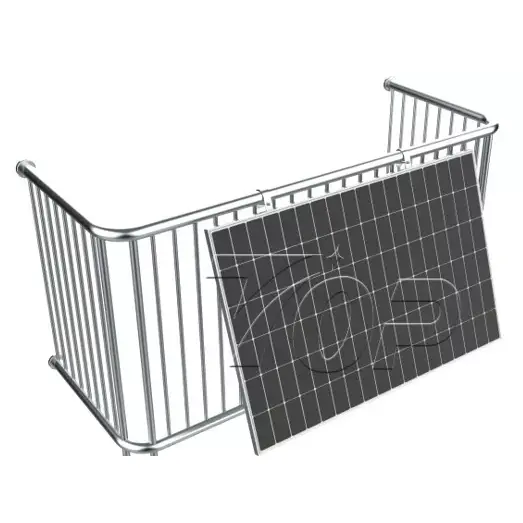
Modern solar fencing systems combine perimeter protection with photovoltaic power generation. Instead of occupying site boundaries as passive infrastructure, these systems transform unused perimeter space into productive energy-generating assets. For industrial parks, logistics facilities, utility-scale solar farms, and agricultural PV projects, this dual-purpose approach can improve infrastructure efficiency without requiring additional land.
Still, not every project benefits equally from solar fencing. The real engineering question is not simply whether solar fencing is “better.” The more important question is: "Which system delivers lower total cost of ownership over the actual operational lifecycle of the project?"
This article provides a practical engineering-level comparison between solar fence systems and traditional fencing solutions from a long-term cost perspective. Instead of focusing only on marketing claims or theoretical ROI calculations, we will analyze the factors EPC contractors and project owners actually care about:
- Initial CAPEX
- Installation complexity
- Labor efficiency
- Corrosion resistance
- Maintenance frequency
- Structural reliability
- Land utilization efficiency
- Long-term operational burden
- Lifecycle infrastructure value
For developers evaluating perimeter solutions for utility-scale or industrial solar projects, understanding these factors early can prevent expensive maintenance issues later.
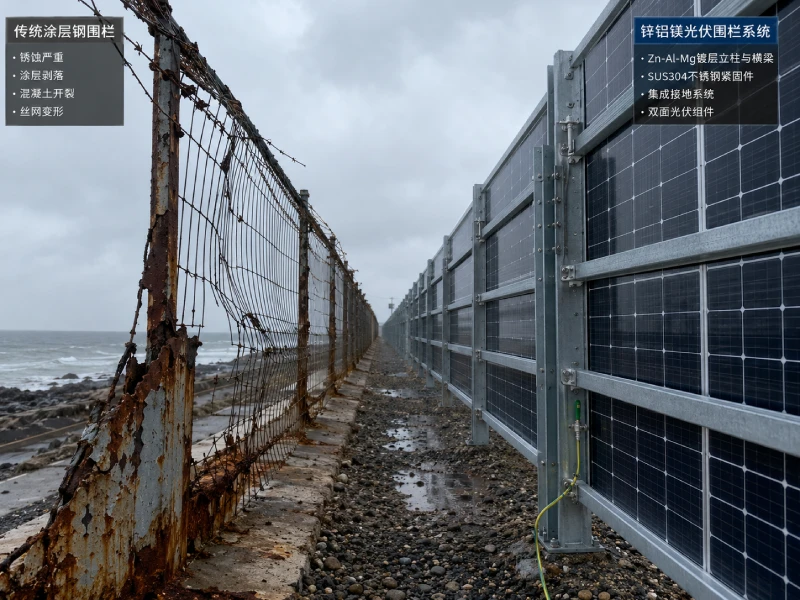
What Is a Solar Fence System?
A solar fence system is essentially a perimeter fencing structure integrated with photovoltaic modules and supporting electrical components. Unlike conventional perimeter barriers that only provide physical security, solar fencing combines security infrastructure with energy generation capability.
From an engineering perspective, solar fencing is not simply “putting solar panels on a fence.” Properly designed systems must simultaneously satisfy:
- Mechanical structural requirements
- Wind load resistance requirements
- Corrosion resistance requirements
- Electrical safety requirements
- Site security requirements
- Long-term outdoor durability requirements
This combination makes solar fencing structurally and operationally more complex than standard chain-link or welded mesh fencing. However, it also creates opportunities for better infrastructure utilization in long-lifecycle PV projects.
Main Components of a Solar Fence System
Most engineering-grade solar fencing systems contain both mechanical and electrical subsystems.
Mechanical Components
- Galvanized or Zn-Al-Mg coated steel posts
- Horizontal rails and reinforcement members
- PV mounting brackets
- Wind-resistant support structures
- Foundation systems
- Stainless steel fasteners
Electrical Components
- Photovoltaic modules
- DC cable routing systems
- Grounding components
- Junction boxes
- Inverters (depending on system architecture)
- Monitoring equipment
Compared with ordinary perimeter fencing, the additional electrical infrastructure increases both design complexity and installation coordination requirements. But at the same time, it allows the perimeter itself to become an active infrastructure asset.
Typical Applications for Solar Fencing
Solar fencing is not limited to utility-scale solar farms. In fact, adoption is growing fastest in projects where land efficiency and infrastructure optimization are becoming more important.
Utility-Scale Solar Farms
Large solar farms often require several kilometers of perimeter fencing. In these projects, fencing represents a significant infrastructure investment, especially when corrosion-resistant materials and reinforced foundations are required.
By integrating PV functionality into the fence itself, developers may improve land productivity without increasing site footprint.
Industrial and Commercial Facilities
Factories, logistics parks, and warehouses increasingly use solar fencing for:
- Perimeter security
- Supplementary electricity generation
- Sustainability initiatives
- Corporate ESG goals
In industrial parks where every square meter has operational value, dual-use infrastructure becomes much more attractive.
Agricultural and Infrastructure Projects
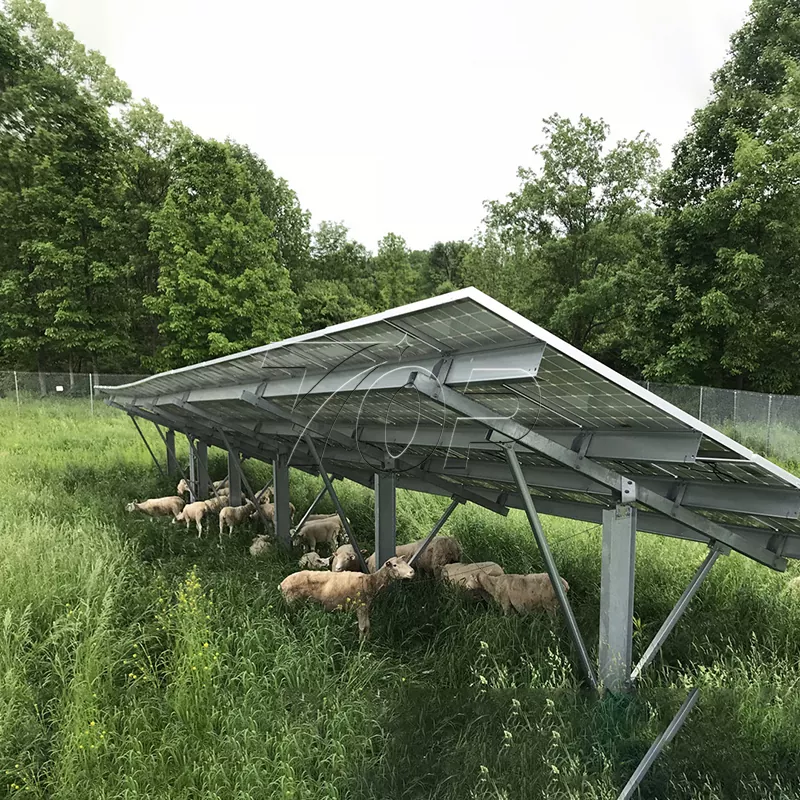
Agrivoltaic projects, highway infrastructure, railway systems, and remote industrial facilities are also suitable environments for solar fence deployment.
Particularly in remote locations where electrical infrastructure expansion is expensive, fence-integrated solar systems may help support:
- Lighting systems
- Security cameras
- Monitoring equipment
- Remote communication devices
How Solar Fence Systems Differ From Traditional Fencing
At first glance, the comparison between solar fence vs traditional fence systems may appear simple:
- One generates electricity
- One does not
But from an EPC engineering perspective, the differences are much broader than energy generation alone.
| Comparison Factor | Solar Fence | Traditional Fence |
|---|---|---|
| Security Function | Yes | Yes |
| Electricity Generation | Integrated PV capability | None |
| Land Utilization Efficiency | Higher | Low |
| Electrical Infrastructure | Required | Not required |
| Maintenance Scope | Mechanical + electrical | Mechanical only |
| Potential Lifecycle Value | Higher | Pure operational expense |
| Structural Complexity | Medium to high | Low |
Traditional fencing remains simpler from both procurement and installation perspectives. For short-duration projects, this simplicity can absolutely make sense.
However, the weakness of conventional fencing becomes more obvious over longer operational periods. A fence that requires repainting, corrosion repair, post replacement, or repeated maintenance visits every few years gradually becomes a recurring operational liability.
This is especially true in:
- Coastal regions
- Tropical climates
- Industrial pollution environments
- High-humidity agricultural areas
In these conditions, long-term durability matters far more than initial procurement cost alone.
Initial Investment Comparison: Understanding Where the Cost Difference Comes From
One of the biggest mistakes buyers make when comparing fencing systems is evaluating only the material quotation without understanding the actual cost structure behind each system.
This often leads to misleading procurement decisions.
Traditional Fence Cost Structure
Standard perimeter fencing systems typically include:
- Fence mesh or welded panels
- Steel posts
- Concrete foundations
- Surface coating treatment
- Mechanical fasteners
- Installation labor
The most commonly used systems in solar projects are:
- Chain-link fencing
- Welded mesh fencing
- Palisade fencing
For temporary or lower-security projects, chain-link fencing is often selected because of its relatively low upfront cost and simple installation process.
But low initial cost does not necessarily mean low lifecycle cost.
Lower-cost fencing systems frequently use:
- Thinner steel sections
- Lower coating thickness
- Standard carbon steel fasteners
- Reduced structural reinforcement
These choices may reduce procurement cost initially, but they also tend to increase corrosion risk and shorten structural lifespan.
Solar Fence Cost Structure
Solar fencing contains all the mechanical elements of conventional fencing while adding photovoltaic infrastructure.
Typical additional components include:
- Solar modules
- PV mounting rails
- Cable management systems
- Grounding systems
- Electrical protection components
- Monitoring equipment
- Inverters depending on design architecture
As a result, the initial CAPEX of solar fencing is naturally higher than ordinary perimeter fencing.
That part is true.
But many online comparisons stop there, which creates an incomplete picture.
The more important engineering question is whether the additional infrastructure cost creates measurable operational value over time.
Why Upfront Cost Alone Can Be Misleading
Traditional fencing immediately begins depreciating after installation.
It does not:
- Generate electricity
- Improve infrastructure productivity
- Offset operational cost
- Contribute to energy output
In contrast, solar fencing has the potential to provide operational return through:
- Electricity generation
- Boundary-space utilization
- Energy offset capability
- Reduced idle infrastructure
This distinction is one reason why more EPC firms are beginning to evaluate perimeter systems using total cost of ownership rather than procurement price alone.
In many utility-scale projects, the project itself may operate for 25 years or longer. Under these conditions, infrastructure durability and operational efficiency often matter more than small reductions in upfront procurement cost.
The EPC Perspective on Cost Evaluation
Professional EPC contractors rarely evaluate infrastructure purely from a purchasing department perspective.
Instead, they usually analyze:
- Installation labor requirements
- Construction efficiency
- Maintenance burden
- Corrosion resistance
- Structural reliability
- Long-term replacement frequency
- Operational disruption risk
This broader lifecycle approach is one reason the solar fence vs traditional fence discussion has become increasingly important in modern photovoltaic infrastructure planning.
Especially in regions with high labor costs, repeated maintenance visits over 20 years can easily exceed the original difference in procurement price.
And honestly, many project owners underestimate that effect during the initial budgeting stage.
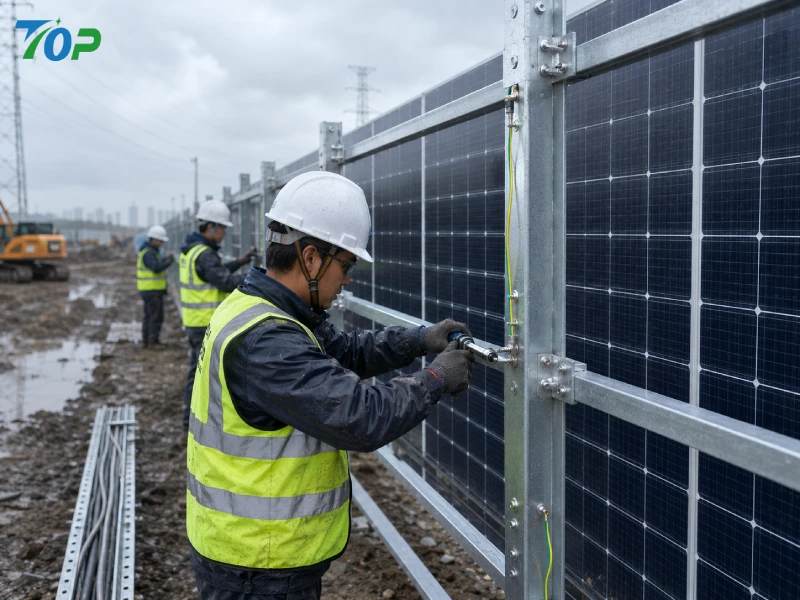
Installation Labor and Construction Complexity Comparison
For EPC contractors, installation cost is often far more important than many manufacturers realize.
A fencing system that looks inexpensive on paper can quickly become expensive if:
- Installation requires excessive field adjustment
- Concrete curing delays project schedules
- Alignment correction consumes additional labor hours
- Electrical routing becomes difficult after mechanical installation
- Structural tolerances are inconsistent between batches
In utility-scale solar projects, labor efficiency directly affects EPC profitability. Even small increases in installation time per meter can create significant cost differences when total perimeter length reaches several kilometers.
This is why professional contractors rarely evaluate fencing systems based only on material pricing.
The actual construction workflow matters just as much.
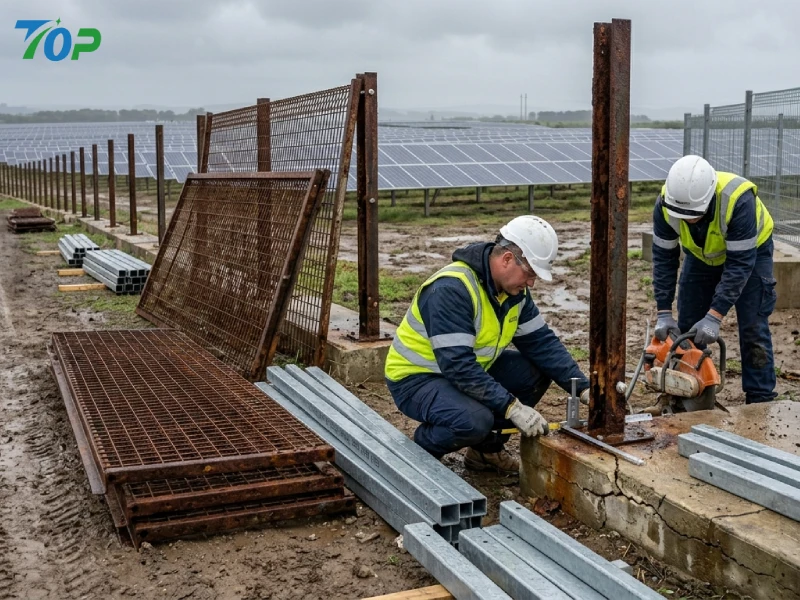
Traditional Fence Installation Workflow
Conventional fencing systems generally follow a relatively straightforward installation process.
Typical Construction Sequence
- Perimeter surveying and layout marking
- Excavation or drilling for fence posts
- Concrete pouring
- Post alignment and leveling
- Fence mesh or panel attachment
- Final tension adjustment
For short-term or lower-budget projects, this process is familiar and widely understood by local contractors.
However, traditional fencing also has several disadvantages that become more obvious in large-scale solar developments.
Common Installation Challenges
- Concrete curing delays
- Large excavation workload
- Difficult alignment correction on uneven terrain
- Increased labor demand in rocky soil conditions
- Foundation cracking risks in freeze-thaw environments
In remote utility-scale PV projects, transporting concrete and foundation materials can also become a significant logistical cost.
This issue is especially common in:
- Mountainous solar farms
- Desert PV installations
- Remote agricultural projects
- Large coastal developments
Under these conditions, reducing civil construction workload becomes increasingly valuable.
Solar Fence Installation Workflow
Solar fence systems introduce additional installation complexity because they combine both mechanical and electrical infrastructure.
A typical installation sequence may include:
- Site surveying and foundation positioning
- Structural post installation
- Rail and bracket assembly
- PV module mounting
- Cable routing and fixing
- Grounding installation
- Electrical continuity testing
- Final structural inspection
Compared with ordinary fencing, the installation process is more technically demanding.
But importantly, a well-designed solar fencing system can also reduce several traditional construction problems.
Engineering Features That Improve Installation Efficiency
Modern EPC-focused solar fence systems increasingly use:
- Pre-assembled structural modules
- Adjustable rail interfaces
- Standardized fastener systems
- Integrated cable routing channels
- Reduced field welding requirements
- Modular grounding integration
These design improvements reduce:
- On-site cutting
- Alignment correction time
- Installation errors
- Electrical rework
- Labor dependency on highly specialized crews
In large perimeter projects, installation efficiency improvements of even 10–15% can produce meaningful EPC cost savings.
Why Installation Design Has Long-Term Cost Impact
Poor installation design rarely creates problems immediately.
The bigger issue is that installation weaknesses often become maintenance problems years later.
Examples include:
- Water ingress through poorly managed cable routing
- Structural loosening caused by uneven load distribution
- Corrosion around field-cut steel sections
- Grounding discontinuity from improper bonding design
- Accelerated fastener failure due to mixed-metal contact
These problems are expensive because they create recurring maintenance visits rather than one-time repairs.
For large solar farms, maintenance logistics alone can become costly when technicians must repeatedly access remote perimeter sections.
Labor Cost Trends Are Changing Infrastructure Decisions
Global labor costs have risen steadily across many photovoltaic markets over the last decade.
This trend is particularly visible in:
- North America
- Western Europe
- Australia
- Southeast Asia industrial sectors
As labor cost increases, infrastructure systems that reduce installation time become more economically attractive.
This shift is one of the reasons more developers are reconsidering the long-term value of integrated perimeter systems rather than relying only on low-cost conventional fencing.
And honestly, in some projects the installation labor difference becomes more important than the material difference itself.
Long-Term Maintenance Cost Comparison
Maintenance cost is where the real lifecycle difference between fencing systems usually becomes visible.
Many project owners focus heavily on procurement cost during early project stages, but over a 20–25 year operational lifecycle, maintenance and replacement expenses can exceed the original material cost several times.
This is especially true in harsh outdoor environments where fencing structures are exposed continuously to:
- Rain
- Salt spray
- Humidity
- UV radiation
- Industrial pollution
- Temperature cycling
The longer the project lifespan, the more important maintenance strategy becomes.
The Hidden Maintenance Burden of Traditional Fencing
Conventional fencing systems appear simple at first, but they often create recurring maintenance obligations over time.
Common Long-Term Problems
- Rust formation
- Coating degradation
- Fence deformation
- Post instability
- Concrete cracking
- Fastener corrosion
- Mesh damage from wind or impact
These issues may seem minor individually, but in large perimeter projects they accumulate into significant operational expense.
For example, replacing corroded fence sections across several kilometers of perimeter can require:
- Additional labor crews
- Site shutdown coordination
- Replacement inventory logistics
- Transportation equipment
- Ongoing inspection programs
Over time, these recurring maintenance activities create a surprisingly high operational burden.
Why Corrosion Becomes a Serious Cost Problem
Low-cost fencing systems often use:
- Thin galvanizing layers
- Paint-only surface protection
- Standard carbon steel hardware
- Lower-grade weld protection
Under aggressive environmental conditions, these materials deteriorate much faster than expected.
In coastal projects, visible corrosion can sometimes appear within only a few years if material quality is inadequate.
And once corrosion starts spreading around welded areas or fastener connections, repair becomes increasingly difficult.
Maintenance Requirements for Solar Fence Systems
Solar fence systems also require maintenance, but the maintenance profile is different.
Instead of repeated structural replacement, maintenance is generally divided into:
- Mechanical maintenance
- Electrical maintenance
Mechanical Maintenance
- Fastener torque inspection
- Structural alignment checks
- Corrosion inspection
- Foundation stability review
Electrical Maintenance
- PV module cleaning
- Cable inspection
- Grounding continuity testing
- Electrical connection verification
- Inverter servicing where applicable
While solar fencing introduces additional electrical maintenance responsibilities, properly designed systems often reduce the frequency of major structural replacement.
That difference matters over multi-decade project lifecycles.
Material Selection Directly Affects Long-Term O&M Cost
One of the most underestimated engineering decisions in fencing systems is material selection.
Many maintenance problems originate not from the structural concept itself, but from aggressive cost reduction during material procurement.
High-Risk Environmental Conditions
The following environments significantly accelerate corrosion:
- Coastal salt spray regions
- Tropical humidity zones
- Industrial pollution environments
- Areas with heavy acid rain exposure
- Agricultural ammonia exposure regions
In these conditions, ordinary painted steel fencing often experiences accelerated deterioration.
Engineering-Grade Material Recommendations
For long-lifecycle PV projects, higher-grade materials generally provide better operational value despite higher upfront cost.
Common engineering-grade solutions include:
- Hot-dip galvanized steel
- Zn-Al-Mg coated steel
- Aluminum alloy structures
- SUS304 stainless steel fasteners
Among these, Zn-Al-Mg coated steel has gained significant attention in recent years because of its improved corrosion resistance compared with traditional galvanizing in many outdoor environments.
Its self-healing characteristics around cut edges can also reduce corrosion propagation.
Lifecycle Service Life Comparison
| System Type | Typical Service Life | Maintenance Frequency |
|---|---|---|
| Low-Cost Painted Fence | 5–10 years | High |
| Standard HDG Fence | 15–25 years | Medium |
| Engineering-Grade Solar Fence | 25+ years | Lower structural replacement frequency |
Actual service life depends heavily on:
- Material quality
- Coating thickness
- Environmental exposure
- Installation quality
- Maintenance strategy
But in general, reducing replacement frequency is often more valuable than minimizing initial material cost.
The Real Cost Driver Is Often Replacement Labor
In many utility-scale projects, the largest long-term expense is not the fence material itself.
It is the operational cost associated with repeated maintenance and replacement activities.
Every major repair event may involve:
- Technician transportation
- Equipment mobilization
- Safety coordination
- Temporary access restrictions
- Inventory replacement management
When these costs are repeated over decades, the total operational burden becomes significant.
This is why experienced EPC contractors increasingly evaluate fencing systems from a lifecycle operational perspective rather than simply selecting the lowest procurement quotation.
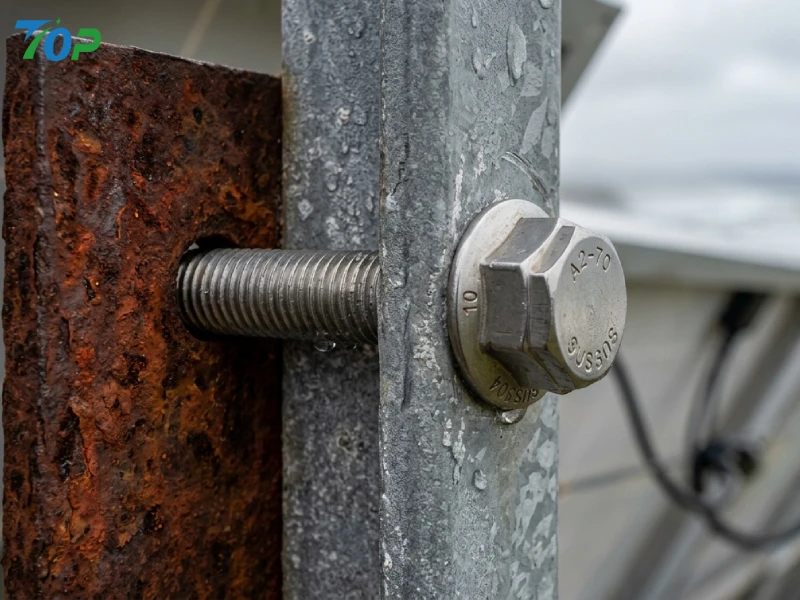
Corrosion Resistance: One of the Most Underestimated Lifecycle Cost Factors
Corrosion is probably one of the least understood — and most underestimated — cost drivers in outdoor photovoltaic infrastructure.
A fence may appear structurally acceptable during initial installation, but once corrosion begins spreading through posts, welds, brackets, or fastener connections, long-term reliability declines very quickly.
In solar projects expected to operate for decades, corrosion resistance becomes an engineering issue, not just a cosmetic issue.
Why Corrosion Is Especially Serious in Solar Projects
Many photovoltaic installations are located in harsh outdoor environments where metal structures remain continuously exposed to aggressive conditions.
Examples include:
- Coastal regions with salt spray exposure
- High-humidity tropical environments
- Industrial zones with airborne pollutants
- Agricultural areas with ammonia exposure
- Desert regions with extreme thermal cycling
Unlike urban architectural fencing, PV project fencing is often installed in open-field environments with little natural protection from weather exposure.
This accelerates:
- Metal oxidation
- Coating degradation
- Galvanic corrosion
- Fastener deterioration
- Structural weakening
Corrosion Failure Creates More Than Material Damage
The impact of corrosion goes beyond visible rust.
Long-term structural degradation may eventually contribute to:
- Fence instability
- Module support weakening
- Grounding continuity problems
- Wind resistance reduction
- Higher maintenance frequency
- Unexpected replacement projects
In solar fence systems, corrosion around electrical grounding points is particularly important because grounding continuity directly affects system safety.
This is one reason engineering-grade material selection matters so much in photovoltaic perimeter infrastructure.
Common Corrosion Failure Points
In real-world projects, corrosion often begins at:
- Welded joints
- Field-cut edges
- Fastener interfaces
- Water accumulation zones
- Mixed-metal contact areas
Improper drainage design can also accelerate localized corrosion.
For example, standing water around post foundations may gradually weaken protective coatings and increase oxidation risk.
These small design details are often ignored during low-cost procurement decisions.
Engineering-Level Anti-Corrosion Strategies
Professional EPC projects increasingly use higher-performance anti-corrosion systems to reduce long-term operational risk.
Common Engineering Solutions
- Hot-dip galvanizing
- Zn-Al-Mg coating systems
- Anodized aluminum structures
- SUS304 or SUS316 stainless steel fasteners
- Isolation pads between dissimilar metals
- Improved drainage and ventilation design
Among these approaches, Zn-Al-Mg coatings have gained attention because of their improved corrosion performance in outdoor environments compared with conventional galvanizing under certain conditions.
Their self-protective characteristics near scratches and cut edges can slow corrosion propagation over time.
Why EPC Contractors Prioritize Corrosion Resistance
From an EPC perspective, corrosion-resistant infrastructure provides several operational advantages:
- Reduced maintenance visits
- Lower replacement inventory requirements
- More predictable lifecycle cost
- Fewer warranty disputes
- Improved project reliability
This is especially important in remote utility-scale projects where maintenance logistics can become expensive very quickly.
A single maintenance event in an isolated solar farm may require:
- Transportation vehicles
- Safety personnel
- Specialized technicians
- Replacement materials
- Temporary operational coordination
When these interventions are repeated over decades because of avoidable corrosion problems, the real lifecycle cost becomes much higher than the original procurement savings.
And honestly, this is where many low-cost fencing systems fail long before the photovoltaic project itself reaches the end of its operational life.
Energy Generation Changes the Entire ROI Model
This is where the comparison between solar fence vs traditional fence systems changes fundamentally.
Traditional fencing is a passive infrastructure expense. After installation, it continues consuming maintenance resources throughout the project lifecycle without generating any operational return.
Solar fencing changes that equation.
Instead of occupying perimeter space purely for security purposes, the boundary itself becomes a productive infrastructure asset capable of generating electricity while still performing its protective function.
From an engineering and asset-management perspective, this distinction is important because modern photovoltaic projects are increasingly evaluated based on overall infrastructure efficiency rather than isolated component pricing.
Traditional Fence Remains a Non-Productive Asset
Conventional fencing still performs an essential security role in PV projects:
- Preventing unauthorized access
- Protecting equipment
- Supporting safety compliance
- Reducing theft and vandalism risk
But financially, traditional fencing remains a pure operational expense throughout the project lifecycle.
It does not:
- Generate electricity
- Create additional land value
- Offset operational energy consumption
- Improve energy density per project area
As land and infrastructure costs continue increasing globally, developers are placing greater attention on infrastructure utilization efficiency.
This trend is especially visible in:
- Industrial PV developments
- Urban-edge solar projects
- Commercial and logistics facilities
- High land-value regions
Solar Fence Converts Boundary Space Into Functional Infrastructure
One of the strongest advantages of solar fencing is that it utilizes perimeter space that would otherwise remain operationally idle.
Instead of building separate:
- Security fencing
- Ground-mounted PV structures
- Independent support infrastructure
Solar fencing combines these functions into one integrated system.
This creates several long-term operational benefits:
- Higher infrastructure efficiency
- Improved land utilization
- Reduced passive asset area
- Potential energy cost offset
- Better site sustainability metrics
For industrial projects with limited usable land, this dual-purpose approach can become increasingly valuable over time.
Common Energy Utilization Scenarios
In real-world projects, solar fence systems are not always designed to become major power-generation assets.
Instead, they are often used to support localized operational energy demands.
Self-Consumption Applications
- Security cameras
- Perimeter lighting
- Monitoring systems
- Communication equipment
- Access control systems
- Low-power operational infrastructure
In remote locations, these systems may reduce the need for additional electrical infrastructure expansion.
This is particularly useful in:
- Remote solar farms
- Agricultural PV sites
- Infrastructure corridors
- Industrial boundary systems
Grid Export and Energy Offset
Depending on local regulations and project design, solar fencing may also contribute to:
- Net metering programs
- Grid export systems
- Supplementary facility power supply
- Operational electricity offset
However, realistic expectations are important.
In most projects, solar fencing is unlikely to replace primary generation infrastructure. Its value usually comes from improving infrastructure efficiency rather than maximizing total energy yield.
That distinction matters because exaggerated ROI claims often reduce engineering credibility.
Lifecycle Financial Impact
Over long project lifecycles, even moderate electricity generation can partially offset:
- Maintenance expenses
- Operational electricity usage
- Infrastructure ownership cost
This creates a fundamentally different economic model compared with traditional fencing.
Instead of functioning only as a depreciating infrastructure asset, solar fencing may provide partial operational return over time.
For long-duration projects, this can improve overall infrastructure efficiency without increasing land occupation.
Why Realistic Positioning Matters
Some marketing materials position solar fencing as a major standalone power-generation solution.
In reality, most professional EPC contractors evaluate solar fencing more pragmatically.
The strongest value proposition is usually:
- Better lifecycle infrastructure utilization
- Reduced passive land usage
- Long-term operational efficiency improvement
- Integrated infrastructure functionality
This engineering-focused positioning is much more credible for utility-scale and industrial project decision makers.
Land Utilization Efficiency Is Becoming Increasingly Important
Land efficiency has become a major consideration in photovoltaic project development, especially in industrial and commercial markets where land cost continues increasing.
In earlier generations of PV projects, perimeter fencing occupied only a small portion of total project economics. But in modern infrastructure planning, every non-productive area is being evaluated more carefully.
This shift is one reason solar fencing is gaining attention beyond simple security applications.
Traditional Fencing Occupies Space Without Producing Operational Value
Conventional fencing consumes perimeter land while contributing no energy generation capability.
In small projects this may not matter significantly.
But in large utility-scale developments with several kilometers of perimeter infrastructure, the cumulative effect becomes more meaningful.
Particularly in:
- Industrial parks
- Commercial developments
- Urban-edge projects
- High-value land regions
developers increasingly seek ways to improve infrastructure productivity without expanding total project footprint.
Solar Fence Improves Perimeter Productivity
Solar fencing transforms boundary infrastructure into energy-producing space.
This provides several efficiency advantages:
- Dual-purpose land use
- Higher infrastructure utilization
- Reduced idle perimeter area
- Improved energy density per site
In projects where available installation area is constrained, this can improve overall project efficiency without requiring additional land acquisition.
Why This Matters for EPC Contractors and Developers
Modern EPC firms are increasingly evaluated not only on construction capability but also on long-term infrastructure optimization.
Efficient perimeter design may contribute to:
- Better project IRR
- Higher land-use efficiency
- Improved ESG positioning
- Reduced infrastructure redundancy
Although fencing alone will not determine overall project profitability, integrated infrastructure planning can improve lifecycle operational performance in measurable ways.
Structural Reliability and Engineering Safety Considerations
Structural reliability is one of the most important differences between engineering-grade solar fence systems and low-cost perimeter solutions.
Because solar fencing supports photovoltaic modules in addition to functioning as a security barrier, it experiences significantly more structural loading than ordinary fencing.
This means engineering quality matters much more.
Wind Load Design Is Critical
Fence-mounted photovoltaic modules create additional wind pressure that conventional fencing systems were never designed to handle.
Depending on:
- Fence height
- Module orientation
- Tilt angle
- Regional wind conditions
- Terrain exposure
wind loading can become one of the primary structural design challenges.
Improper wind-load calculation may eventually result in:
- Structural deformation
- Post instability
- Fastener loosening
- Foundation failure
- Module damage
This is why engineering-grade systems typically require:
- Finite structural analysis
- Regional code compliance verification
- Foundation pull-out calculations
- Reinforcement optimization
Important Structural Design Factors
Reliable solar fencing systems should evaluate multiple environmental variables during engineering design.
Key Considerations Include:
- Local wind speed requirements
- Soil bearing conditions
- Flood exposure risk
- Thermal expansion behavior
- Dynamic vibration loading
- Foundation stability
- Long-term corrosion exposure
These factors become especially important in utility-scale projects where perimeter length may extend for several kilometers.
Waterproofing and Cable Protection
Electrical integration introduces additional reliability considerations that traditional fencing does not face.
Poor waterproofing design can gradually lead to:
- Cable degradation
- Water ingress
- Insulation failure
- Grounding discontinuity
- Accelerated corrosion
Professional engineering design usually includes:
- Protected cable routing channels
- Drainage optimization
- UV-resistant cable management
- Weather-resistant connection systems
- Grounding continuity verification
These details may appear minor during procurement stages, but they strongly influence long-term maintenance performance.
Why Certified Components Matter
Component certification is another important consideration for EPC contractors and project developers.
Engineering-grade systems commonly use:
- TUV-certified components
- ISO manufacturing systems
- CE-compliant structural designs
- SGS material verification
Certification does not guarantee perfect performance, but it does improve:
- Material traceability
- Quality consistency
- Engineering credibility
- Procurement confidence
This is particularly important in international utility-scale projects where documentation and compliance requirements are strict.
Fastener Quality Is Frequently Overlooked
In outdoor photovoltaic infrastructure, fasteners are small components with disproportionately large long-term impact.
Low-quality hardware often becomes one of the earliest failure points in outdoor structures.
Common problems include:
- Corrosion spread around bolts
- Thread seizure
- Structural loosening
- Mixed-metal galvanic corrosion
- Maintenance access difficulties
Using SUS304 stainless steel fasteners significantly improves outdoor durability compared with ordinary carbon steel hardware.
For highly corrosive coastal environments, some projects may also require higher-grade stainless solutions depending on exposure conditions.
When Traditional Fence Still Makes More Sense
Despite the advantages of solar fencing, traditional fencing is still the better choice for certain projects.
Professional infrastructure planning should always evaluate actual project conditions rather than assuming one system is universally superior.
Temporary or Short-Term Projects
If project duration is relatively short, the additional infrastructure investment of solar fencing may not provide sufficient lifecycle value.
Examples include:
- Temporary construction facilities
- Short-term leased land projects
- Interim infrastructure installations
In these cases, lower-cost conventional fencing may remain more practical.
Extremely Budget-Constrained Projects
Some projects prioritize minimizing initial CAPEX above all other considerations.
When procurement budget is extremely limited, developers may choose simpler fencing systems despite higher long-term maintenance risk.
This decision is not always ideal from a lifecycle perspective, but it can still be commercially understandable in certain markets.
Poor Solar Exposure Conditions
Solar fencing performs best in locations with adequate solar exposure.
Projects with:
- Heavy shading
- Dense urban obstruction
- Poor orientation conditions
- Extremely limited sunlight access
may not generate sufficient operational value from integrated PV fencing systems.
Regulatory Restrictions
Some regions maintain strict regulations regarding:
- Fence-mounted electrical systems
- Grid interconnection approvals
- Perimeter infrastructure requirements
- Electrical safety compliance
Under these conditions, traditional fencing may remain the simpler solution from both permitting and operational perspectives.
When Solar Fence Delivers the Best Long-Term Value
Solar fencing becomes more attractive as project lifecycle length, infrastructure scale, and operational optimization requirements increase.
The strongest applications are usually projects where long-term infrastructure efficiency matters more than lowest initial procurement cost.
Utility-Scale Solar Farms
Large solar farms often require extensive perimeter infrastructure with operational lifecycles exceeding 25 years.
In these projects, reducing:
- Maintenance frequency
- Replacement labor
- Idle infrastructure
- Corrosion risk
can produce meaningful long-term operational advantages.
Industrial and Commercial Facilities
Factories, warehouses, logistics centers, and industrial parks increasingly value:
- Land-use efficiency
- Integrated infrastructure
- ESG positioning
- Operational energy optimization
Solar fencing aligns well with these priorities because it combines security and energy functionality within the same footprint.
High Electricity Cost Regions
In markets with high electricity prices, even moderate perimeter-based generation can create more meaningful operational savings.
This improves:
- Self-consumption value
- Energy offset potential
- Infrastructure efficiency
Coastal and High-Corrosion Environments
Engineering-grade solar fencing systems using corrosion-resistant materials may outperform low-cost fencing significantly in aggressive environments.
Reducing corrosion-related replacement frequency can become a major operational advantage over long project lifecycles.
ESG-Oriented Infrastructure Projects
Sustainability-focused developments increasingly seek multifunctional infrastructure solutions.
Solar fencing may contribute to:
- Carbon reduction initiatives
- Green infrastructure planning
- Corporate sustainability goals
- Improved ESG reporting metrics
Key Questions EPC Contractors Should Evaluate Before Choosing a Fence System
Before selecting either solar fencing or traditional fencing, EPC contractors should evaluate several project-specific variables carefully.
What Is the Expected Project Lifecycle?
A project expected to operate for:
- 5 years
- 15 years
- 30 years
requires completely different infrastructure planning logic.
Longer operational duration increases the importance of:
- Durability
- Corrosion resistance
- Maintenance efficiency
- Replacement frequency reduction
What Environmental Risks Exist?
Local conditions strongly affect infrastructure performance.
Key environmental factors include:
- Salt spray exposure
- Wind load
- Flood risk
- Snow accumulation
- Soil conditions
- Industrial pollution
Ignoring these factors during procurement often creates expensive long-term maintenance problems later.
What Is the Expected O&M Budget?
Projects with limited long-term maintenance budgets generally benefit more from:
- Higher durability materials
- Reduced replacement frequency
- Lower corrosion exposure risk
In these situations, minimizing maintenance burden may become more valuable than minimizing procurement cost.
Is Land Utilization Efficiency Important?
For industrial and commercial projects where usable land is limited, integrated infrastructure solutions can provide meaningful operational advantages.
This is one reason solar fencing is gaining more attention in logistics and industrial development sectors.
Will the Electricity Be Used On-Site or Exported?
The financial value of solar fencing depends partly on how generated electricity is utilized.
Possible strategies include:
- Self-consumption
- Operational energy offset
- Grid export
- Remote equipment support
Project economics vary depending on local electricity pricing and regulatory conditions.
Are Replacement Components Easy to Source?
Standardized structural components and commonly available hardware simplify:
- Maintenance logistics
- Inventory management
- Future expansion
- Long-term replacement planning
This becomes increasingly important in projects with large perimeter scale.
Conclusion
The real comparison between solar fencing and traditional fencing is not simply about security infrastructure.
It is a comparison between:
- Passive infrastructure
- Integrated multifunctional infrastructure
Traditional fencing still remains appropriate for many projects, particularly:
- Temporary developments
- Highly cost-sensitive installations
- Projects with poor solar exposure
However, in long-lifecycle photovoltaic projects, infrastructure decisions should not be based solely on initial procurement price.
Over time, factors such as:
- Corrosion resistance
- Maintenance frequency
- Replacement labor
- Land utilization efficiency
- Structural reliability
- Operational infrastructure value
often create much larger financial impact than small differences in upfront material cost.
This is why the solar fence vs traditional fence discussion has become increasingly relevant for modern EPC planning and utility-scale infrastructure design.
Professional EPC contractors now evaluate perimeter systems more strategically than before. Instead of viewing fencing purely as a security expense, many developers are beginning to treat perimeter infrastructure as part of broader lifecycle asset optimization.
Solar fencing is not the ideal solution for every project.
But for utility-scale, industrial, and long-duration photovoltaic developments, it can provide meaningful advantages in:
- Infrastructure efficiency
- Land utilization
- Maintenance reduction
- Lifecycle operational value
- Integrated project functionality
And realistically, those factors matter much more over 25 years than the lowest quotation on procurement day.
Frequently Asked Questions
Q1. Is solar fencing more expensive than traditional fencing?
Yes, solar fencing generally has higher upfront installation cost because it includes photovoltaic modules, mounting systems, electrical infrastructure, and grounding components in addition to standard perimeter structure.
However, long-term lifecycle value may offset part of the additional investment through:
- Electricity generation
- Improved land utilization
- Reduced passive infrastructure area
- Potential maintenance optimization
Q2. How long does a solar fence system typically last?
Engineering-grade solar fence systems using high-quality corrosion-resistant materials can often achieve operational lifecycles exceeding 25 years under proper maintenance conditions.
Actual lifespan depends on:
- Environmental exposure
- Material quality
- Coating performance
- Installation quality
- Maintenance practices
Q3. Are solar fences suitable for coastal environments?
Yes, but material selection becomes extremely important in coastal regions because salt spray significantly accelerates corrosion.
Recommended solutions often include:
- Zn-Al-Mg coated steel
- Hot-dip galvanized structures
- SUS304 or SUS316 stainless steel fasteners
- Enhanced drainage and isolation design
Q4. Can solar fencing withstand high wind conditions?
Properly engineered solar fencing systems can be designed for high wind environments through:
- Structural reinforcement
- Wind-load analysis
- Foundation optimization
- Regional code compliance verification
Because photovoltaic modules increase wind pressure, professional structural engineering is essential.
Q5. What projects benefit most from solar fencing?
Solar fencing is typically most valuable in:
- Utility-scale solar farms
- Industrial facilities
- Commercial logistics parks
- Long-lifecycle PV projects
- Land-constrained developments
- ESG-oriented infrastructure projects
These projects usually benefit more from integrated infrastructure efficiency and lifecycle optimization.
Reduce Long-Term Fence Replacement Costs in Utility-Scale PV Projects
Still comparing solar fence vs traditional fence solutions for your photovoltaic project? In coastal, high-humidity, and utility-scale environments, low-grade fencing systems often lead to accelerated corrosion, repeated maintenance labor, grounding failures, and rising lifecycle operational costs. TOPFENCE provides engineered solar fencing systems designed for long-term EPC performance, featuring Zn-Al-Mg anti-corrosion steel structures, SUS304 stainless steel fasteners, integrated grounding design, modular installation workflow, and utility-scale wind load resistance. Improve perimeter infrastructure reliability, reduce long-term maintenance burden, and optimize lifecycle ROI for industrial and utility-scale photovoltaic developments.
Request Solar Fence Design, Samples & EPC QuotationRelated News
- The Global EPC Sourcing Checklist: Managing Lead Times and Logistics for Solar Mounting Systems
- BIPV & Commercial Rooftops: Solving Waterproofing and Structural Integrity Challenges in Urban Solar
- Navigating Solar Certifications: Why UL 2703 and International Standards Matter for Project Bankability
- Maximizing Yield with Bifacial Modules: How to Select the Optimal Tracker for Enhanced Energy Output
- Wind Load and Coastal Engineering: Ensuring Your Ground-Mounted Solar Array Survives Extreme Weather
- Aluminum vs. Galvanized Steel: Choosing the Right Solar Mounting Structure for High-Corrosivity Environments
Leave me a message