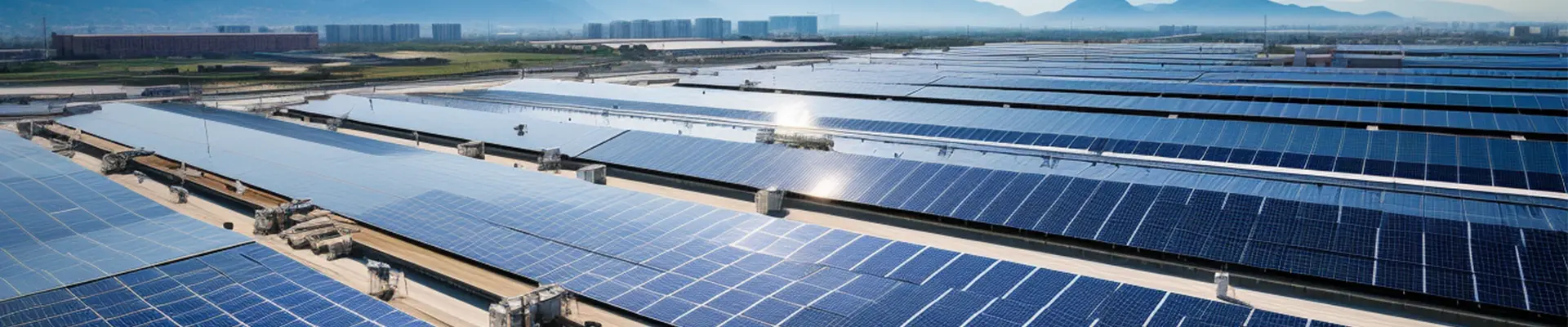
Customized Solar Mounting Services for Extreme Climate Conditions: Engineering PV Structures for Wind, Snow, Corrosion and Terrain Challenges
Why Customized Solar Mounting Services Matter in Extreme Climate Conditions
As solar projects continue expanding into harsher and more complex environments, Customized Solar Mounting Services for Extreme Climate Conditions have become an increasingly important part of project planning. Whether the project is located in a typhoon-prone coastal region, a heavy-snow mountain area, or a desert exposed to extreme temperature fluctuations, the mounting structure is no longer just a support component—it is a critical engineering system that directly affects project safety, energy yield, maintenance costs, and long-term return on investment.
Many EPC contractors have learned this lesson the hard way. A mounting system that performs well in one region may experience excessive deformation, accelerated corrosion, or even structural failure when deployed under different environmental conditions. This is exactly why Customized Solar Mounting Services for Extreme Climate Conditions are becoming a standard requirement for utility-scale developers, commercial rooftop investors, and engineering procurement contractors seeking long-term reliability.
The challenge is simple: environmental loads vary dramatically from one project site to another. Wind speeds, snow accumulation, soil conditions, corrosion categories, terrain slopes, and local building codes all influence structural performance. Standardized mounting systems can provide cost advantages in simple environments, but when climate risks increase, customization often becomes the most economical solution over the project lifecycle.
This article explores how customized solar mounting solutions are engineered, why they have become increasingly important for modern PV projects, and what EPC companies should evaluate when selecting a mounting structure supplier for extreme climate applications.
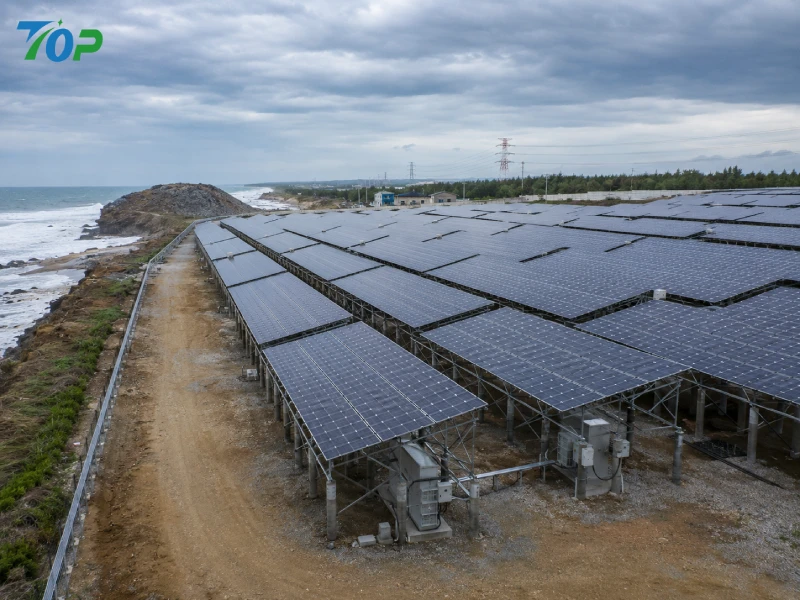
Why Extreme Climate Is Becoming a Major Design Challenge for Solar Projects
The global solar industry is entering a new development phase. Ten years ago, most utility-scale projects were concentrated in regions with relatively favorable environmental conditions. Today, available land resources are becoming more limited, while governments and investors are pushing solar deployment into areas previously considered technically challenging.
As a result, solar projects are increasingly being developed in:
- Typhoon and hurricane exposure zones
- Heavy snow regions
- High-altitude mountainous terrain
- Coastal and marine environments
- Desert areas with extreme temperatures
- Regions with complex geotechnical conditions
For EPC contractors, these locations introduce engineering variables that cannot be ignored. The mounting structure must withstand environmental loads continuously for 25 to 30 years while maintaining structural integrity and supporting optimal module performance.
In many projects, developers spend considerable effort evaluating module efficiency, inverter technology, and monitoring systems, yet underestimate the importance of structural engineering. However, a solar mounting system is often one of the few components that cannot be easily replaced after installation. Once foundations are completed and modules are installed, structural modifications become expensive and disruptive.
This reality has shifted industry attention toward engineering-driven mounting design rather than simply purchasing standardized racking products from a catalog.
The Cost of Underestimating Environmental Loads
When climate conditions are not properly incorporated into structural design, the resulting consequences can extend far beyond repair costs.
Common issues include:
- Module uplift during high-wind events
- Foundation settlement caused by inadequate soil assessment
- Excessive beam deflection under snow loads
- Accelerated corrosion of structural connections
- Misalignment affecting long-term energy production
- Unexpected maintenance expenses
In severe cases, structural failures can trigger warranty disputes, insurance claims, and reputational damage for EPC contractors responsible for project delivery.
For large utility-scale projects, even a small percentage of structural failure can create substantial financial exposure. This is one reason lenders and project owners increasingly require detailed structural calculations and third-party engineering verification before approving investments.
What Does “Customized Solar Mounting Service” Actually Mean?
The term "customized mounting system" is often misunderstood within the solar industry.
Some suppliers describe simple dimensional modifications as customization. In reality, true engineering customization involves adapting the mounting structure to site-specific environmental and operational requirements.
A properly customized mounting solution considers:
- Local wind loads
- Snow load requirements
- Corrosion classification
- Terrain characteristics
- Foundation conditions
- Module dimensions and weight
- Installation methodology
- Project economics
The goal is not simply to increase structural strength. Overdesign can be just as problematic as underdesign because excessive material consumption increases project costs and installation complexity.
Effective customization seeks the optimal balance between safety, durability, installation efficiency, and lifecycle value.
Beyond Standard Catalog Products
Most standard mounting products are developed around average environmental assumptions. These assumptions may work adequately for moderate climates but become increasingly unreliable as environmental loads deviate from design parameters.
For example, a ground-mounted system designed for moderate wind conditions may require significant modifications when installed in a coastal region regularly exposed to typhoons.
Rather than using the same structural profile everywhere, engineers may adjust:
- Foundation depth
- Pile diameter
- Bracing configuration
- Rail section dimensions
- Fastener specifications
- Module arrangement
- Array spacing
These modifications are based on engineering calculations rather than generalized assumptions.
Typical Engineering Deliverables Included in a Customized Service
Professional EPC contractors generally expect far more than hardware supply. A complete customized mounting service typically includes:
- Site-specific structural calculations
- Foundation recommendations
- Wind load analysis
- Snow load verification
- Material optimization studies
- CAD drawings
- 3D structural models
- Installation documentation
- Bill of Materials optimization
These engineering deliverables reduce uncertainty during procurement, construction, and commissioning phases.
Which Climate Conditions Require Customized Solar Mounting Solutions?
Although every project benefits from proper engineering analysis, certain environments almost always require a customized approach.
High-Wind and Typhoon Regions
Wind remains one of the most critical structural considerations in photovoltaic projects.
Unlike static loads, wind forces are dynamic and can create complex pressure distributions across the array surface. Uplift forces generated during severe weather events often exceed what many project owners initially expect.
In regions affected by tropical cyclones, hurricanes, or typhoons, design wind speeds can exceed:
- 40 m/s (144 km/h)
- 50 m/s (180 km/h)
- 60 m/s (216 km/h)
Under these conditions, module uplift becomes a major engineering concern.
Typical High-Wind Project Locations
- Japan
- Philippines
- Taiwan
- Vietnam
- Southern China
- Coastal United States
- Caribbean Islands
- Northern Australia
Projects in these regions often experience multiple severe weather events throughout their operational lifespan.
Engineering Strategies Used in High-Wind Design
A customized design process generally focuses on reducing uplift forces while increasing structural resistance.
Typical optimization measures include:
- Shorter table configurations
- Improved aerodynamic layouts
- Additional cross-bracing
- Higher-strength structural members
- Deeper pile embedment
- Enhanced module clamping systems
- Optimized edge-zone reinforcement
One commonly overlooked factor is edge loading. Wind pressures near array edges and corners are often significantly higher than those experienced in central zones. Proper customization accounts for these localized load concentrations.
The Risk of Using Standard Systems in Typhoon Areas
Some EPC contractors attempt to reduce procurement costs by applying standard mounting systems originally designed for lower wind regions.
While this approach may reduce initial investment, the long-term risk profile often changes dramatically.
Potential consequences include:
- Module displacement
- Rail deformation
- Foundation pull-out failure
- Fastener fatigue
- Increased maintenance requirements
- Unexpected downtime after severe weather events
The financial impact of a single structural failure event frequently exceeds the cost difference between standard and customized designs.
Heavy Snow Load Areas
Snow presents a very different engineering challenge.
Unlike wind, snow creates a sustained static load that remains on the structure for extended periods. Depending on local weather patterns, snow accumulation can remain on modules for days or even weeks.
As snow depth increases, the resulting downward force can significantly affect structural behavior.
Many snow-prone regions experience design loads exceeding:
- 1.0 kN/m²
- 1.5 kN/m²
- 2.0 kN/m²
- 3.0 kN/m² or higher
Without proper structural adaptation, excessive loading can cause deflection, connection stress, and long-term fatigue issues.
Regions Where Snow Load Design Becomes Critical
- Northern Japan
- Canada
- Northern United States
- Scandinavia
- Alpine Europe
- Northern China
- Korea
In these markets, snow load analysis is often a mandatory requirement during project approval.
Key Design Adjustments for Snow Regions
Customized mounting structures frequently incorporate:
- Larger beam sections
- Reduced span distances
- Additional support points
- Higher structural safety margins
- Optimized tilt angles for snow shedding
- Strengthened connection systems
The objective is not merely to survive peak snow events but to maintain structural performance over decades of seasonal loading cycles.
For EPC companies working in northern climates, proper snow load engineering often represents one of the most important factors influencing long-term project reliability.
Coastal and Marine Environments
If wind is the most visible threat to a solar project, corrosion is often the most underestimated one.
Many PV systems installed in coastal areas show no obvious structural issues during the first few years of operation. However, corrosion is a cumulative process. Once protective coatings begin to deteriorate or galvanic reactions develop between dissimilar metals, degradation can accelerate unexpectedly.
For EPC contractors responsible for long-term system performance, corrosion-related failures can be particularly frustrating because they are rarely caused by a single extreme event. Instead, they develop gradually over time until maintenance costs begin to rise and component replacement becomes necessary.
This is why experienced developers often evaluate corrosion risk with the same level of attention given to wind and snow loads.
Why Coastal PV Projects Face Greater Structural Risks
Marine environments create a combination of factors that accelerate material degradation:
- Salt-laden air
- High humidity levels
- Frequent condensation cycles
- UV exposure
- Temperature fluctuations
- Wind-driven salt deposition
Even projects located several kilometers inland may still experience significant corrosion exposure depending on prevailing wind patterns and local climate conditions.
According to engineering studies performed across coastal infrastructure sectors, chloride contamination can significantly shorten the service life of improperly protected steel components. In severe marine environments, corrosion rates may be several times higher than those observed in inland installations.
Common Corrosion Failure Points in Solar Mounting Systems
Not all components corrode at the same rate.
In many solar projects, failures begin at connection points rather than primary structural members.
Typical vulnerable locations include:
- Bolted connections
- Module clamps
- Grounding interfaces
- Fastener threads
- Cut edges on steel sections
- Dissimilar metal contact areas
Once corrosion develops in these critical areas, structural performance may gradually decline even if the main support members appear visually intact.
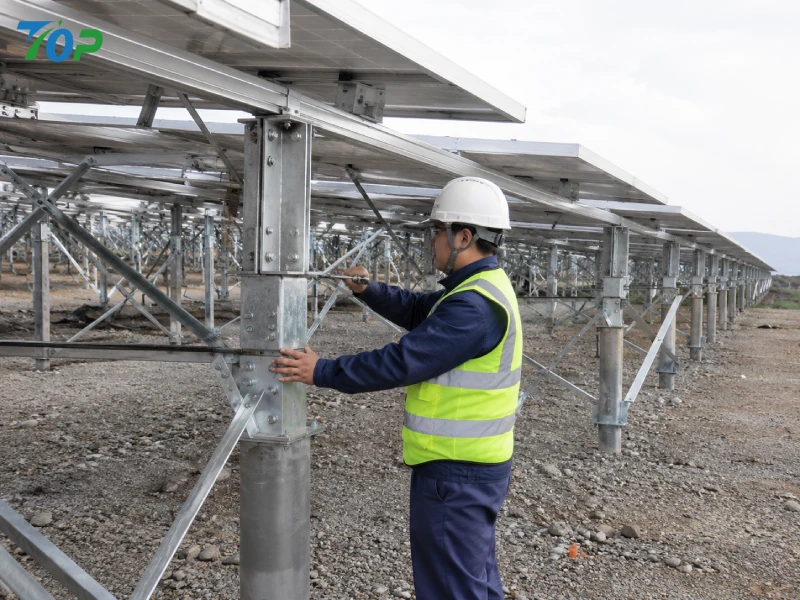
Material Selection Strategy for Coastal Projects
One of the most effective methods of improving durability is selecting materials appropriate for the site's corrosion classification.
| Component | Recommended Material | Primary Benefit |
|---|---|---|
| Rails | Aluminum 6005-T5 | Excellent corrosion resistance |
| Fasteners | SUS304 Stainless Steel | Long-term durability |
| Marine Fasteners | SUS316 Stainless Steel | Enhanced chloride resistance |
| Main Structure | Zn-Al-Mg Steel | Superior coating performance |
| Roof Clamps | Anodized Aluminum | Reduced corrosion risk |
For projects located very close to the ocean, many engineers recommend evaluating SUS316 stainless steel hardware despite its higher material cost. The initial investment increase is often relatively small when compared to the potential cost of premature replacement during the project lifecycle.
Expected Service Life Considerations
Developers increasingly evaluate mounting systems based on lifecycle cost rather than procurement cost alone.
A structure that saves 5% during purchasing but requires major maintenance after ten years may ultimately become more expensive than a system designed for thirty years of exposure.
When comparing mounting solutions, EPC contractors should evaluate:
- Coating thickness
- Corrosion testing reports
- Salt spray testing results
- Material certifications
- Expected design life
- Warranty coverage
These factors often provide a more realistic picture of long-term value than simple material pricing comparisons.
Desert and High-Temperature Regions
Desert environments present a completely different set of engineering challenges.
Unlike coastal regions, where corrosion dominates design considerations, desert projects must cope with extreme heat, thermal expansion, UV degradation, and abrasive dust exposure.
Many utility-scale solar projects are now being developed in arid regions because of their high solar irradiance and abundant land availability. However, these environmental advantages come with structural design implications that should not be overlooked.
Thermal Expansion Effects on Solar Structures
Metal expands and contracts as temperature changes.
In desert climates, surface temperatures on mounting components can exceed ambient air temperatures by a substantial margin. It is not uncommon for structural members to experience temperature swings exceeding 40°C to 60°C between night and daytime conditions.
Over thousands of thermal cycles throughout a project's lifespan, expansion and contraction can create:
- Connection stress
- Bolt loosening
- Material fatigue
- Alignment issues
- Premature wear
Customized mounting designs often include expansion allowances that accommodate these movements while maintaining structural integrity.
Sand and Dust Exposure
Desert winds frequently carry abrasive particles that affect both modules and support structures.
While most discussions focus on module soiling losses, dust exposure can also influence:
- Protective coatings
- Cable insulation
- Mechanical connections
- Moving tracker components
For fixed-tilt systems, engineering teams may specify enhanced surface treatments and optimized cable management systems to reduce long-term wear.
UV Resistance Considerations
High ultraviolet exposure affects more than photovoltaic modules.
Non-metallic components such as:
- Cable ties
- Protective sleeves
- Polymer clips
- Cable conduits
may experience accelerated aging in desert conditions.
A properly customized mounting solution accounts for these factors during material selection rather than treating them as secondary considerations.
Engineering Strategies for Desert Installations
Common optimization measures include:
- Expansion joints for long rail runs
- UV-resistant accessories
- Enhanced cable routing systems
- Improved airflow beneath modules
- Corrosion-resistant hardware
- Thermal movement accommodation
The objective is to minimize degradation mechanisms while maintaining installation efficiency and cost competitiveness.
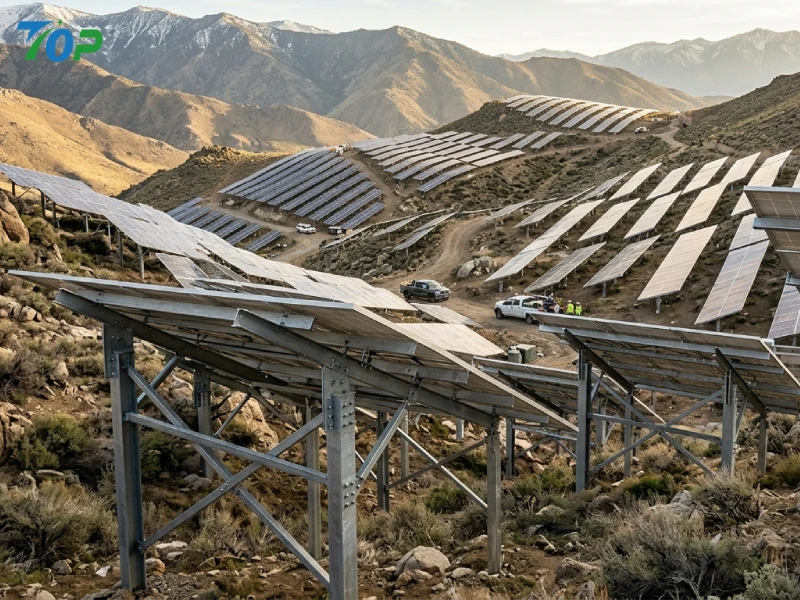
Mountainous and Uneven Terrain
Not every project site is perfectly flat.
As available land becomes increasingly scarce, developers are turning toward hilly, mountainous, and irregular terrain where traditional mounting approaches become less practical.
These projects often require some of the highest levels of structural customization.
Challenges Associated with Uneven Terrain
Complex topography introduces several engineering difficulties:
- Variable foundation elevations
- Slope instability risks
- Difficult equipment access
- Irregular pile lengths
- Drainage challenges
- Construction inefficiencies
Without proper engineering adaptation, installation costs can rise quickly due to excessive grading requirements and site preparation work.
Why Excessive Land Grading Is Not Always the Best Solution
Historically, many projects attempted to solve terrain challenges through large-scale earthwork activities.
Although grading can simplify installation, it often increases:
- Civil engineering costs
- Construction timelines
- Environmental permitting complexity
- Soil erosion risk
- Stormwater management requirements
For this reason, many modern utility-scale projects seek to minimize grading wherever possible.
Terrain-Following Mounting Designs
Advanced customized mounting systems can be engineered to follow natural site contours.
Typical approaches include:
- Adjustable support legs
- Variable pile heights
- Articulated connection points
- Slope-adaptive layouts
- Independent table configurations
These solutions often reduce civil construction costs while preserving structural reliability.
In some cases, terrain-following designs can significantly reduce land preparation expenses and shorten project schedules, creating measurable financial benefits for developers.
How Engineers Design Solar Mounting Structures for Extreme Climate Projects
A successful customized mounting system is not created through guesswork.
It is the result of a structured engineering process that combines environmental data, structural analysis, material science, and practical installation considerations.
While every project is unique, most engineering workflows follow a similar sequence.
Step 1 – Comprehensive Site Assessment
Every customization project begins with data collection.
Without accurate site information, even the most sophisticated structural calculations may produce unreliable results.
Engineering teams typically evaluate:
- Wind speed maps
- Snow load maps
- Seismic zones
- Topographical surveys
- Soil investigation reports
- Corrosion exposure categories
- Drainage conditions
- Local building regulations
The quality of this initial assessment often determines the quality of the final design.
Step 2 – Structural Load Calculations
Once site data is collected, engineers perform detailed structural calculations.
The objective is to determine how the mounting system will behave under all relevant loading conditions throughout its service life.
Typical load categories include:
- Dead loads
- Live loads
- Wind loads
- Snow loads
- Seismic loads
- Maintenance loads
ASCE 7 Wind Load Methodology
For projects in North America and many international markets, ASCE 7 is widely used as a reference standard for wind load determination.
The standard considers:
- Basic wind speed
- Exposure category
- Topographic effects
- Importance factors
- Pressure coefficients
These variables significantly influence the final design loads applied to solar mounting structures.
Eurocode Snow Load Requirements
Many European projects reference Eurocode standards when determining snow load requirements.
Factors considered include:
- Ground snow load
- Roof geometry
- Exposure conditions
- Thermal effects
- Altitude adjustments
Although the specific formulas vary by jurisdiction, the engineering principle remains the same: structures must safely resist expected environmental loads throughout their design life.
Step 3 – Foundation Engineering and Selection
Even the strongest mounting structure will fail if supported by an inadequate foundation system.
Foundation selection is therefore one of the most important decisions during project development.
The optimal solution depends on:
- Soil bearing capacity
- Groundwater conditions
- Frost depth
- Terrain characteristics
- Wind loading requirements
- Construction budget
| Foundation Type | Typical Application | Main Advantage |
|---|---|---|
| Ground Screw | Medium-density soils | Fast installation |
| Driven Pile | Utility-scale projects | Cost efficiency |
| Concrete Foundation | Weak soils | High stability |
| Ballasted System | Flat rooftops | No roof penetration |
Selecting the wrong foundation type can significantly increase project costs and create long-term performance issues.
This is one reason experienced EPC firms prioritize geotechnical investigation before finalizing structural designs.
Step 4 – Finite Element Analysis (FEA) for Structural Optimization
After environmental loads and foundation parameters have been established, engineering teams typically move to advanced structural modeling. For large commercial and utility-scale projects, Finite Element Analysis (FEA) has become one of the most important tools for optimizing solar mounting systems.
Rather than relying solely on simplified hand calculations, FEA allows engineers to simulate how structural members behave under various loading conditions and combinations.
This process helps identify:
- Stress concentrations
- Deflection behavior
- Potential failure points
- Connection performance
- Material utilization efficiency
- Structural redundancy requirements
For example, a mounting structure designed for a coastal typhoon-prone region may appear adequate based on basic calculations. However, detailed FEA modeling might reveal excessive stress concentrations at specific connection points during peak wind events.
Identifying these issues during the design stage is significantly less expensive than discovering them after construction.
Another major advantage of FEA is material optimization.
Many inexperienced designs simply add more steel to increase safety margins. While this approach may improve strength, it often creates unnecessary material costs, transportation expenses, and installation labor requirements.
A properly optimized design seeks the most efficient balance between structural safety and material consumption.
Step 5 – Prototype Testing and Validation
Engineering calculations and digital simulations provide valuable insights, but physical testing remains an essential part of project verification.
Before large-scale deployment, many mounting manufacturers perform validation testing to confirm structural performance.
Common testing procedures include:
- Pull-out testing
- Compression testing
- Connection strength testing
- Salt spray testing
- Coating adhesion testing
- Mechanical load testing
- Fatigue testing
For ground-mounted systems, pull-out testing is particularly important because soil conditions can vary significantly across project sites.
Laboratory assumptions may not always match actual field conditions. Conducting on-site testing helps verify foundation performance before large-scale construction begins.
Likewise, corrosion testing provides valuable data regarding coating durability and expected service life in aggressive environments.
The combination of engineering calculations, FEA modeling, and physical testing creates a much higher level of confidence than relying on any single method alone.
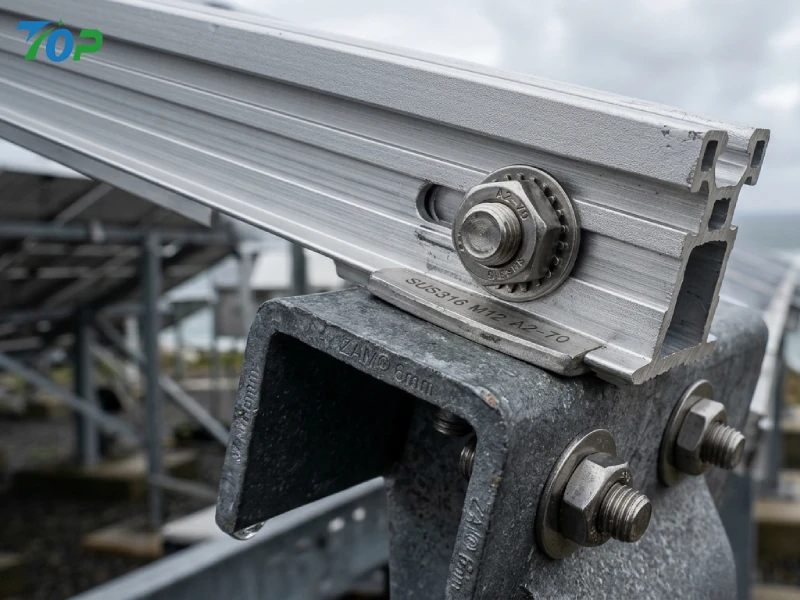
Material Selection for Long-Term Reliability
Material selection plays a major role in determining the long-term performance of a solar mounting structure.
While structural design receives significant attention, material quality often determines how well the system performs after years of environmental exposure.
The most cost-effective material is not necessarily the cheapest option at procurement stage. Instead, it is the material that delivers the lowest lifecycle cost while meeting project performance requirements.
Aluminum vs HDG Steel vs Zn-Al-Mg Steel
These three materials dominate the global solar mounting industry, but each has different advantages depending on project conditions.
| Property | Aluminum | HDG Steel | Zn-Al-Mg Steel |
|---|---|---|---|
| Weight | Very Light | Heavy | Moderate |
| Corrosion Resistance | Excellent | Good | Very Good |
| Structural Strength | Moderate | High | High |
| Transportation Cost | Lower | Higher | Moderate |
| Installation Speed | Fast | Moderate | Fast |
| Marine Environment Suitability | Excellent | Moderate | Good |
| Lifecycle Cost | Low | Moderate | Low |
Aluminum remains popular for rooftop projects due to its lightweight characteristics and excellent corrosion resistance.
Hot-dip galvanized steel continues to dominate many utility-scale applications because of its strength and relatively low material cost.
Zn-Al-Mg coated steel has gained significant attention in recent years because it combines high structural strength with enhanced corrosion protection, making it particularly attractive for large-scale ground-mounted projects.
Why SUS304 Fasteners Have Become the Industry Standard
Fasteners represent a relatively small percentage of total project cost, yet they play a disproportionately important role in structural reliability.
Even if primary structural members remain intact, failure of bolts, nuts, or connection hardware can compromise overall system performance.
SUS304 stainless steel has become the preferred choice for many solar mounting applications because it offers:
- Strong corrosion resistance
- Excellent mechanical properties
- Long service life
- Global availability
- Proven field performance
For most commercial and utility-scale projects, SUS304 provides an effective balance between performance and cost.
When SUS316 Is Worth the Additional Cost
Although SUS304 performs well in many environments, certain coastal and marine applications may justify upgrading to SUS316 stainless steel.
SUS316 contains molybdenum, which improves resistance to chloride-induced corrosion.
Projects that may benefit from SUS316 include:
- Island installations
- Ports and harbors
- Coastal desalination facilities
- Projects located very close to shorelines
- Marine industrial zones
The material cost increase is usually concentrated in fasteners and connection components rather than the entire mounting structure, making the upgrade financially reasonable in many high-corrosion environments.
The Hidden Cost of Using Non-Customized Solar Mounting Systems
One of the most common procurement mistakes in the solar industry is evaluating mounting systems primarily based on initial purchase price.
While procurement budgets are important, the lowest-cost solution is not always the most economical over the life of the project.
This becomes especially true in extreme climate environments.
Common Failure Scenarios
Projects using non-optimized mounting systems may experience:
- Excessive structural deflection
- Foundation movement
- Corrosion-related degradation
- Wind-induced damage
- Connection fatigue
- Increased maintenance requirements
Many of these issues do not appear immediately after commissioning. Instead, they develop gradually over several years, making them difficult to detect during the procurement phase.
The Financial Impact of Structural Problems
When evaluating project economics, EPC contractors should consider costs beyond initial procurement.
Potential lifecycle expenses include:
- Repair labor
- Replacement components
- Equipment rental
- Production losses
- Site access costs
- Warranty administration
- Insurance claims
A customized mounting solution may require slightly higher upfront engineering investment, but it often reduces lifecycle risk significantly.
For investors focused on 25- to 30-year project performance, lifecycle economics generally matter far more than initial hardware pricing alone.
How Customized Mounting Systems Improve EPC Profitability
The benefits of customization extend beyond structural reliability.
Many EPC companies discover that properly engineered systems can improve project profitability throughout multiple phases of execution.
Faster Installation
Site-specific engineering reduces the need for field modifications.
When components arrive optimized for actual project conditions, installation crews spend less time performing adjustments on-site.
This can result in:
- Shorter construction schedules
- Lower labor requirements
- Reduced equipment utilization
- Earlier project commissioning
Reduced Labor Costs
Labor costs continue to increase in many global solar markets.
Mounting systems designed for efficient assembly can help contractors reduce installation hours while improving consistency across large projects.
Lower Maintenance Expenses
Well-engineered structures generally require fewer corrective interventions throughout their service life.
Reduced maintenance translates directly into lower operational costs and improved project economics.
Improved Project Bankability
Financial institutions increasingly evaluate technical risk when assessing solar investments.
Projects supported by documented engineering calculations, validated designs, and reliable mounting systems often inspire greater confidence among lenders and investors.
Although structural engineering alone does not determine financing outcomes, it contributes significantly to overall project credibility.
Certifications and Compliance Requirements Buyers Should Verify
For distributors, EPC contractors, and project developers, certifications provide an additional layer of quality assurance.
They help verify that manufacturing processes, materials, and engineering practices meet recognized industry standards.
Material Certifications
- Mill Test Certificates (MTC)
- Chemical composition reports
- Mechanical property reports
- Coating thickness verification
- Traceability documentation
Manufacturing Certifications
- ISO 9001 Quality Management System
- ISO 14001 Environmental Management System
- Factory quality control procedures
- Inspection records
Product Certifications and Testing Reports
- TÜV testing reports
- Structural validation reports
- Corrosion resistance testing
- Mechanical load testing results
Buyers should request supporting documentation rather than relying solely on marketing claims.
What EPC Contractors Should Ask Before Selecting a Mounting Supplier
Choosing a solar mounting supplier involves much more than comparing prices.
The following checklist can help procurement teams evaluate potential partners more effectively.
Engineering Capability
- Can site-specific structural calculations be provided?
- Does the supplier have in-house engineering resources?
- Can wind and snow load requirements be customized?
Manufacturing Capability
- What is the production capacity?
- How is quality controlled?
- Are traceability systems implemented?
Project Experience
- Has the supplier completed similar projects?
- Are references available?
- Can climate-specific case studies be provided?
Customization Flexibility
- Can materials be adjusted?
- Can foundation systems be customized?
- Can installation methods be optimized?
Lead Time and Logistics
- What are typical production timelines?
- Can global delivery schedules be supported?
- How are urgent projects handled?
Why EPC Contractors Choose TopFence for Customized Solar Mounting Projects
As solar projects become increasingly complex, mounting system suppliers must deliver more than standardized hardware.
They must provide engineering support, manufacturing reliability, and practical project experience.
In-House Engineering Support
TopFence works closely with EPC contractors, developers, and distributors to develop project-specific mounting solutions based on actual site conditions rather than generic assumptions.
Engineering teams can assist with:
- Structural calculations
- Wind load analysis
- Snow load assessment
- Foundation recommendations
- Material optimization
Flexible Material Options
Different climate zones require different material strategies.
TopFence supports multiple material configurations, including:
- Aluminum mounting systems
- Hot-dip galvanized steel structures
- Zn-Al-Mg steel systems
- SUS304 hardware
- SUS316 hardware for marine environments
From Design to Delivery
Successful project execution depends on coordination across engineering, manufacturing, logistics, and installation phases.
By integrating these capabilities, customized mounting solutions can be delivered more efficiently and with fewer project risks.
Frequently Asked Questions
Q1. What wind speed can a customized solar mounting system withstand?
The answer depends on project-specific engineering requirements. Customized systems can be designed according to local building codes and site conditions, including regions exposed to severe typhoons or hurricanes.
Q2. Is SUS304 sufficient for coastal solar projects?
For many coastal installations, SUS304 performs well. However, projects located very close to the ocean may benefit from SUS316 hardware due to its improved chloride resistance.
Q3. How is snow load determined for solar mounting structures?
Snow load calculations typically consider local climate data, ground snow loads, site elevation, array geometry, and applicable building code requirements.
Q4. Which foundation type is best for weak soil conditions?
The optimal solution depends on geotechnical investigations. Concrete foundations, specialized piles, or alternative foundation systems may be required depending on soil characteristics.
Q5. Does customization significantly increase project cost?
Not necessarily. In many cases, optimization reduces material waste and installation expenses, offsetting additional engineering costs.
Q6. Can customized mounting systems reduce steel consumption?
Yes. Proper engineering analysis can often identify opportunities to optimize material usage without compromising structural safety.
Q7. How long does a customized engineering process usually take?
Project complexity determines engineering timelines. Simple adaptations may require only a few days, while large utility-scale projects may require more extensive analysis.
Q8. What certifications should buyers request from mounting suppliers?
Common documents include material certificates, quality management certifications, structural testing reports, and relevant third-party verification records.
Conclusion
Extreme climate conditions introduce engineering challenges that standard mounting systems are not always equipped to address. High winds, heavy snow loads, coastal corrosion, desert temperatures, and complex terrain all influence structural performance and long-term project economics.
This is why Customized Solar Mounting Services for Extreme Climate Conditions are increasingly becoming a strategic investment rather than an optional upgrade.
Through site-specific engineering, optimized material selection, structural verification, and lifecycle-focused design, customized mounting solutions help reduce risk, improve installation efficiency, lower maintenance costs, and support long-term asset performance.
For EPC contractors, developers, and distributors seeking reliable solar infrastructure in demanding environments, the goal is not simply to build a structure that survives today's conditions. The goal is to deliver a system that continues performing safely and efficiently for decades.
If your next solar project involves challenging environmental conditions, consulting with an experienced engineering team during the early design stage can help identify the most cost-effective and technically reliable mounting solution before construction begins.
Need a Solar Mounting Solution Engineered for Extreme Climate Conditions?
High winds, heavy snow loads, coastal corrosion, desert temperatures, and complex terrain can significantly increase structural risks and lifecycle costs for solar projects. TOPFENCE provides customized solar mounting services tailored to site-specific environmental conditions, including wind load analysis, snow load design, foundation recommendations, corrosion-resistant material selection, and utility-scale structural optimization. Our engineering team supports EPC contractors, developers, and distributors with project-specific calculations, rapid design customization, and reliable mounting solutions designed to improve installation efficiency, reduce maintenance requirements, and maximize long-term project ROI.
Request Structural Design Support & EPC Project QuotationRelated News
- Integrated Solar Fencing: The Perfect Combination of Aesthetics, Security, and Renewable Energy
- Solar Fence vs Traditional Fence: Which Delivers Better Long-Term Value for Solar Projects?
- Industrial Maintenance Walkways for Factory Roofs: Compliance Standards, Structural Safety, and Solar-Compatible EPC Design Guide
- Lightweight Solar Panels for Balcony Installations: Engineering Advantages, Structural Safety & EPC Buying Guide
- Vertical Solar in Snowy Regions: Engineering Advantages of Vertical PV Systems in Winter Conditions
- Common PV Installation Mistakes and How to Avoid Roof Damage in Solar Projects
Leave me a message