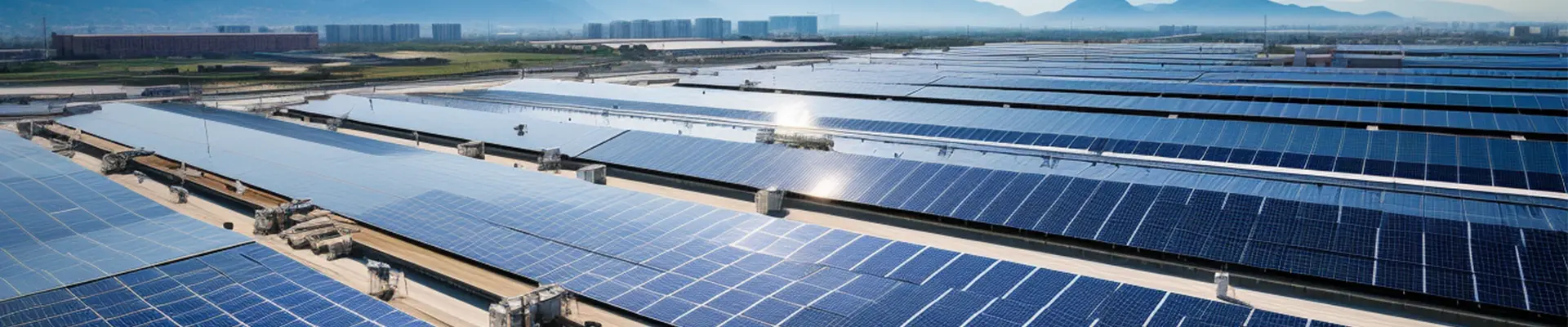
Agrivoltaics: How to Grow High-Yield Crops Under Solar Panels
What Is Agrivoltaics and Why It Matters for Land Use Efficiency
Agrivoltaics is rapidly gaining attention as land costs rise, renewable energy policies tighten, and competition for usable land intensifies across global markets. For solar developers, EPC contractors, and agricultural investors, the challenge is no longer just maximizing energy output—but achieving higher land-use efficiency and stable long-term returns under increasing cost pressure.
Can crops truly grow efficiently under solar panels without compromising yield or project profitability? This article explores how agrivoltaics systems work, which crops perform best under solar arrays, and how to design a solution that balances agricultural productivity with solar energy generation for maximum ROI.
What Is an Agrivoltaic System?
An agrivoltaic system refers to the integration of solar power generation with agricultural activities on the same land. Instead of dedicating land exclusively to either farming or energy production, this approach enables both functions to coexist through optimized system design.
Unlike traditional ground-mounted solar farms, agrivoltaics systems are specifically engineered to allow sufficient sunlight, airflow, and operational space for crops and farming equipment. This requires careful consideration of panel height, spacing, tilt angle, and structural configuration.
Key Types of Agrivoltaic System Design
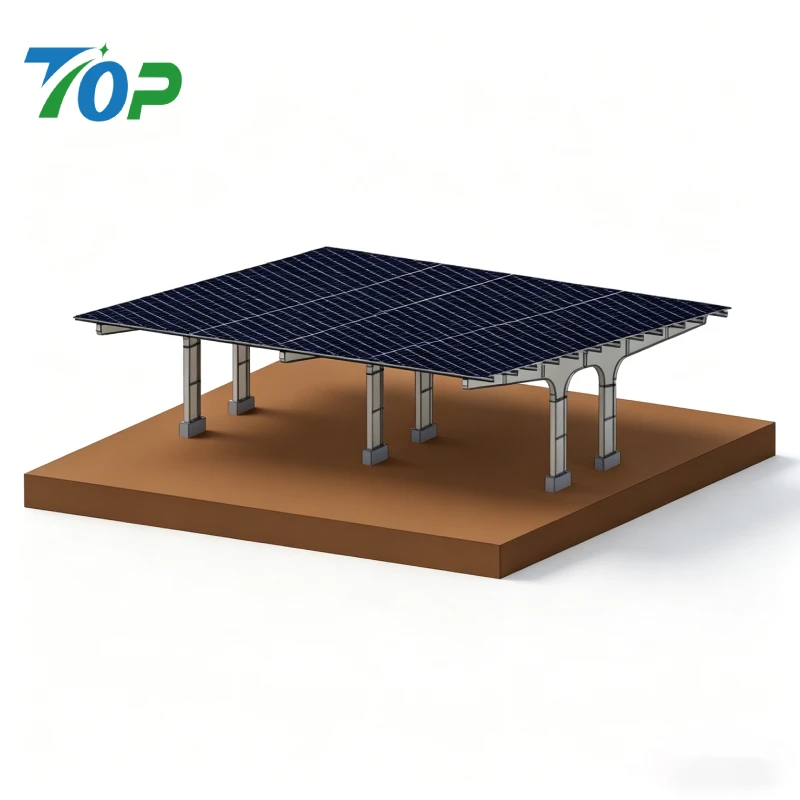
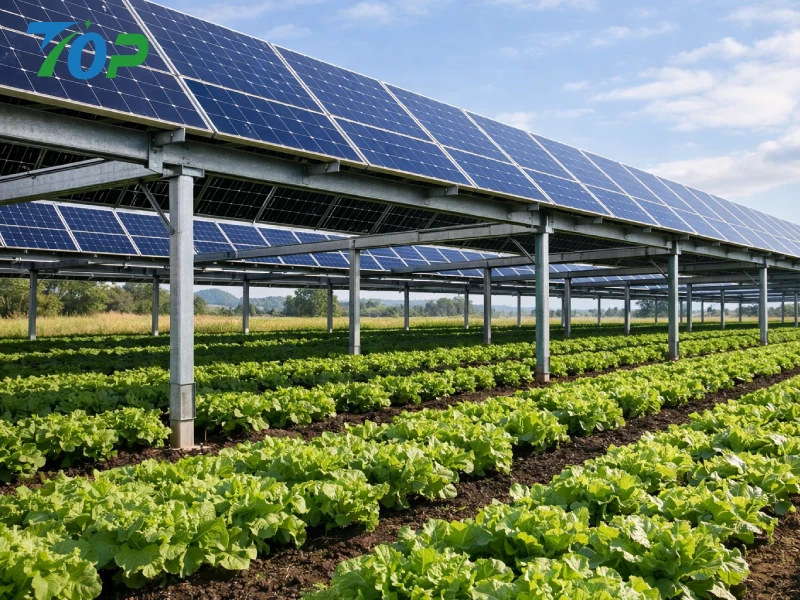
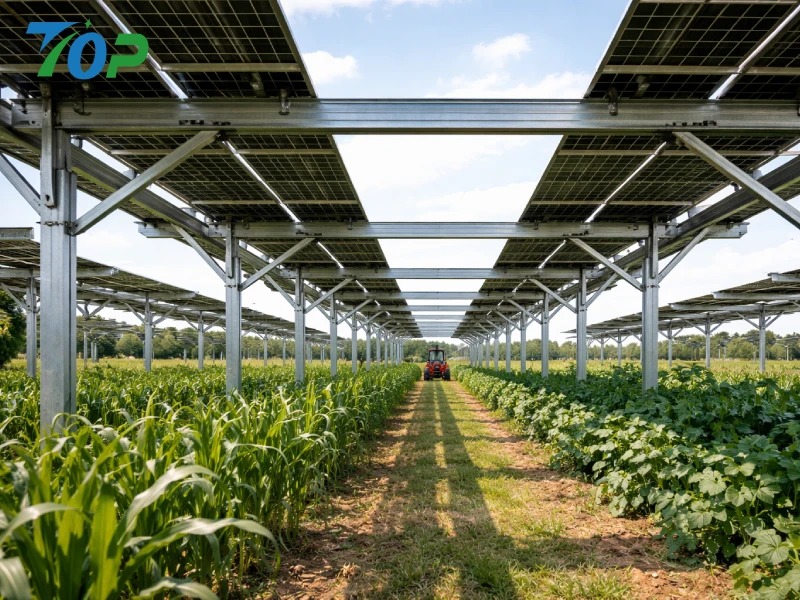
- Elevated Solar Mounting Systems: Panels are installed at a higher clearance (typically 2.5–4.5 meters), allowing crops and machinery to operate underneath.
- Vertical Solar Arrays: Bifacial panels are mounted vertically to reduce shading and optimize land usage, especially suitable for certain row crops.
- Adjustable Tilt Systems: Dynamic systems that optimize sunlight distribution between crops and energy generation.
Each agrivoltaic system design must balance energy yield with crop productivity, making engineering expertise a critical factor in project success.
Why Agrivoltaics Is a High-ROI Strategy for Landowners and Developers
For B2B stakeholders, including solar developers, agricultural enterprises, and landowners, agrivoltaics offers a compelling business case. By transforming single-use land into a dual-revenue asset, it significantly enhances overall project profitability.
Dual Revenue Streams: Agriculture + Solar Energy
The most immediate advantage of agrivoltaics is the ability to generate income from both crop production and electricity sales. This dual-income model reduces financial risk and stabilizes cash flow, especially in regions with volatile agricultural markets.
- Consistent revenue from solar power generation
- Seasonal or continuous income from crop production
- Improved land utilization efficiency
In many markets, government incentives and renewable energy policies further enhance the financial attractiveness of agrivoltaic projects.
Improved Crop Resilience and Microclimate Benefits
One of the lesser-known benefits of agrivoltaics systems is their ability to create a more stable microclimate for crops. Partial shading from solar panels can reduce heat stress, minimize water evaporation, and protect plants from extreme weather conditions.
- Reduced irrigation requirements
- Lower soil moisture loss
- Protection against hail, heavy rain, and excessive sunlight
These factors can lead to more stable yields, particularly in regions affected by climate variability.
Higher Land Productivity (Land Equivalent Ratio)
Agrivoltaics improves what is known as the Land Equivalent Ratio (LER), a metric used to measure how efficiently land is utilized. In well-designed systems, the combined output of crops and electricity often exceeds what could be achieved through separate land use.
For developers and investors, this translates into higher long-term returns per hectare, making agrivoltaics an increasingly attractive option in land-constrained markets such as Europe, Japan, and Southeast Asia.
As the business case becomes clearer, the next critical question is: which crops are actually suitable for growing under solar panels, and how can yield be optimized?
Best Crops for Agrivoltaics: What Grows Well Under Solar Panels?
One of the most frequently asked questions about agrivoltaics is: what crops can actually grow efficiently under solar panels? While shading does affect photosynthesis, many crops not only tolerate partial shade but can also benefit from the improved microclimate created by agrivoltaic systems.
Choosing the right crops is critical to ensuring the success of any agrivoltaic system. The goal is to match crop light requirements with system design parameters such as panel spacing, tilt angle, and height.
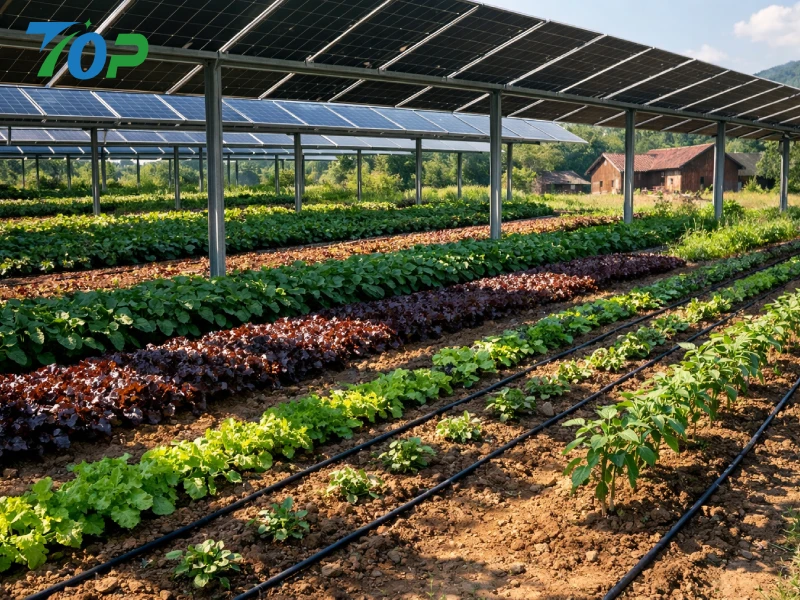
Leafy Greens: High Adaptability and Stable Yield
Leafy greens are among the best crops for agrivoltaics due to their low to moderate sunlight requirements. These crops often perform well under filtered light conditions, making them ideal for solar farming environments.
- Lettuce (romaine, butterhead)
- Spinach
- Kale
- Arugula
In many agrivoltaics projects, leafy greens have shown equal or even improved yields due to reduced heat stress and better moisture retention.
Root Crops: Moderate Shade Tolerance with Consistent Output
Root vegetables are another strong candidate for agrivoltaic systems. Since their edible portion grows underground, they are less sensitive to reduced sunlight compared to fruiting crops.
- Carrots
- Beets
- Radishes
- Turnips
These crops can maintain stable productivity under solar panels, especially when soil conditions and irrigation are properly managed.
High-Value Crops for Agrivoltaics Systems
For commercial agrivoltaics projects, high-value crops can significantly improve ROI. Many shade-tolerant specialty crops perform well in partially shaded environments.
- Strawberries
- Blueberries
- Herbs (basil, mint, parsley)
- Medicinal plants
These crops not only adapt well to agrivoltaics conditions but also offer higher market prices, making them attractive for B2B investors and agricultural operators.
What Crops to Avoid in Agrivoltaics
Not all crops are suitable for growing under solar panels. High light-demand crops typically experience reduced yield in shaded environments.
- Corn (maize)
- Wheat
- Sunflowers
- Tomatoes (in dense systems)
For these crops, careful system design or alternative layouts such as wider spacing or vertical solar arrays may be required.
With crop selection defined, the next step is understanding how to design an agrivoltaic system that optimizes both crop yield and solar energy production.
How to Optimize Crop Yield in Agrivoltaics Systems
Maximizing agricultural output in agrivoltaics requires more than just selecting the right crops. It involves fine-tuning the interaction between solar infrastructure and plant growth conditions.
For developers and system designers, this means balancing shading, airflow, soil conditions, and irrigation strategies to achieve optimal results.
Optimize Light Distribution, Not Just Light Quantity
A common misconception is that more sunlight always leads to higher yields. In agrivoltaics systems, controlled shading can actually enhance crop performance by reducing heat stress and preventing excessive evaporation.
- Use wider row spacing to allow sunlight penetration
- Adjust tilt angles to balance light distribution
- Consider bifacial panels for improved light diffusion
The goal is not to eliminate shading, but to optimize it for both energy and agricultural efficiency.
Improve Soil Moisture Retention and Irrigation Efficiency
One of the key benefits of agrivoltaics is reduced water loss. Solar panels provide partial shading, which helps maintain soil moisture and reduces irrigation demand.
- Lower evaporation rates under panels
- More stable soil temperature
- Improved water-use efficiency
This is particularly valuable in regions facing water scarcity or high irrigation costs.
Ensure Adequate Airflow and Crop Accessibility
Proper airflow is essential to prevent humidity buildup and plant diseases. At the same time, the system must allow easy access for farming operations.
- Design sufficient panel height for ventilation
- Maintain spacing for machinery access
- Avoid overly dense panel layouts
These factors are often overlooked but can significantly impact long-term system performance.
Key Design Considerations for Agrivoltaic Systems
A successful agrivoltaic system depends heavily on its structural design. For B2B buyers, selecting the right solar mounting system is critical to ensuring both agricultural compatibility and long-term durability.
Panel Height and Clearance
Panel height is one of the most important design parameters in agrivoltaics. It determines the usability of the land beneath the solar array.
- Typical height: 2.5–4.5 meters
- Higher clearance allows tractor access
- Improves airflow and light distribution
Customized mounting structures are often required depending on crop type and farming practices.
Row Spacing and Layout Optimization
Row spacing directly affects both solar output and crop yield. Narrow spacing increases energy density but reduces light availability for crops.
- Wider spacing improves crop growth
- Optimized layout balances dual output
- Site-specific design is essential
This is where engineering expertise plays a key role in achieving optimal system performance.
Choosing the Right Solar Mounting System for Agriculture
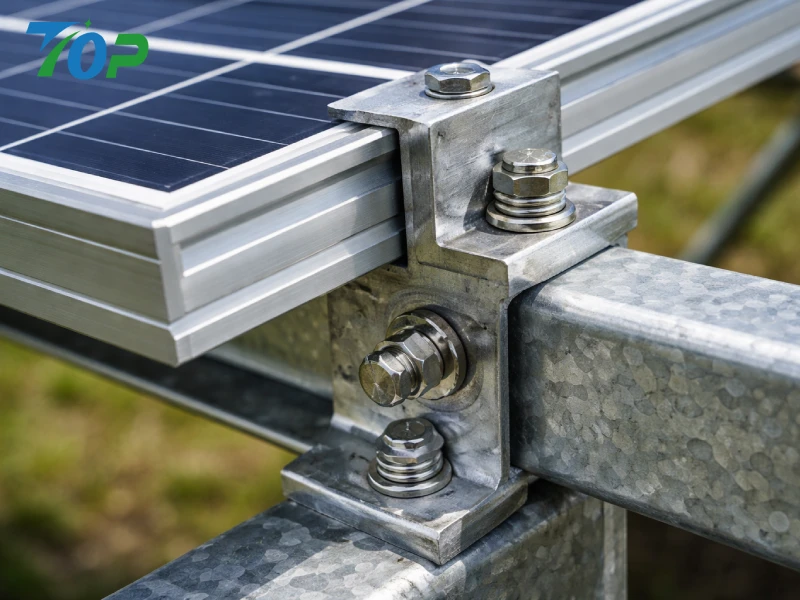
Not all mounting systems are suitable for agrivoltaics. Agricultural applications require structures that are durable, corrosion-resistant, and adaptable to different terrains.
- Galvanized steel structures for long lifespan
- High wind resistance for open-field installations
- Customizable designs for different crops
For large-scale projects, working with an experienced supplier that offers tailored agrivoltaics solutions can significantly reduce risks and improve ROI.
Agrivoltaics Applications Across Global Markets
As agrivoltaics continues to gain traction worldwide, different regions are adopting this dual-use solar strategy based on their specific land constraints, energy policies, and agricultural practices. Understanding these regional applications can help developers and investors identify the most suitable market opportunities.
Europe: Policy-Driven Agrivoltaics Growth
In Europe, agrivoltaics is strongly supported by renewable energy policies and land-use regulations. Countries such as France, Germany, and Italy are actively promoting agrivoltaic systems to balance food production with clean energy generation.
- Strict land-use policies encourage dual-use solutions
- Government incentives improve project ROI
- High land costs accelerate agrivoltaics adoption
As a result, agrivoltaics has become a key strategy for utility-scale solar developers across Europe.
Japan: Maximizing Limited Agricultural Land
Japan is one of the earliest adopters of agrivoltaics due to its limited arable land and high population density. Solar farming solutions are widely used to ensure continued agricultural production while expanding renewable energy capacity.
- Small-scale, high-efficiency agrivoltaic systems
- Focus on specialty and high-value crops
- Strong integration of technology and farming
This model demonstrates how agrivoltaics can be successfully implemented even in land-constrained environments.
Southeast Asia: High-Growth Market for Agrivoltaics Systems
Southeast Asia is emerging as a high-potential market for agrivoltaics, driven by rapid energy demand, abundant solar resources, and growing pressure on agricultural land.
- Expanding solar infrastructure across the region
- Favorable climate for diverse crop cultivation
- Increasing interest from international investors
For developers targeting countries such as Vietnam, Thailand, and Indonesia, agrivoltaics offers a scalable solution that aligns with both energy and agricultural development goals.
Challenges in Agrivoltaics and How to Overcome Them
While agrivoltaics presents significant opportunities, it also comes with technical and operational challenges. Addressing these issues early in the project planning phase is critical to ensuring long-term success.
Balancing Crop Yield and Solar Output
One of the primary challenges in agrivoltaics is achieving the right balance between shading and sunlight exposure. Excessive shading can reduce crop yield, while insufficient panel density may lower energy output.
- Use optimized spacing and tilt angles
- Conduct site-specific simulations
- Select crops based on light tolerance
A well-designed agrivoltaic system ensures that both outputs are optimized rather than compromised.
Higher Initial Investment Costs
Compared to conventional solar farms, agrivoltaics systems often require higher upfront investment due to elevated structures and customized designs.
- Use cost-effective mounting materials
- Optimize structural design to reduce steel usage
- Leverage government incentives where available
Despite higher initial costs, the dual-revenue model typically results in stronger long-term returns.
Compatibility with Agricultural Operations
Ensuring that farming activities can continue efficiently under solar panels is another critical factor.
- Design sufficient clearance for machinery
- Maintain accessible row spacing
- Plan for easy maintenance and harvesting
This highlights the importance of working with suppliers who understand both solar engineering and agricultural requirements.
How to Choose the Right Agrivoltaic System Supplier
Selecting the right partner is one of the most important decisions in any agrivoltaics project. A reliable supplier not only provides high-quality products but also contributes to system optimization and long-term project success.
Engineering and Customization Capabilities
Agrivoltaics projects require tailored solutions rather than standard solar mounting systems. The supplier should be able to customize system height, spacing, and structural design based on specific crop and site conditions.
Experience in Large-Scale Solar Projects
Suppliers with proven experience in utility-scale solar projects are better equipped to handle the complexity of agrivoltaics systems.
- Track record of international projects
- Understanding of regional standards
- Ability to support EPC contractors
Product Quality and Durability
Agrivoltaics installations are exposed to harsh outdoor conditions, including wind, rain, and soil moisture. High-quality materials and robust structural design are essential.
- Galvanized steel for corrosion resistance
- High wind load capacity
- Long service life with low maintenance
Technical Support and System Optimization
Beyond product supply, a strong partner should offer engineering support, layout optimization, and cost-efficiency recommendations.
This ensures that the agrivoltaic system delivers maximum performance over its entire lifecycle.
Build a High-Performance Agrivoltaic System with the Right Partner
As agrivoltaics continues to reshape the future of solar farming, choosing the right system design and supplier is critical to achieving long-term success. A well-designed agrivoltaic system not only improves land-use efficiency but also unlocks new revenue opportunities for developers and landowners.
With extensive experience in solar mounting system manufacturing, we provide customized agrivoltaics solutions tailored to different crops, terrains, and project requirements. Our engineering-driven approach ensures optimal system performance, durability, and cost-efficiency for B2B clients worldwide.
- Customized solar mounting systems for agriculture
- High-strength, corrosion-resistant structures
- Support for large-scale and international projects
- Optimized design for maximum ROI
If you are planning an agrivoltaics project or looking to optimize your current system, our team is ready to support you with professional solutions and technical expertise.
Contact us today:
Tel: +8613365923720
E-mail: nancy@xmtopfence.com
Agrivoltaics FAQ: Key Questions for Developers and Investors
1. Can crops really grow efficiently under solar panels?
Yes, many crops can grow efficiently under solar panels when the agrivoltaic system is properly designed. Shade-tolerant crops such as leafy greens, herbs, and certain berries often maintain stable yields or even improve due to reduced heat stress and better soil moisture retention.
2. What are the best crops for agrivoltaics systems?
The best crops for agrivoltaics are those with low to moderate sunlight requirements. These include lettuce, spinach, kale, carrots, strawberries, and various herbs. Crop selection should always be aligned with system design factors such as panel spacing, tilt angle, and local climate conditions.
3. How does agrivoltaics impact overall project ROI?
Agrivoltaics improves ROI by generating dual revenue streams from both agricultural production and solar energy. While initial investment costs may be higher, the combined output and improved land-use efficiency typically result in stronger long-term financial returns.
4. What is the ideal height for an agrivoltaic solar mounting system?
The ideal height for an agrivoltaic system usually ranges from 2.5 to 4.5 meters, depending on crop type and farming practices. Higher clearance allows for better airflow, improved light distribution, and compatibility with agricultural machinery.
5. Does shading from solar panels reduce crop yield?
Not necessarily. Controlled shading can actually benefit certain crops by reducing heat stress and lowering evaporation rates. However, excessive shading due to poor system design may negatively impact yields, which is why proper layout optimization is critical.
6. How do you design an efficient agrivoltaic system?
An efficient agrivoltaic system requires optimizing panel height, row spacing, tilt angle, and structural layout. Site-specific factors such as sunlight availability, crop type, and terrain must also be considered to balance energy generation with agricultural productivity.
7. What are the main challenges in agrivoltaics projects?
Key challenges include balancing crop yield with solar output, managing higher initial costs, and ensuring compatibility with farming operations. These challenges can be addressed through customized system design and collaboration with experienced suppliers.
8. How to choose a reliable agrivoltaics system supplier?
A reliable supplier should offer strong engineering capabilities, customization options, and experience in large-scale solar projects. It is also important to evaluate product durability, wind resistance, and the ability to provide technical support throughout the project lifecycle.
Build a High-ROI Agrivoltaic System for Your Project
Planning to develop an agrivoltaics system or improve land efficiency for solar farming?
Our engineering team provides customized solar mounting systems for agriculture, including optimized structure height, row spacing, and crop-compatible layouts—helping you maximize crop yield, energy output, and overall project ROI.
Related News
- Integrated Solar Fencing: The Perfect Combination of Aesthetics, Security, and Renewable Energy
- Customized Solar Mounting Services for Extreme Climate Conditions: Engineering PV Structures for Wind, Snow, Corrosion and Terrain Challenges
- Solar Fence vs Traditional Fence: Which Delivers Better Long-Term Value for Solar Projects?
- Industrial Maintenance Walkways for Factory Roofs: Compliance Standards, Structural Safety, and Solar-Compatible EPC Design Guide
- Lightweight Solar Panels for Balcony Installations: Engineering Advantages, Structural Safety & EPC Buying Guide
- Vertical Solar in Snowy Regions: Engineering Advantages of Vertical PV Systems in Winter Conditions
Leave me a message